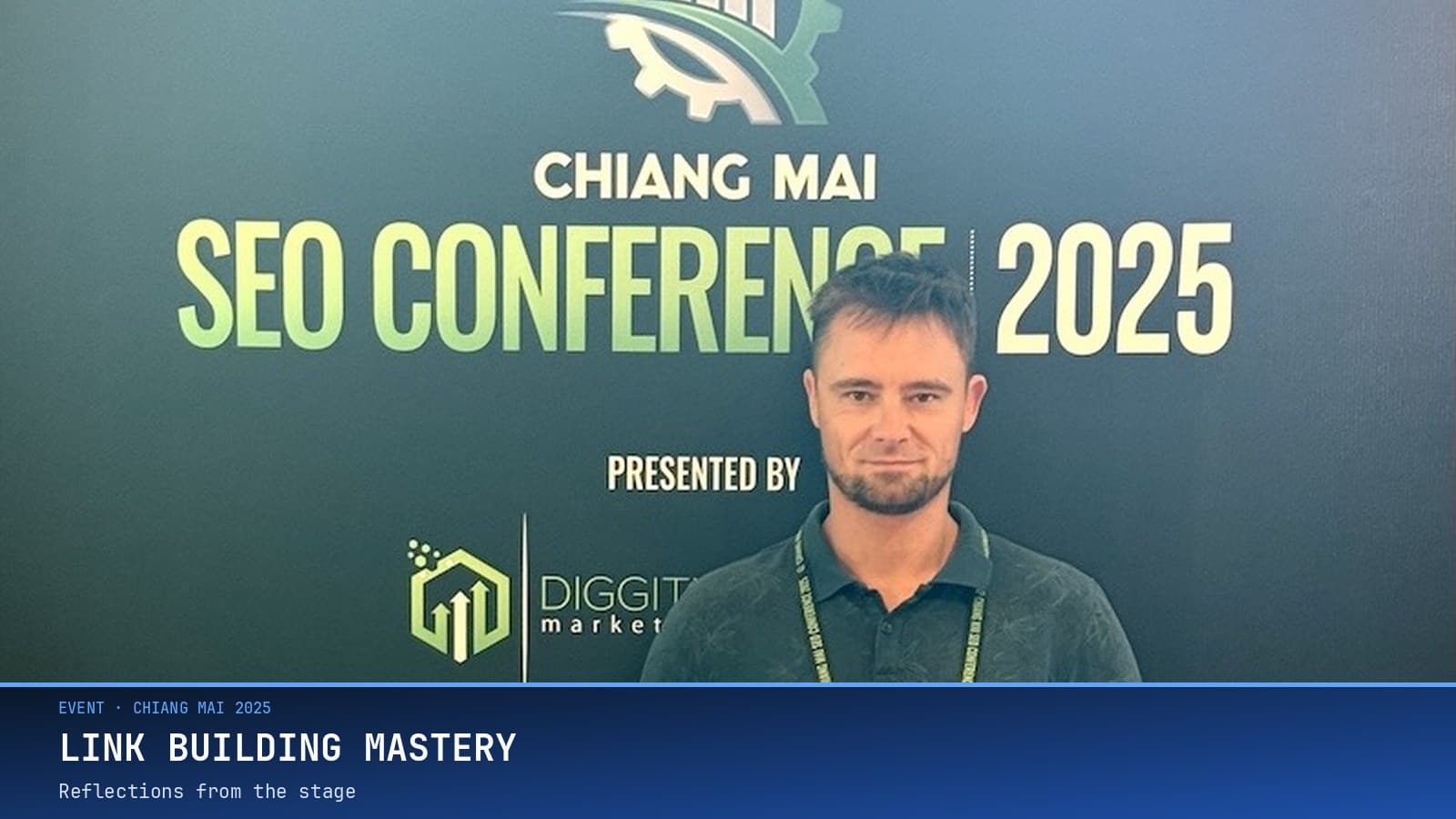
I left Chiang Mai with my head buzzing. AI search is the first impression. It is the opening message, the shortlist, the first judgment.
Large language models now recommend brands. If they do not understand you, they will not remember you. They are more than just answer engines. Powerful and relevant links hold even more weight and can make or break your AI search strategy.
The Big Shift
Pages are no longer just pages. They are facts, claims, and proof. Look at your sites through the lens of retrieval.
Can a machine pull the essentials in seconds? Can a buyer do the same?
Drop the fantasy that one playbook fits all. Ecommerce, SaaS, lead gen. Each behaves differently. Strategy must follow the money and the user. Not our preferences.
The New Front Door
Search results are no longer ten blue links. The first touch is a synthesized answer with sources. That answer now shapes awareness and trust. We have to earn a place there.
“Citations are the new backlinks” – Tim Suolo
Mentions that are easy to verify carry power. Models reward clarity, consensus coverage, and credible proof.
Link Building for LLMs
Third party recommendations are the fuel for citations. Models look for credible signals from contextually relevant sources, not random placements.
Even big corporations chase hyper relevant mentions on trusted sites. They want to be quoted. They want their facts reused. So should you.
What moves the needle:
Hyper relevance over volume
Contextual mentions that align with the query intent
Verifiable facts and unique data worth citing
Consistent entity naming and clean author signals
Pages designed to be quotable in one or two lines
Avoid unrelated links. They add noise to your graph and confuse retrieval. Build assets that keep earning references long after launch.
Page Optimization for LLMs
Sentiment is overrated. Mentions matter. Some brands carry lousy sentiment and still show up in AI answers because they get cited a lot. Reputation polish has its place, but visibility comes from being referenced in the right places. Do not confuse likeability with legibility.
Sources are volatile. Some appear constantly. Others flicker in and out. Aim for citations from the stable set that shows up again and again. That is where consistency is won.
Information coverage beats word count. Length is an outcome, not the lever. Cover the facts fully. Do not pad.
Front load answers. Two patterns drive inclusion:
Early answer. Provide the direct answer in the opening 50 to 100 words.
Early confirmation. State clearly that the page will answer the underlying question.
Use both. Make the promise, then deliver fast.
Keep a clean logical flow. General to specific. Each section sets up the next. No detours for jokes or fluff. Models reward coherence.
Structure for retrieval:
First 500 words are most often cited
H2 plus paragraph is the most common cited combo
Use clear headings for each subtopic
Keep syntax tidy and sections self contained
Different models weight factors differently. Fundamentals hold across surfaces, but nuances vary. Optimize the basics first. Adjust to the surface if you must.
Write for people, trim for machines. You can have a human friendly version. Then create a citation ready variant that is tighter, cleaner, and easier to quote.
The New Approach
Start with revenue. Identify the pages that pay the bills. Strengthen them first. Improve clarity, proof, and retrieval. Then expand outward.
User experience sits beside visibility. If discovery works but conversion stalls, UX is the constraint. Fix navigation, remove friction, shorten the path. The most visible page still fails if it makes people work.
Testing matters, but discipline matters more. Pick the few changes with the highest leverage. Ship them, measure, move on. Endless experiments are a tax on momentum.
Links are not a scoreboard. Relevance is. If a link sits outside the topic neighborhood, it adds noise. Keep the graph clean. Earn references that reinforce the story you want models to tell.
Data assets compound. Publish numbers, trends, and concise explanations. These pieces attract citations over time. They also anchor your topic depth. Models like that.
Budget for AI Search
AI search is not the same as traditional SEO. You need a separate budget for getting recommended by LLMs. Topical authority will move rankings, but it will not unlock the best outcomes on its own.
Run a two track plan:
Track 1 Traditional SEO: crawl, rank, index, convert
Track 2 AI Recommendation: recommend, cite, compare, shortlist
Allocate budget to:
Citation acquisition on hyper relevant sources
Retrieval ready content and specs
Data assets worth quoting
Objection and dealbreaker content
Monitoring and optimization of AI surfaces
Measure with different KPIs:
Inclusion rate in AI answers and snapshots
Frequency and quality of citations as a source
Share of voice for priority queries inside LLMs
Assisted revenue from AI influenced journeys
Think Like Retrieval
This is the mental model SEOs should be using:
Map the task. Define questions, objections, and dealbreakers.
Model the topic. Entities, attributes, relationships, examples.
Make it retrievable. Clear headings, concise summaries, explicit specs.
Earn citations. Verifiable facts, benchmarks, and expert commentary.
Tighten UX. Simple navigation, fewer blockers, faster proof.
Follow Up Questions Decide Winners
LLMs guide people through sequences. The second and third questions reveal intent. We must answer the chain, not just the opener. If the dealbreakers are not obvious on page, you disappear from the conversation.
This is where many brands lose. Core features sit buried. Differentiators hide behind fluff. Models cannot find what is not stated plainly. Competitors who say it cleanly get the recommendation.
Consensus, Then EDGE
Consensus is baked in. Cover what credible competitors cover, completely. Then add the one or two pieces that shift preference. A better explanation. A sharper comparison. A data point that settles doubt.
What Clients Should Expect from This Approach
Strategy shaped by revenue, not vanity metrics.
Content built for understanding, citation, and recommendation.
User journeys that turn attention into action.
Reporting tied to pipeline and assisted revenue.
What SEO Teams Should Audit Next
Can a model extract key facts in seconds.
Do follow up questions find ready answers on site.
Are citations accruing from relevant contexts.
Is navigation quietly blocking intent.
Are we investing in pages that pay back first.
Closing Stance
Optimizing for LLMs is not a side quest. It is table stakes. Treat AI answers as the new front page. Build brands that machines can understand, trust, and recommend. That is how visibility compounds. That is how you win the shortlist.