
Every founder is sitting on data nobody is reading properly. Your customer signals, your sales numbers, your competitor moves, your product analytics. The opportunities you are missing are already inside the tools you pay for every month. Finding them and acting on them is the whole game, and most founders never get to it, because the finding takes hours nobody has.
Meanwhile a competitor is using AI to read the same data faster than you, every single day, and acting on openings you have not even spotted yet. That gap, between what AI can do today and what you actually use it for, is where your next 12 months of growth lives. It is the argument I brought to a room of founders at the Entrepreneur Future Summit in Pune on June 13, 2026. The talk was a founder's guide to AI workflows, not a talk about SEO. Here is the expanded version, and how to close the gap inside your own business.

This Is for Founders, Not for SEOs
This is a guide for founders using AI to spot opportunities, and it is not a talk about SEO. An AI workflow is the specific way you connect a model to data you already own, give it clear instructions, and ship a real deliverable on the other side. The data is yours. The leverage is in the workflow, not the model.
My examples come from search data because that is the work I do, but nothing here is specific to search. The same logic applies whether your signal lives in Stripe, HubSpot, Shopify, your support inbox, or a warehouse of spreadsheets. For a founder the question is never "which AI tool should I buy." It is "which boring, repeatable job in my business should an agent own end to end." Answer that one question well and most of the value follows on its own.
You Don't Have a Data Problem, You Have An Assembly Problem
You do not have a data problem. You have an assembly problem. Your business already holds more data than anyone reads: sales dashboards, analytics, the CRM, a dozen spreadsheets. The data has always been there. The bottleneck is the manual assembly that turns it into a decision.
Pulling the numbers, cross-referencing them, writing the report, building the deck, drafting the email, cleaning the sheet. None of it needs your judgment. All of it steals your week. So most founders do one of three things: keep doing it by hand, stop looking entirely, or hire someone who quits in eight months and restarts the cycle. Every one of those is expensive, and the worst part is hidden. Each report you assemble by hand is a context switch that drags you out of the work only you can do, and the data ages while you format it.
The founders who win are not the ones with the most data. They are the ones who shortened the distance between a signal and a decision. Assembly work is exactly what an agent is good at, and exactly what frees you for the judgment only you can do.
The Stack Any Founder Can Build
The stack is one diagram: a model in the center, with a handful of integrations across four categories - data sources, infrastructure, communication, storage - all feeding one workspace. You can stand up the first version in a weekend, on free tiers. The cost is your time, not your budget, and you do not need an engineering team to do it.
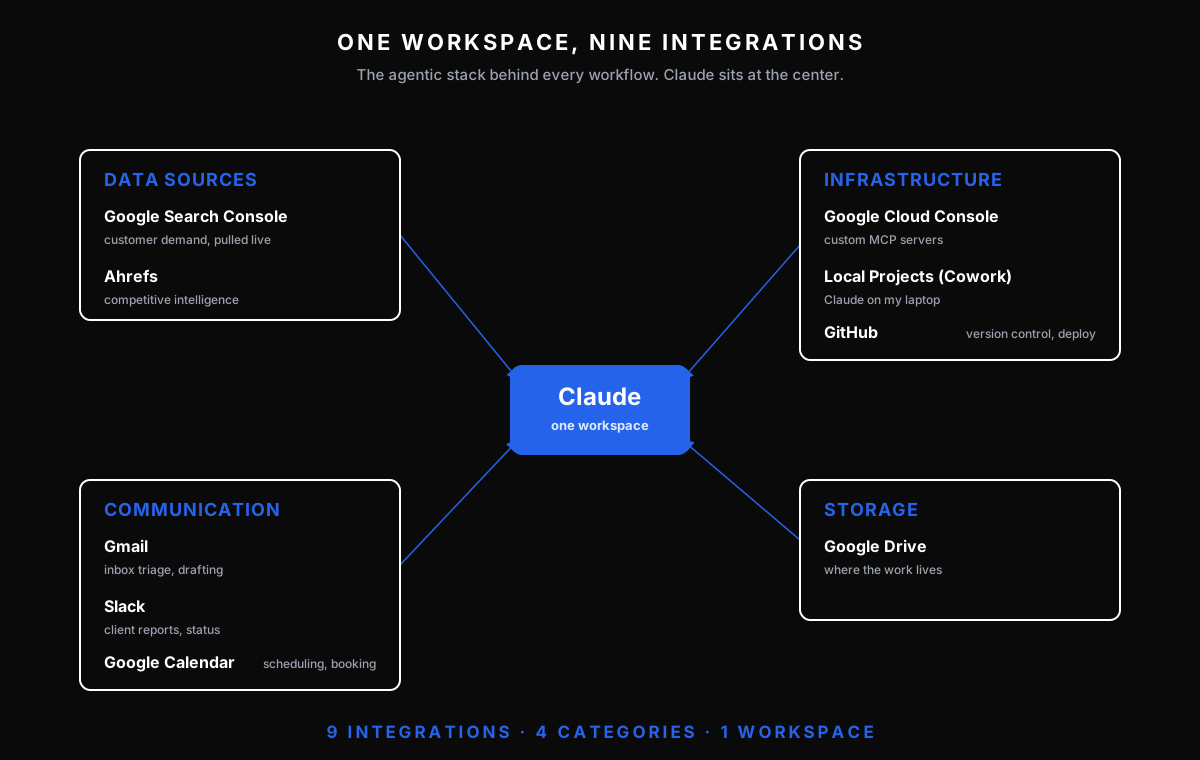
Connect the data that signals demand and competition: Search Console, Ahrefs, or whatever your industry uses instead, like SimilarWeb, Crunchbase, or your own CRM. Wire in the channels your work already lives in: email, Slack, the calendar, your drive. The payoff is measured in hours handed back. Inbox triage alone can return a founder 90 minutes a day, which is 220 hours a year; calendar coordination another 200. I run nine integrations across this stack, but you should start with two: the single source that matters most, and the channel your outputs need to reach. The point is not my setup. The point is that these pieces are already sitting in your business, paid for and disconnected from each other.
Turn Every Prospect into a Pre-Sold Conversation
The first workflow turns the homework you skip into a deliverable that closes. Before a sales call, an agent can produce a six-page audit and a short video showing a prospect exactly where their business loses money and what to fix first. What takes four hours by hand takes ten minutes, and it converts far better.
The prompt behind it is four parts you can reuse for any analysis a buyer needs to see. One, who it is for: the company, what they sell, who their customer is. Two, which data to pull: the two or three sources that actually carry the signal. Three, the pattern to look for: the specific kind of leak or opportunity, not "anything interesting." Four, the format to ship: a document ready to send, the same structure every time. When I send that audit before a call, the prospect arrives already half-convinced and the close rate is three times what it was. Whatever you sell, that same four-part shape gives a buyer proof before you ever get on the phone. The version of this you ignore is the deal you lose to a competitor who did the homework.
Kill The Report Nobody Wants To Write
The second workflow ends the recurring report that eats your week. The weekly or monthly update you build by hand is the clearest assembly job to hand to an agent: point it at the folder, tell it what changed, and review instead of write. The report you dread is the report an agent should own.

Here is the scale of it. A single client progress report used to take six hours by hand: pull the data, open four browser tabs, cross-reference last week against this, draft, format, send. Across ten clients and a year, that is more than 3,000 hours. The same report now takes ten minutes, and it is better. Your version is whatever report you dread, whether that is the board update, the investor note, or the weekly numbers for your team.
The agent reads the folder, finds what changed, drafts the recommendation, and catches the pattern you would have missed scrolling the data yourself. That last part is what nobody mentions when they sell you AI: it does not only save time, it sees things you skip. Build the format once as a reusable skill and the distinction gets sharper over time. The weekly report is about what changed; the monthly is about what worked. Define each shape a single time, then run it with a different name on top, and you stop being the bottleneck on your own reporting.
Find The Money Your Business Is Losing
The third workflow is the one for founders to remember. The first two save time. This one finds money. Pointed at your own web data, an agent surfaces three patterns of revenue bleed in about two minutes each: demand you are not capturing, the wrong customers finding you, and investment without traction. This is the heart of using AI to spot opportunities, and it has nothing to do with SEO.

Pattern one is demand you are not capturing. A US career-services company ranked at position 2.2 for roughly 3,500 monthly searches around a service they do not sell and have no page for. For months, high-intent buyers were sent to an offer that did not exist: zero revenue, maybe ten thousand dollars a month in lost pipeline, invisible until the workflow found it. Ask what your business gets found for that it does not actually sell, because that is demand walking out the door before it touches your product.
Pattern two is the wrong customers finding you. The same company's highest-traffic post pulled 4,500 impressions a month at a zero percent click-through rate, because the topic was a LinkedIn feature, not their offer. The dashboard looked green and none of it converted. Your most popular page may be your worst-converting, quietly starving your real buyer pages of attention and budget while it looks like a win.
Pattern three is investment without traction. Their homepage carried 600 backlinks and a 9 out of 10 authority score for 28 clicks a month, while a plain city service page with zero backlinks pulled 142. Five times the traffic, none of the spend. Somewhere, you are funding the wrong asset too, pouring effort into the thing that is not working while the thing that is quietly carries the business. These are not edge cases. They are the default state of almost any business that has been online for more than a year. The data has been telling you. Nobody has been reading it.
Who This Is For
This is for founders, CMOs, and operators who own a revenue number and have run out of hours. If your business has a website, an inbox, and a report you send on a schedule, you already have the raw material. The data exists. The only work is connecting it to an agent and telling that agent what to look for.
The founders who feel this most are the ones past product-market fit, where the business is real and the operations are drowning them. Start with two integrations, not nine. Pick the source that matters most and the channel your outputs need to reach, then add the rest as each workflow proves itself. Anything you do more than three times in a month is a candidate to package once and never do by hand again.
Where Founders Get This Wrong
These workflows fail in predictable ways, and every one of them is avoidable. The mistake is almost never the model. It is how the work around the model is set up before you ever write a prompt.
Chasing tools when the workflow is the actual asset.
Automating a process you have never written down.
Wiring up nine integrations before shipping one working workflow.
Letting the agent make judgment calls it should only tee up for you.
The most common one is automating a process you have not defined. If you cannot describe the steps to a new hire, you cannot describe them to an agent. Run the report by hand one more time and write down exactly what you do, then automate that. The agent is fast, but it is only ever as clear as the instructions you give it, and a vague process produces vague output no matter how good the model is.
What You Are Actually Buying, and What You Are Not
This is not magic, not strategy, and not a product you can buy off a shelf. An agent does what you tell it, so your instructions set the ceiling on the work. It assembles; you direct. The judgment calls - what to build, who to serve, what to charge - stay yours. The agent simply buys back the time you need to make them well.

It is also not something anyone will sell you in the right shape. You configure it for your business, your data, your team, and that configuration is your moat. The version that fits your company is the version you build. Garbage in, garbage out still holds, same as it always has. The real win is not the headcount you save. It is the attention you reclaim, the hours you stop spending on assembly so you can spend them on the decisions only a founder can make.
The Pattern You Can Copy Tomorrow
Every workflow here runs on one pattern. Each prompt tells the agent three things: what you want, where the data lives, and the format to ship. Same shape, every workflow, every business, including yours.
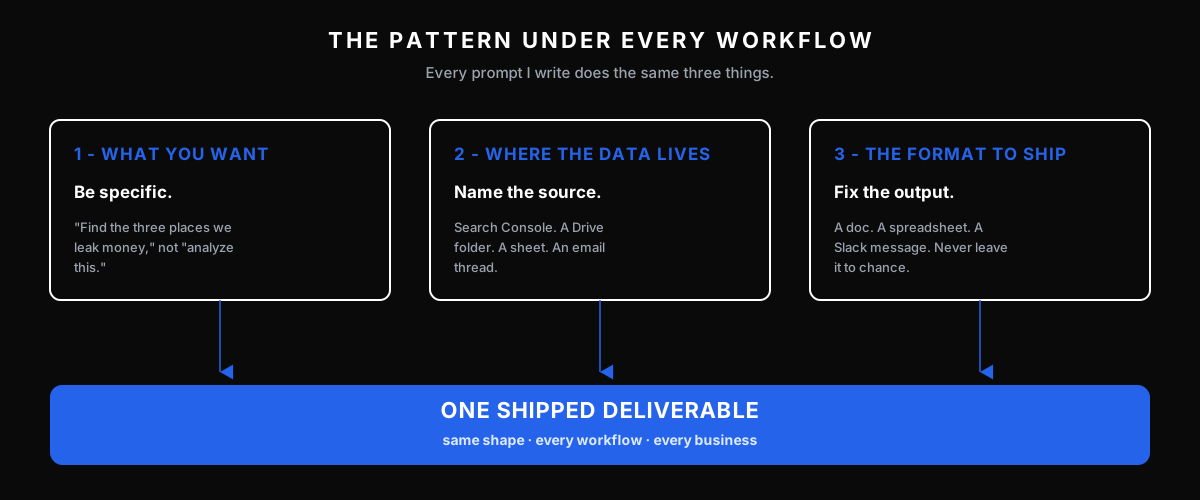
Be specific about the want: "find the three places we are leaving money on the table," not "analyze this." Name the source exactly: Search Console, a drive folder, a sheet, an email thread. Fix the output before you start: a doc, a spreadsheet, a Slack message, a one-page summary, never left to chance. Your first version will be rough, and that is the point: you iterate the prompt, not the data. Your tenth version is a workflow. By your twentieth, you do not write the report anymore. The agent does.
Stop Hiring. Start Automating.
I closed Pune with three words for the founders in the room: stop hiring, start automating. Not because people stop mattering, but because paying a person to do assembly work is the most expensive way to solve a problem an agent handles in a weekend. Spend your headcount on judgment, not on cross-referencing tabs.