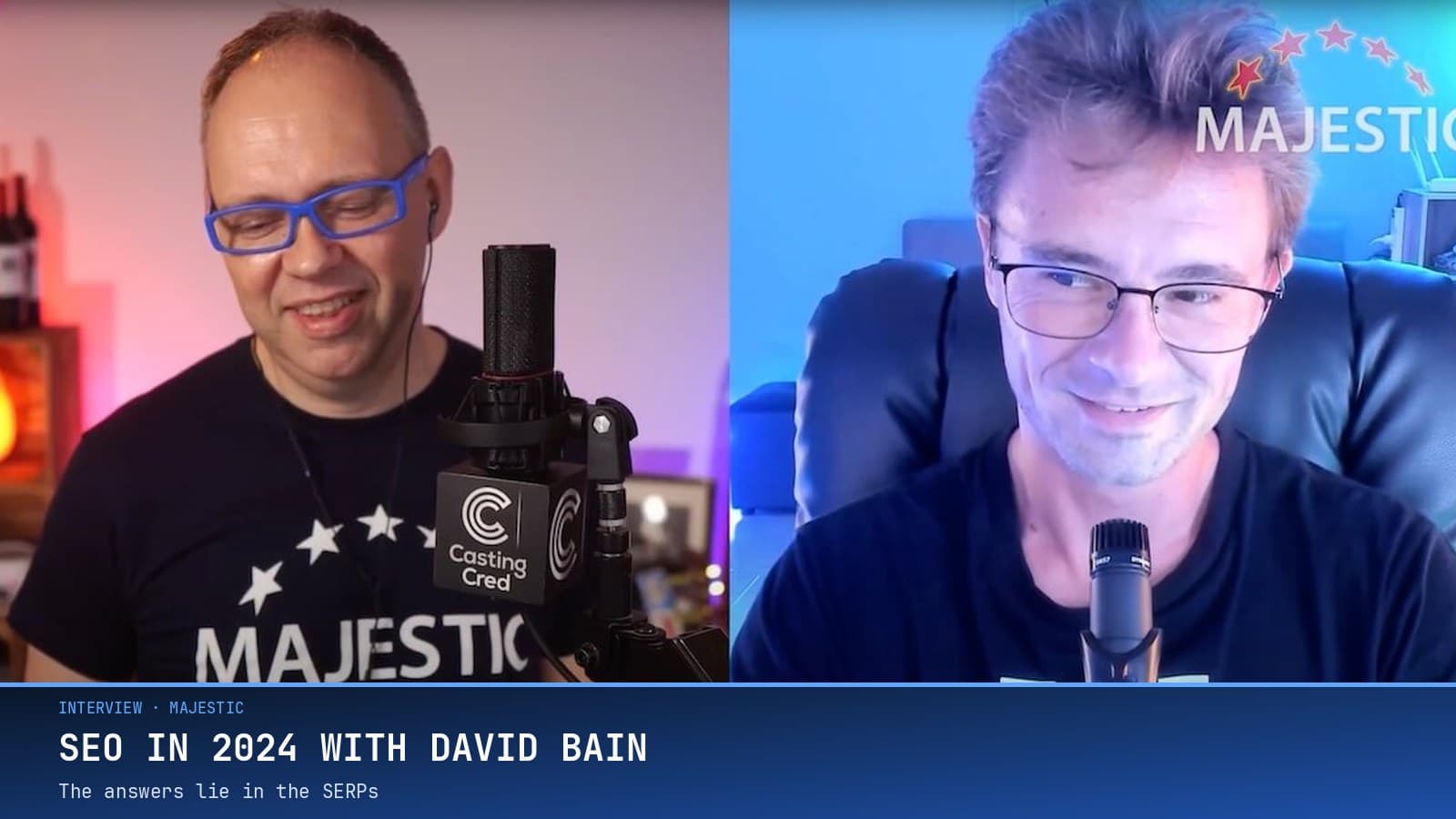
David Bain runs SEO in 2024, a podcast and book series for Majestic, and he had me on the Additional Insights episode in February 2024. The whole show is built around a single question: what is the one extra insight you want SEO operators to carry into the year? My answer was that all the answers lie in the SERPs.
The SERPs Are The Best Software You Already Have
The pitch was simple. Stop reaching for the next tool. The SERPs hold most of what you need if you know how to read them and you are willing to look every day.
"My additional insight in 2024 is that all the answers lie in the SERPs. And if you look into the SERPs, and you look into your competitors, and slowly start, in reverse, reverse engineering what they are doing, you can get a lot of answers to your problems."
It is the cheapest research method in SEO and the one most teams skip. Everyone wants a dashboard. The SERP is the dashboard.
The Cannibalization Problem Is Worse Than People Admit
One thing David and I spent time on was how often a single site shows up multiple times for the same query, with none of the pages earning a clean position. Google has a hard time picking a winner when there are too many candidates with overlapping coverage.
"One of the problems Google is having is a hard time figuring out what is happening because of the sheer volume of the pages. And it takes time to crawl the web pages of your own website and your competitors, and to figure out which page to put at the top."
The fix is rarely "publish more." The fix is consolidation, redirects, and a single page per intent. Most audits I run still find three to five pages competing for the same entity.
High Impressions, Low Clicks Is a Map, Not a Problem
I walked through a workflow I still run on every audit. Pull GSC, sort by impressions, find the pages with high visibility and low CTR, and either fix the title and meta against intent or surface an internal-linking opportunity. The pages at the very bottom of the impressions list, with zero clicks and zero impressions, are usually candidates for deletion or consolidation.
"Some quick and easy wins is, for example, if you have pages with high impressions but no clicks. You can potentially, in your spreadsheet, highlight them, you can move them up. If you have a really high number of pages, you'll see at the bottom of your list there are pages with zero clicks and zero impressions. You can visually tell, okay, this is very low quality, thin content, maybe you can delete them."
Historical Ranking Data Is a Real Signal
David asked how I decide which competitors to benchmark against. My answer was historical ranking data. A page that has ranked over time is a different asset from a page that has never ranked.
"There is something embedded in the algorithm called historical ranking data. You might have two pages, one had some historical rankings, and one didn't. The page that had some historical rankings, you have much more data to work with. And that page can actually benefit you in the long run."
This is why a freshly published page and a page with three years of ranking history are not interchangeable, even if the on-page is identical. The accumulated signal is part of what is being ranked.
Search Intent Is Not a Fixed Property
The line that got the strongest reaction came from Kyle Roof, who I quoted on the show. The SERPs change so often that the concept of a fixed intent for a query is breaking down.
"As Kyle Roof puts it, there is no search intent. Because, as we started this conversation before, the answers lie in the SERPs. So my answer right now might be completely different than it was a month ago, because Google decided to put commercial keywords upfront."
You might be ranking number one for a keyword and getting half the clicks you got last quarter, because Google decided to bolt a product carousel above your result. The query did not change. The SERP did.
"Google is a money-making machine. And depending on the keyword you're looking for, the SERPs can look wildly different."
Digital PR and HARO Beat Tactic-of-The-Month Link Building
On link building, I gave David the same answer I give clients. The shady gray-hat tactics are aging out. Real placements from journalists and big domains are aging in.
"One thing that's working really well across so many niches right now is digital PR, and HARO links. Big websites, journalists, big businesses, big domain authorities, they are vouching for you. So these links actually make a difference."
The Trap: Shiny Object Syndrome
David asked the closing question. What should SEO not be doing in 2024? My answer was attention discipline.
"I would call it the shiny object syndrome, because there is so much information, so much opportunity out there. So many things you want to get, so many things you want to learn, so many things you want to try. A lot of SEOs have this problem when they are doing their work, writing, doing SEO, and then they see their friend or their mentor or their guru talking about this brand new link building tactic. Those things that distract you are the biggest obstacles."
The operators who compounded through 2024 were not the ones who tried every new tactic. They were the ones who held a thesis, ran it long enough to test it, and shipped while the rest of the industry chased the next shiny tactic.
What I Took Away
Looking back at the episode, the SERP-first frame held up better than I expected. Cannibalization is still the most common audit finding. Historical ranking data is still underrated. Digital PR is now mainstream. Shiny object syndrome is, if anything, worse with AI in the mix.
Thank you to David Bain and the Majestic team for the invitation.