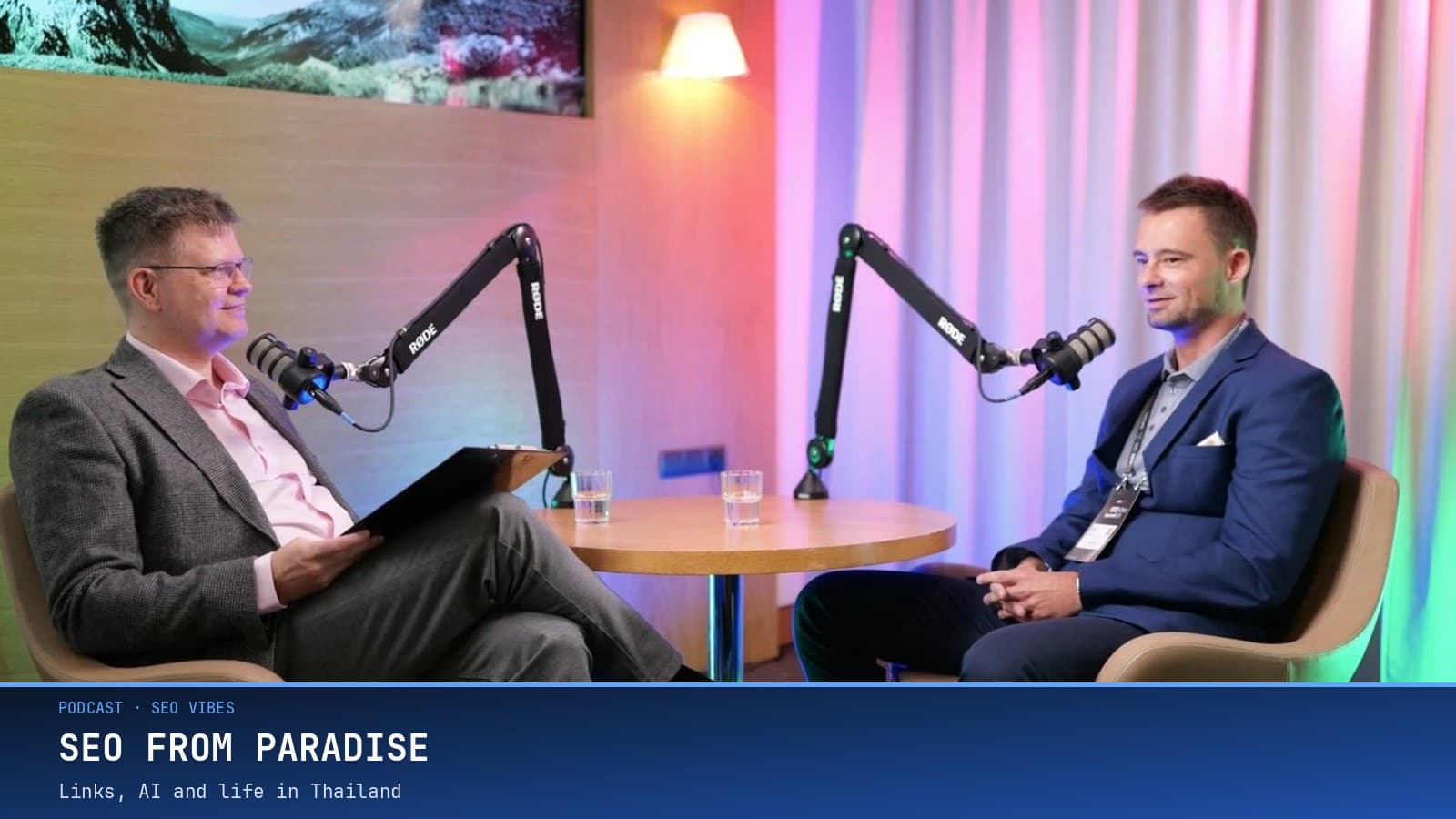
Tomasz Domański runs WhitePress. A few hours after I finished my first workshop as a speaker, he recorded a short podcast with me for SEO Vibes in Zakopane. We talked about running an SEO operation from Thailand, and what has changed in this business since AI arrived.
How I Ended Up Running SEO from Thailand
I landed in Thailand as a teacher, not an SEO. I had aimed for China and ended up south of Bangkok, where I discovered SEO and got introduced to affiliate marketing. I built an Amazon affiliate site, made my first money online, and got hooked.
That was 10 years ago. I did not understand what I was doing at first. I understood that passive income was real and that I wanted to know how it worked. Teaching paid the rent while the first site taught me the craft. Ten years later, Thailand is not a backdrop for Instagram. It is where I built an operation.
The Discipline Problem Nobody Posts About
Running a business from paradise has one real enemy, and it is discipline. Everyone around me is on vacation. I still work 8 to 10 hours a day. The method I have used for years is simple: replace the temptation with an obsession I cannot put down.
Before SEO I had two bands in Poland. Music videos, festivals, a few competitions won. When I found SEO it became the next obsession. When AI arrived it forced a third one. AI changed content, changed the business, and for a moment looked like it had taken the job. Then it became the opportunity.
I am lazy by design, so I build automations for the work I do not want to do. When Claude arrived I tested it against ChatGPT and stopped second-guessing. The 8-to-10-hour day turned into an 18-hour day of building tools, because building stopped feeling like work. Claude is the current obsession.
Why I Position as a Strategist in Regulated Niches
I differentiate on the hardest niches, not the cheapest rate. Clients in medical and legal hire me to fix problems no off-the-shelf service covers: hreflang localization, shops carrying thousands of broken canonical tags, and custom rules a junior cannot be handed.
One of my best results is an Australian law firm. I built the strategy, ran the technical work, and wired AI automation in on top. Regulated niches reward a strategist because the cost of a mistake is not a ranking dip. It is a compliance problem with a legal team attached.
I once cleaned up a US stem-cell clinic whose older pages still used terms that had since become non-compliant. That was not a job for a crawler on autopilot. I set custom rules for the crawler, and the team removed the language by hand, page by page. Claude did not exist yet. Even today I would keep a human on that final pass.
Which Links Still Move The Needle in 2026
Links still need power. Relevance decides which ones I keep. I do not push for volume. I vet every link for authority and topical fit, because a strong but irrelevant link in 2026 is wasted budget.
I advise agencies and run campaigns directly, and the pattern holds across both. The link that moves a ranking is the one that is authoritative and on-topic at the same time. Finding those is slower, and that is the point.
Brand Mentions Are The New Currency
Brand mentions are the currency that matters now, because of the wallet behind them. When ChatGPT recommends you, it sends a person with buyer intent and a credit card already out. That traffic converts, so clients fund it from a separate testing budget.
Links built the old SERP. Mentions feed the answer engines. I treat AI recommendation as its own channel with its own budget, because the buyer who arrives from a model has already had the comparison done for them.
Semantic SEO and Technical SEO Are One Job
Pairing semantic SEO with technical SEO is the only approach that scales on large sites. On enterprise and fast-growing sites, content gets forgotten and goes stale, and neither a pure technical audit nor a pure content pass catches it. You need both running together.
The stem-cell cleanup is the clearest example. A semantic problem, non-compliant language, lived inside a technical problem, crawl rules and page-level edits at scale. Split the two and you fix neither. The strategy layer where the disciplines meet is the work I keep for myself.
What I Tell People Asking About Asia
If you are starting out, go to Chiang Mai. The digital-nomad community there is the largest in Thailand, the cost of living is low, and you can meet a mentor or a business partner inside a week. Phuket is paradise, but it is cut off from the business crowd.
The logistics are less romantic. Thailand rewrites its visa rules every year, so there is no stability to plan around. I keep my company registered in the US for that reason, and a DTV visa covers the rest. A Thai company needs a Thai partner. Every category has its own trade-off, and they all move.
First of Many
This was my first podcast as the guest, and it will not be the last. Thank you to Tomasz Domański and the WhitePress team for the invitation and the conversation, and for asking the questions that actually matter to operators.