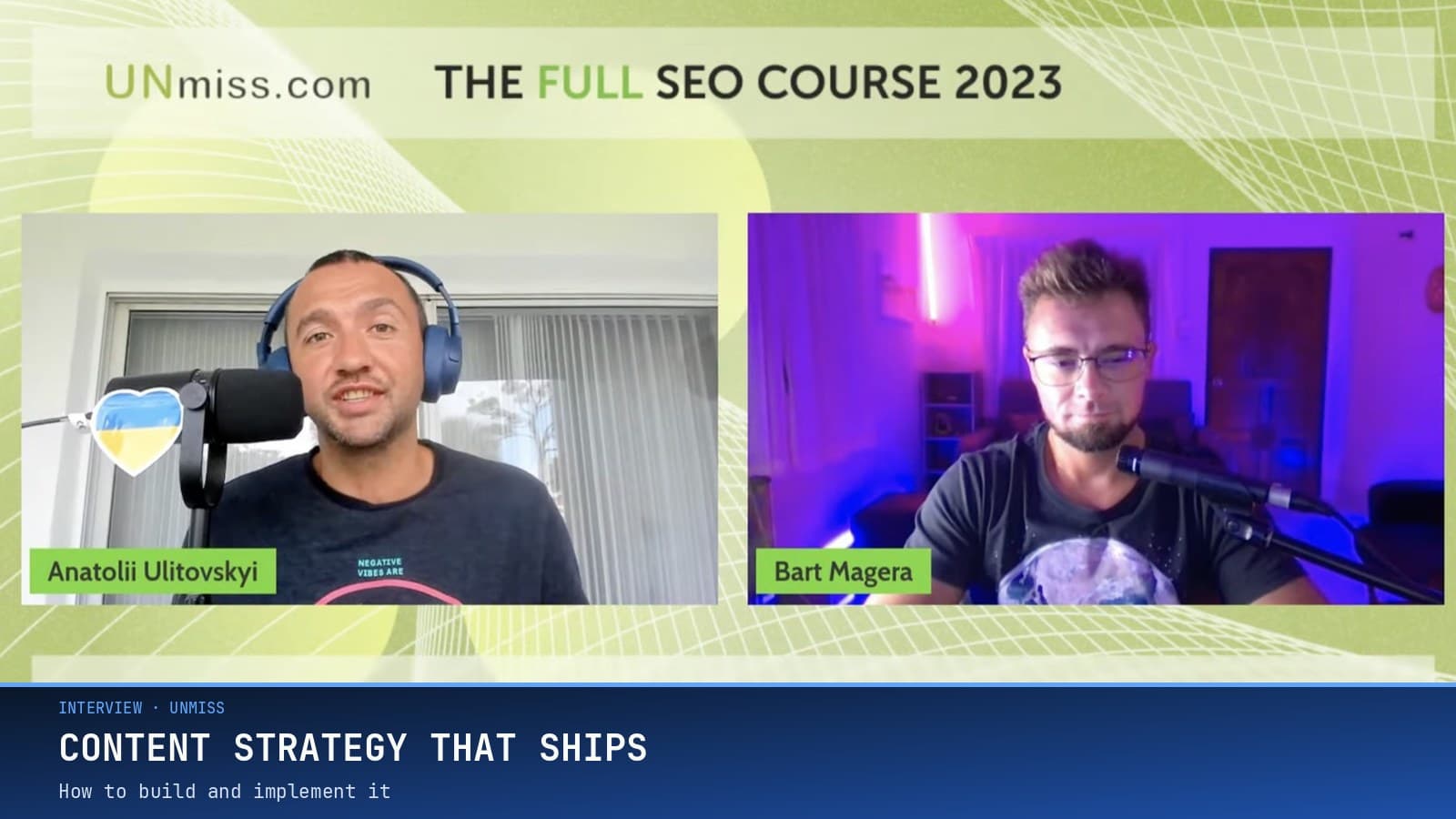
The UNmiss podcast had me on in March 2023 to talk about content strategy and how to actually implement one. By then I had been deep in SEO for about seven years, the first website I ever built was still ranking and still making money, and most of the patterns I would later formalize were already visible if you ran enough audits.
Stop Replicating Your Competitors
The host opened with the right diagnosis. Most companies pick a niche, look at their competitors, replicate what they see, and wonder why they cannot break out. The strategy is dead before it ships, because copying produces parity at best.
"It's better to find something that your competitors ignore, because I see when companies' websites can't get results for a long time, some of them can't get for two, three years, because they just do what competitors do."
The ignored topics are where the real returns live. Map your niche broadly enough and you will find them.
Match Keyword Difficulty To Domain Power
One of the most useful pieces of operator math I shared on the episode is also the most overlooked. Keyword difficulty is not abstract. It is calibrated against your domain's actual power.
"One thing you can actually quantify and measure now in SEO is keyword difficulty, and you can use various tools to verify that. You can match that keyword difficulty with the highs and the lows of the traffic of your domain, which correlates with the domain power, and you can actually gauge the difficulty of the keywords to your domain. So a lot of the guesswork is actually removed."
A new domain with Ahrefs Domain Rating zero is not chasing the same keywords as an aged domain with DR 40. The same keyword can be a stretch goal for one and a fast win for the other. The tools tell you which is which, if you ask.
Topical Maps Are The Real Strategy
Pillar pages and topic clusters are the structural answer to the question "what should I publish next?" Service pages anchor the cluster. Blog posts support them. Internal links create the navigational web.
"You have to figure out which are your pillar pages. You start off with those, and then you go into topic clusters. You figure out the SEO titles, and ideally you create some anchor text that's related to all those topics. You interlink them. If you can do that, it will create a nice web of flow and navigational wonders for Google."
The 2022 Review Update Lesson
I told the story on the show of getting hit by the 2022 Google review update. The takeaway was not subtle.
"I was hit, for example, in 2022 with the core update and the review update, which is what many websites got hit with when you got too much review content. So now we have a little bit more information about what Google likes, and Google likes information. If you can provide the information and the value to the user, you will get rewarded."
Sites that had over-indexed on review content were demoted. Sites with information density held up. The post-update direction was clear: provide information, not just verdicts.
What AI Still Gets Wrong
The host asked how to know whether users will love your content. The honest answer in 2023 was that AI was bad at this, and the gap with human judgment was visible.
"One of the problems with AI is it's really bad at this. AI gets a lot of things wrong, and the intent wrong sometimes, and the answer to the problem or solution wrong, providing incorrect data."
The models are much better today. The structural point still holds: the algorithm rewards content that helps a real human, and AI-generated content that misses the underlying intent gets discounted regardless of polish.
The Algorithm Is a Reflection of Us
The line that got the most pickup from this episode was a framing of what the algorithm actually is.
"I believe the algorithm is actually a reflection of humans. It's just getting better and better at reflecting how we think, how we ask, how we inquire, how we are curious, and how we find solutions to problems. It's just an extension of us."
Optimize for the human and the algorithm follows. Optimize for the algorithm and you will be optimizing for the wrong target by the next update.
The Manuka Honey Win
One of the first wins I ever had in SEO came from a piece of content nobody else had bothered to consolidate properly.
"That was actually my first win in SEO, when I was building that website about honey. I was trying to find some information about this grading system of Manuka honey from New Zealand and I couldn't find it. It was spread all around. So I decided I'm gonna make the best one. And I did, and I ranked it number one, and it got me a lot of traffic over the years."
The pattern repeats. Find the question that is half-answered across five mediocre pages. Write the consolidated answer. Rank.
Personal and Vulnerable Outperforms Polished
One of the more useful exchanges of the episode came when the host asked how to stand out when everyone is rewriting the same competitors. My answer was that the algorithm does not buy fluff, and people do not either.
"If you can get personal and vulnerable, this is something that speaks to people and relates to the previous point, because people no longer buy the fluff. The algorithm doesn't buy the fluff. They always don't need to be entertained. Sometimes they like straight to the point, honest but clear and concise professional information."
Where To Start: Writing
The closing question was the one I have been asked the most. If you started from scratch today, what would you do first?
"I would start with writing. I would start to learn how to write content, and try to get some writing jobs, try to get better, learn how to provide great customer service, get better at it. Make a lot of content, write a lot, and get better at it. Increase the prices, work with clients, make them happy, improve your customer service, and then learn from them and work even more, and start your own side projects. And then get more orders, increase your prices, and one day you'll start making money with your own project."
The order is not accidental. Writing is the load-bearing skill in SEO. Everything downstream (link building, technical, content strategy) is a function of it. Get writing right and the rest gets easier. Skip writing and nothing downstream compounds.
What I Took Away
The episode was recorded at a moment when the industry was halfway through the review-update fallout and just starting to absorb how much information density mattered. Looking at it now, the structural points still hold. Stop replicating competitors. Match keywords to your real domain power. Build topical maps before you publish. Write better than you talk.
Thank you to the UNmiss team for one of my earlier long-form conversations on the record.