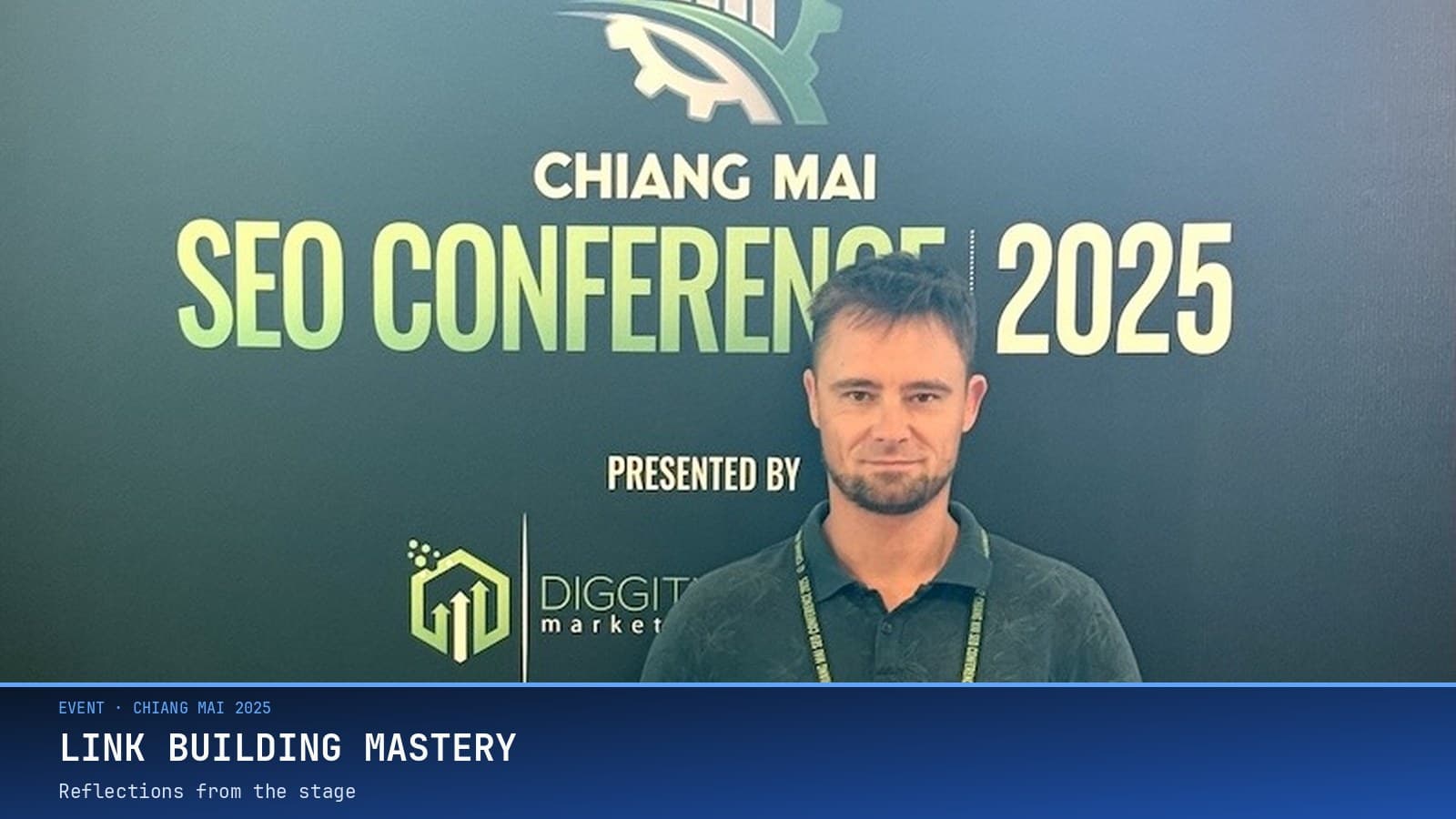
Six hours, every Friday. That is what my client reporting used to cost me, and it is the number I opened with on stage at Cebu Summit 2026, the AD Cebu Summit billed as "Future of Agencies: Asia's Premier AI Agency Summit", held on October 2-3 at the Bai Hotel in Cebu. The room was agency owners. So the talk was not about rankings. It was about the SEO audit system I built to stop doing assembly work by hand, and how its output signs retainers.

The talk was called "Build Your Own SEO Audit System: From Revenue Leak to Signed Retainer." This post is the long version, with the client data, the diagrams I built for it, and the parts I had to cut for time.

What An SEO Audit System Is (and Why Agencies Need One)
An SEO audit system is a fixed setup that connects an AI model to live search data and runs the same audit structure on any domain in minutes. Mine pairs Claude with Google Search Console and Ahrefs, runs in about 10 minutes, and replaces a manual audit that took 4 hours.
The core claim of the talk is simple. Agencies do not have a data problem. They have an assembly problem. The data your client's buyers generate is already sitting in Search Console, already indexed by Ahrefs, already one export away. What eats the week is assembling it: opening tabs, exporting CSVs, cross-referencing one tool against another, formatting the deck. None of that needs judgment. All of it steals the hours you need for judgment.

A system fixes the assembly problem, and that is the whole thesis. The audit is not smarter because a model wrote it. It is faster because the assembly is gone, and it is more consistent because the structure never changes between clients.
The Stack: 9 Integrations, 4 Categories, 1 Workspace
My SEO audit system runs on 9 integrations grouped into 4 categories inside 1 Claude workspace. Data sources are Google Search Console and Ahrefs. Infrastructure is Google Cloud Console, local projects, and GitHub. Communication is Gmail, Slack, and Google Calendar. Storage is Google Drive.
For the audit itself, only three of those carry the weight. Google Search Console shows what a client's customers actually search for, live; Claude reads it and I never log in, which kills the manual CSV export. Google Cloud Console hosts the custom MCP servers that connect Claude to that data; I built them once and they cost nothing to run. Ahrefs supplies the competitive layer (backlinks, keywords, niche trends) pulled live, which replaces roughly 4 hours of competitor research per prospect.

Drive, Gmail, Slack, Calendar, and GitHub sit in the same workspace but do a different job, which is why they got one slide and no more. I covered how they reshape a founder's week in my Entrepreneur Future Summit talk in Pune. Cebu was about one workflow only: the audit that finds money.

Three Revenue Leaks The System Surfaces
The SEO audit system looks for three revenue leaks: demand a client is not capturing, the wrong customers finding the client, and investment without traction. I call them leaks, not issues, because each one has a cost an agency can put in a proposal. I showed all three on real client data.

Leak one is demand you are not capturing, which I frame as entity cannibalization. Three or more pages rank inside one topic and no page owns it, so Google rents authority from URLs that were never built for the job. A US career-services client, over 90 days, ranked at position 2.2 for "career coach" on 3,500 impressions and at position 1.4 for "career coaching services" on 572 impressions. No page existed for either. Across that topic the audit found 9 queries spread over 13 URLs and 0 pillar pages. This is the practical face of topical authority: Google already trusts the domain on the topic, and the site never gave it a page to send the demand to.
Leak two is the wrong customers finding you. The same client's top pages by impressions were a blog post about a LinkedIn feature at 4,500 impressions and a 0% click-through rate, a sub-brand page at 1,200 impressions that is not the core service, and a post that attracts recruiters rather than the buyer. Three top performers, and none of them sells anything. It looks like success on the dashboard while it starves the pages that sell.
Leak three is investment without traction: the pages with the links are not the pages with the clicks. Nobody pulls both data sources at once, so nobody sees it. That is the leak the next diagram is built for.
The Authority-Demand Quadrant
The authority-demand quadrant plots each of a client's top 30 pages by Ahrefs URL Rating on one axis and Google Search Console clicks on the other. It sorts every page into four states: coverage gap, healthy, deprioritize, and link equity opportunity. Each state has one obvious next move.
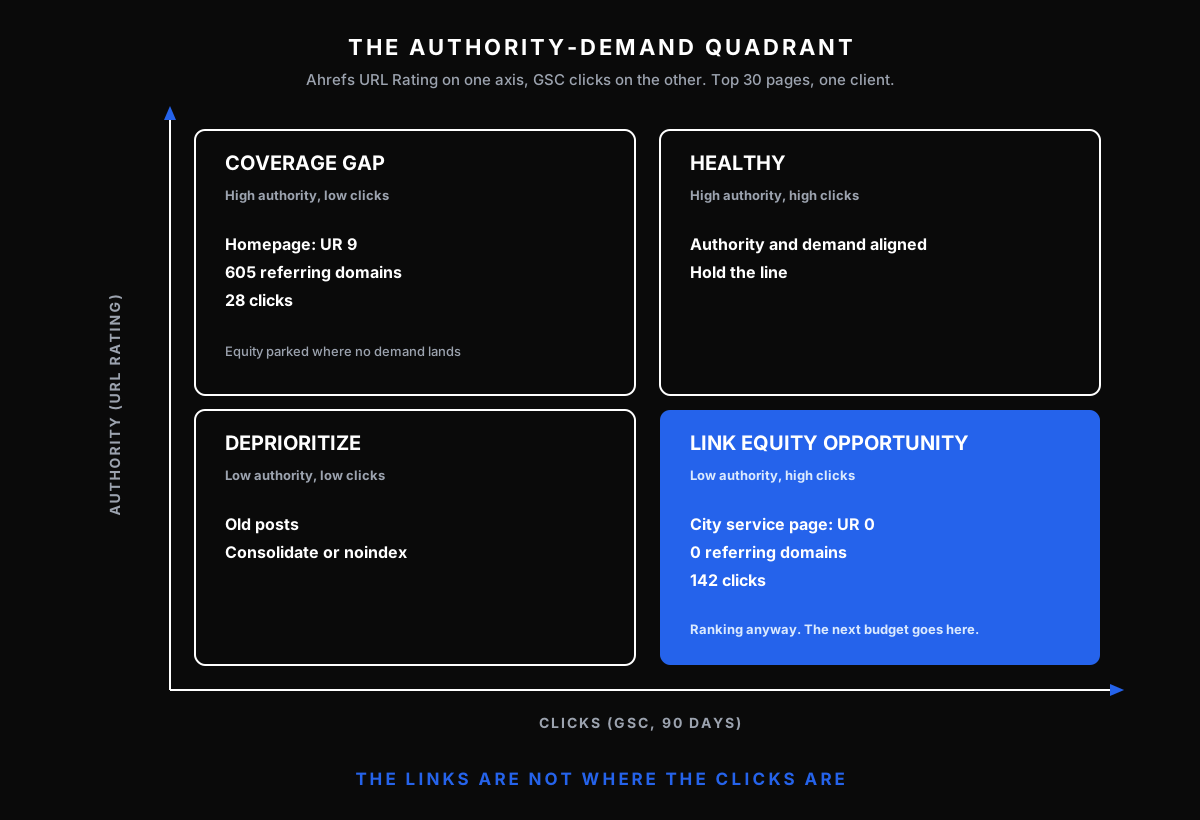
On the career-services client the quadrant was brutal. The homepage carried a URL Rating of 9 and 605 referring domains for 28 clicks. A city service page with a URL Rating of 0 and 0 referring domains pulled 142 clicks, ranking on relevance alone. That page is where the next link budget goes, and no single tool would have told you so. Search Console sees the clicks without the links. Ahrefs sees the links without the clicks. The SEO audit system reads both in the same pass, and the mismatch becomes obvious.
What a Fixed Leak Is Worth
A fixed revenue leak is worth the gap between the demand a site earns and the demand it converts into clicks. On a US e-commerce client over 12 months, that gap was the story: 59.5K clicks against 6.48M impressions, and three markers on the timeline explained most of it.
Marker one: a content vendor published 131 pages, and the money pages got buried under them. Marker two: a core update landed on top of that dilution. Marker three: the cannibalization was cleared, and the curve turned. I put the gap between the impressions line and the clicks line on the slide because that gap is the job. An agency that can show a prospect this chart about their own site is not selling SEO in the abstract. It is pointing at money the client can already see leaving.
How The Audit Runs in 10 Minutes
The audit runs in 10 minutes because every prompt carries the same four parts: who the audit is for, which data sources to pull, the pattern to look for, and the format to ship. The structure never changes between clients. Only the domain does.
On stage I ran the pull live: two sources, real data, while I drank my coffee. The deliverable is a written document plus a short video walkthrough, sent before the sales call rather than presented during it. On my own numbers, that combination closes 3x more than a call without it. The prospect arrives having already seen their own leak, so the call starts at "how do we fix this" instead of "why should I care."

The part that scales is a single service account inside Google Cloud Console. I add its email as a user on every Search Console property I manage, and that one credential reads all of them with no re-authentication. A new client grants access once. That is why I can sign a client on Monday and audit them on Monday.
Why The Prompts Stayed in The Room
The prompts behind my SEO audit system stayed in the room. I showed them on stage to the people who were there, and the slide said "Phone out. I'll wait." On the blog I share the structure, not the wording, because the wording is the part that took the longest to get right.

What makes the output usable is not the model and not clever phrasing. It is the constraints: the four-part structure, live data only, and an explicit instruction to say so when a pattern does not surface. An audit that is allowed to come back empty is an audit you can trust when it comes back full.
From Revenue Leak To Signed Retainer
A revenue leak becomes a signed retainer when the agency puts a number on it. A ranking problem is a conversation. A revenue leak priced from impressions, position, the client's conversion rate, and their order value is a proposal. You are not pitching SEO. You are quoting a repair.
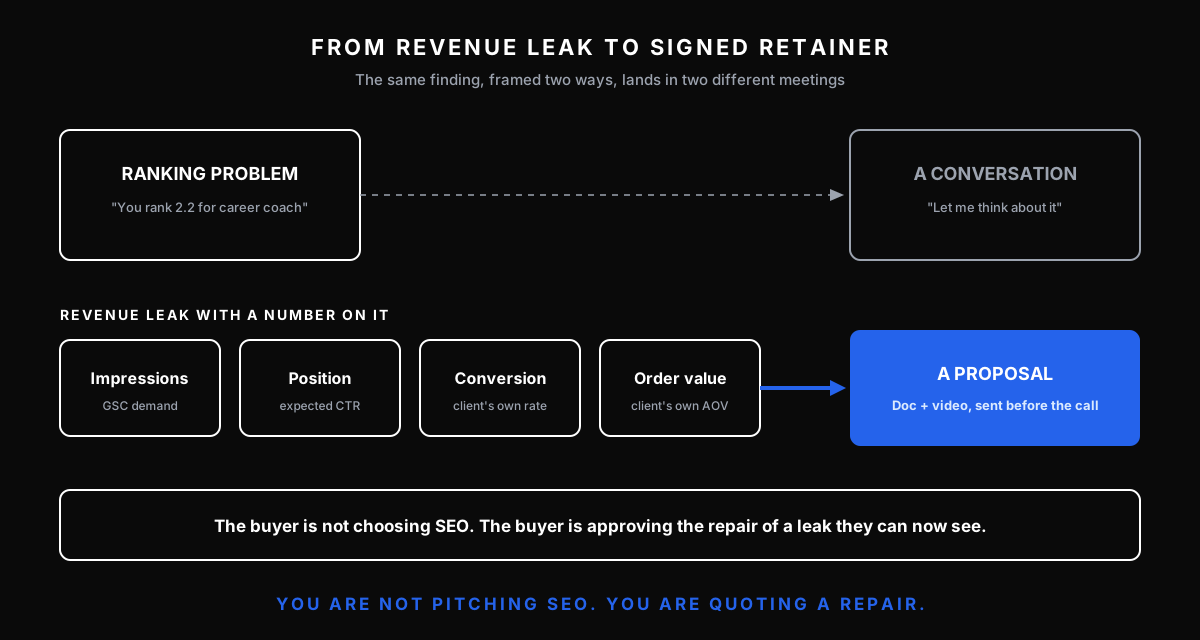
This is the slide I most wanted agency owners to take home. Most audits die because they describe symptoms in the agency's language: positions, crawl errors, missing tags. The buyer cannot price any of it, so they defer. The same finding stated as "this topic earns 3,500 impressions at position 2.2 and you have no page to convert it" is something a founder can multiply by their own conversion rate in their head. Put the number in the document. Send it before the call.
Where An AI Audit System Breaks Down
An AI audit system breaks down when it drifts from the data. It is not magic: it does what I tell it. It is not strategy: it assembles and I direct. It is not a product: every agency builds its own. Trust the output only after checking it against the source.
I gave the room four checks. Good sign: real URLs from the real domain. Good sign: numbers that match when you spot-check them in Search Console. Red flag: generic advice like "improve page speed," which means the model drifted away from the data, so re-prompt. Red flag: URLs that do not exist, so re-prompt with "only URLs from the tools." I run both checks on every audit before it leaves my desk.

The deeper limit is judgment. The SEO audit system will tell you a pillar is missing. It will not tell you whether that client can afford to build it this quarter, or whether the topic fits where the business is going. That call stays with the operator, which is the point: the system buys back the hours to make it.
Who Should Build One
Agency owners and in-house SEO leads who audit more than a few domains a month should build their own SEO audit system. The setup takes a weekend on free tiers, and the payoff compounds with every prospect, because the four-part structure never has to be rewritten.
I built mine for my own client work and for Mojo Links, and the reason I teach it rather than sell it is that the configuration is the moat. Your ICPs, your offers, your proposal format: none of that ships in a product. Agencies in that ballroom already had the data for every client they serve. What they lacked was the 10-minute path from data to a document a buyer will sign.
Frequently Asked Questions About The Cebu Summit 2026 Talk
What Was Bart Magera's Talk at Cebu Summit 2026 About?
My talk, "Build Your Own SEO Audit System: From Revenue Leak to Signed Retainer," showed agency owners how to connect Claude to Google Search Console and Ahrefs, surface three revenue leaks on real client data, and turn the findings into proposals that close.
What Data Sources Does The SEO Audit System Use?
The audit pulls two sources: Google Search Console for queries, pages, and query-page pairs over 90 days, and Ahrefs for organic keywords, top pages by traffic, pages by referring domains, and domain rating. Claude reads both through MCP servers in one pass.
How Long Does An Automated SEO Audit Take?
My audit takes about 10 minutes, down from 4 hours by hand. The time drops because the four-part prompt structure stays fixed and the data arrives live through MCP, so there are no CSV exports or tab-switching left to do.
Do I Need To Code To Build The MCP Server?
No. Claude writes the Python MCP server and walks you through the Google Cloud Console setup step by step. The hard part is not the code. It is writing an audit brief precise enough to keep the output on the data.
Why Send The Audit Before The Sales Call?
Sending the document and video before the call means the prospect arrives having seen their own revenue leak. The meeting starts at fixing it, not at justifying SEO. On my numbers, that closes 3x more than a call without the audit.
What I Took Home from Cebu
I closed the talk with one line: your clients are already losing the money, and the data has been sitting there the whole time. Go read it. The SEO audit system is just the fastest way I know to do that reading, every client, every time.
Cebu gave me a room of agency builders, which is the audience this system was made for. Thank you to Ashish, who organized the AD Cebu Summit and invited me to speak, and to everyone who held their phones up for the slides.