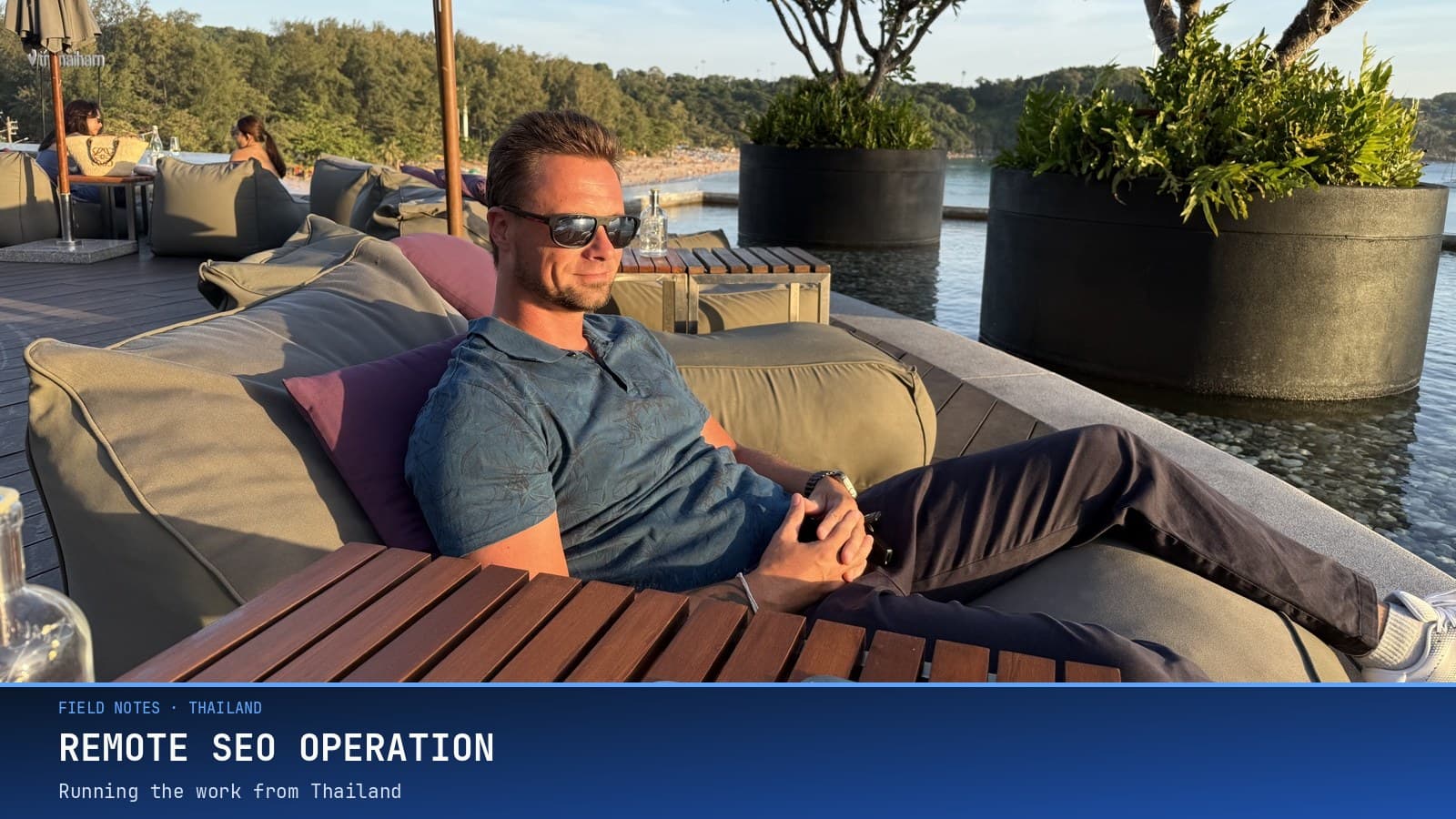
I closed my last Polish ecom audit in 12 days from a desk in Phuket. The client signed in a single email exchange. That is what a remote SEO operation looks like in practice, and the rest of this post is the system that produced it.
What a Remote SEO Operation Is (and Isn't)
A remote SEO operation is a delivery model where async written artifacts replace meetings as the primary work product. Mine runs on Loom walkthroughs, GSC exports, and decision documents shipped before any call. The work moves at the speed of decisions, not meeting availability.
It is not a freelancer with a laptop. It is not an agency in pyjamas. The defining attribute is that the deliverable lands before the conversation does. Every other choice (time zones, automation stack, client selection) follows from that one.
The entity I am describing has specific attributes: async-first workflow, one update per client per week, 12-hour offset to US clients, Loom plus data plus decision doc as the standard artifact set, 40 percent of time on decisions and 60 percent on review and writing.
The Async-First Workflow in Practice
Every engagement runs on three artifacts per update: a Loom walkthrough between 8 and 12 minutes, a GSC export of the actual data we are looking at, and a decision document listing what I recommend, what I dismissed, and why. One async update per client per week, not five quick syncs.
Most agencies have the opposite default. They book the call first, then figure out the deliverable in real time. The client leaves the call with action items and three TBDs. Three days later somebody schedules another call to clarify. Work moves at the speed of meeting availability.
Async-first flips that. The deliverable lands first. The call is for nuance, not for figuring out what to ship. The client gets a written record of every decision, dated, with reasoning, that they can refer back to four weeks later when something becomes urgent.
The Automation Stack Behind The Operation
The stack pulls GSC daily (not weekly), runs cannibalization checks the day conflicts emerge, and templates reporting so the numbers fill themselves in. I built Semapoly specifically to turn GSC into deterministic decisions rather than a wall of data.
Outreach automation scrapes targets, enriches each prospect with a context signal from their own GSC, drafts templated outreach, and queues sends for me to review. I stay the human in the loop for judgment calls. Volume work happens without me.
Time allocation tells the story. I spend roughly 40 percent of working hours on actual decisions and 60 percent on review and writing. Most agency operators have the inverse: 80 percent coordination, 20 percent work. Automation is what flips the ratio.
Remote vs in-House: When Each Wins
Remote operation wins when written communication is feasible, decisions can be batched, and the client values precision over presence. In-house wins when the work requires constant cross-team sync, when stakeholders prefer to talk things out, or when the engagement is genuinely emergent and improvising in a room is necessary.
Cost economics also break differently. An independent operator based in the US lists at 300 to 500 dollars per hour. I deliver the same caliber of work at lower rates because my cost base is roughly one third of San Francisco. The margin holds. The client rate drops.
The 12-hour offset to US clients is a feature, not a bug. They ship a brief at end of day, I deliver overnight, they review with morning coffee. The week effectively gains a day because work happens while they sleep. That is not a small advantage when you are running an SEO program against quarterly revenue goals.
Where Remote Operation Breaks Down
Remote operation breaks down on three failure modes: trust erosion, time-zone math, and cross-cultural communication signals. Each has a specific fix, and each shows up early enough that you can decide if remote is right for a given client before you sign.
Trust erosion is the biggest risk. If you go too async, some clients feel abandoned even while the work ships faster than ever. The fix is proactive written communication, not more meetings. A short Loom on a Friday afternoon saying here is where we are and here is what is next does the work of a status call.
Time-zone math gets brutal when you are the only Asia-based person on a US team. Tuesday morning standups happen at midnight Phuket time. I handle it by being explicit upfront: one synchronous block per week with US clients, by request. The rest is async. Clients who cannot accept that filter out, which is the point.
Cross-cultural communication signals scale poorly. American Sounds good is a green light. British Sounds good might mean I am politely declining. Eastern European directness reads as rudeness to Americans. I write client-facing comms in a deliberately flat tone and let the work carry the meaning.
The Numbers Behind 13-Month Client Retention
Client retention runs 13 months on average against an industry baseline of 6. The Polish ecom audit closed last month produced 47 data points pulled from GSC and Semapoly in 12 days, six prioritized fixes, and a three-month projected revenue impact spelled out before I quoted the engagement.
The same pattern shows up across the portfolio. Sprintlaw in legal, Regenexx in YMYL medical, Vaibhav for SaaS founder consulting. Different industries, different countries, same approach: written record of every decision, work shipped before the meeting, retainer kept because the US-based alternative with five-figure monthly fees and four-hour weekly calls is slower and more expensive.
The remote model is not just an arrangement that suits me. It is part of the value the client gets. A US-based agency cannot deliver overnight. A team that works only in meetings cannot match the written-decision audit trail. Remote is the moat, not just the lifestyle.
Should You Run a Remote SEO Operation?
Run a remote SEO operation if you can write better than you talk, if you can build or buy automation, and if you can be selective about which clients you accept. Skip it if you need a salary worth of synchronous human contact per week to feel sane, or if your buyer market specifically wants face time.
The buyers I attract want this. The buyers who do not, route to agencies that work differently, which is also part of the design. Remote operation acts as a filter for client fit before any contract gets signed.