Most SEO content treats a ranking drop as a generic "something broke" event with a 10-item checklist. That framing wastes the first 4 hours of every diagnosis. The real work is narrowing the cause space before you touch any tool. This pillar lays out the 9 categories search rankings actually drop into, the 4 diagnostic axes that map any drop to its category in under 10 minutes, and the recovery timeline you can quote a stakeholder with confidence.
The central entity here is the SEO ranking drop: a sustained position decrease for one or more queries, beyond normal SERP volatility. I publish this as a framework, not a workflow. If you want the workflow run for you, the operational playbooks live on Mojo Links.
Entity-Attribute-Value Reference Block
Entity: SEO ranking drop
Definition: sustained position decrease beyond normal SERP volatility (greater than 3 positions for established pages, greater than 5 for newer pages, lasting more than 7 days)
Cause categories: 9 distinct categories (algorithmic update, manual action, technical or indexing failure, content decay, Helpful Content System downgrade, link loss, cannibalization, CTR collapse, SERP feature change)
Diagnostic axes: scope (page vs sitewide), timing (sudden vs gradual), recent changes (yes vs no), branded query performance (preserved vs hit)
Normal volatility threshold: plus or minus 2-3 positions for established pages, plus or minus 5-7 for new pages, within a 14-day window
Investigation trigger: drop greater than 3 positions sustained over 7 days, OR drop greater than 5 positions on a single day
Diagnostic tools: Google Search Console (Performance, Coverage, Manual Actions, Page Indexing), Ahrefs Site Explorer (organic keywords, lost backlinks, position history), Semrush Sensor, Mozcast
Entity: Google algorithm
Core update cadence: 3-4 confirmed core updates per year
Spam update cadence: 2-3 confirmed spam updates per year
Continuous adjustments: ongoing, unannounced, sub-update level
Rollout window: 1-3 weeks typical for confirmed core updates
Documented systems: Core ranking, Helpful Content System, Reviews System, BERT, MUM, Passage Ranking, Page Experience, RankBrain
Confirmed update source: Google Search Central announcements
Entity: Diagnostic decision tree
Primary axes: scope, timing, recent changes, branded query performance
First-check rule: branded queries also dropped, the cause is algorithmic or domain-wide; only non-branded dropped, the cause is content or relevance
Sudden + sitewide + no recent changes: algorithm update (highest probability)
Sudden + sitewide + recent deploy: technical failure (highest probability)
Gradual + single page over months: content decay (highest probability)
Sudden + single page + position 50 or worse: manual action (check Google Search Console immediately)
Entity: Recovery timeline
Technical fix: 4-12 weeks from deployment to full re-indexation
Link rebuild: 3-6 months to restore lost authority signal
Algorithmic update reversal: 3-6 months (typically until next core update)
Content decay rewrite: 2-4 months for the new version to ranking-stabilize
Manual action removal: 6-18 months including reconsideration cycles
Helpful Content System recovery: 6-12 months minimum after sitewide rework
What Counts as An SEO Ranking Drop?
An SEO ranking drop is a sustained decrease in a page's Google position for one or more queries, beyond normal SERP volatility. Drops worth investigating exceed 3 positions for established pages or 5 positions for newer pages, lasting more than 7 days. Anything below that threshold is volatility noise, not signal.
The threshold matters because Google rankings shift constantly. A page sitting at position 4 might appear at position 2 on Monday, position 6 on Tuesday, and position 4 again on Wednesday. None of that is a ranking drop. It is the natural drift of a system that re-scores millions of queries against billions of pages at sub-second intervals.
I draw the diagnostic line at three concrete attributes: magnitude, persistence, and scope. Magnitude is the position delta. Persistence is the duration past 7 days. Scope is whether one page or many pages moved together. A page that drops from position 4 to position 8 for one query for two days and bounces back is not a ranking drop. A page that drops from position 4 to position 8 for one query and stays there for 14 days has dropped. A site whose 200 ranking pages all shifted down 3-5 positions over 24 hours has experienced a sitewide drop, regardless of whether any single page crossed the magnitude threshold.
Established pages tolerate a tighter volatility band (plus or minus 2-3 positions). Newer pages (under 90 days indexed) tolerate a wider one (plus or minus 5-7 positions) because Google is still calibrating their rankings. A 6-position drop on a 3-month-old page is normal. A 6-position drop on a 3-year-old page is a signal.
How Google Cascades Ranking Signals Across a Site
Google cascades ranking signals through three combined layers: relevance, authority, and quality. Updates change how these layers weight, producing ranking shifts across thousands of queries simultaneously. A drop is the visible output of a re-weighting you cannot see directly.
Relevance is the semantic match between a query and a page's content. Authority is the strength of the linking graph pointing at the page and the domain that hosts it. Quality is Google's assessment of whether the page is useful, original, and trustworthy. The three layers combine multiplicatively. A page can rank with a high score in two layers and a moderate score in the third, but a low score in any one layer dampens the ranking output of the other two.
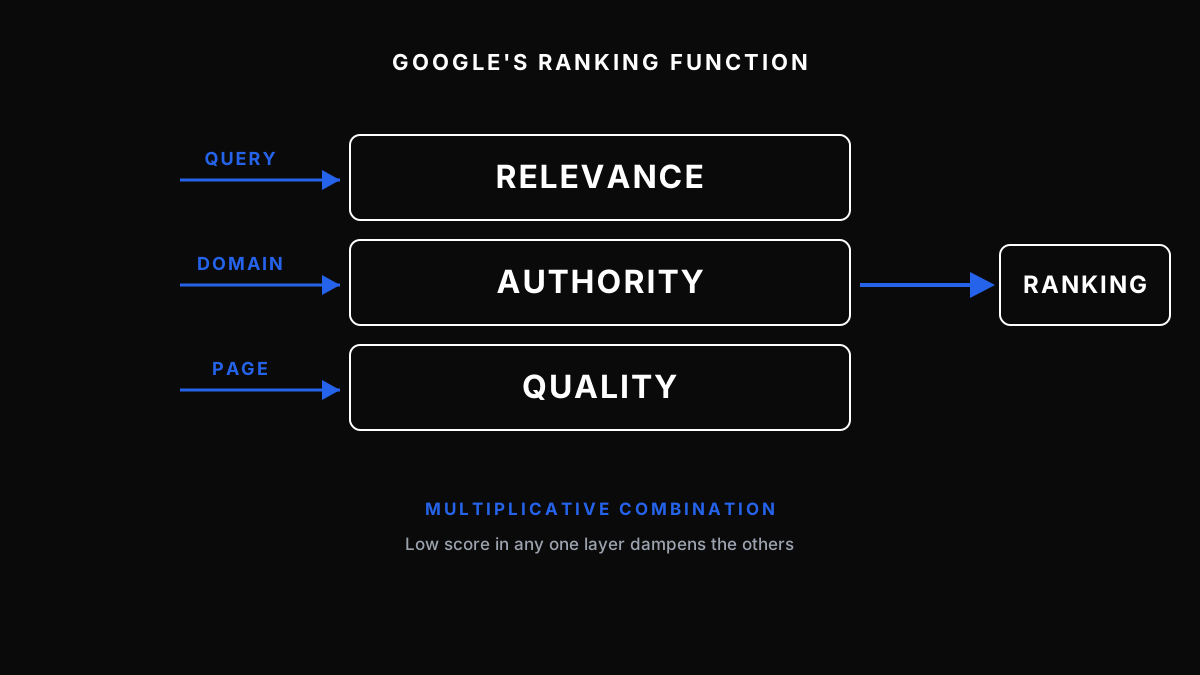
When Google ships a core update, what changes is the relative weighting between (or within) these layers. A core update might reweight quality signals upward by 15%, which means pages with weak quality signals lose more ranking even if their relevance and authority did not change. Mathematically, the page's underlying signal data did not move; the function that interprets the data did.
Per the Google ranking systems documentation, Google operates a stack of named systems running in combination: the core ranking system, the Helpful Content System, the Reviews System, BERT, MUM, Passage Ranking, Page Experience, and RankBrain among others. Each system contributes a sub-score. The final ranking is the assembled output.
This matters for diagnosis. A drop driven by one system (say, the Helpful Content System downgrading site-quality scores) presents as a sitewide, gradual loss across most rankings. A drop driven by a different system (Page Experience flagging a Core Web Vitals regression on one template) presents as a page-cluster loss limited to URLs that share that template. The diagnostic surface is the same number on a chart; the underlying cause is different.
A Backlinko analysis of 11.8 million Google search results found that top-10 pages carry, on average, more referring domains, faster page experience, and tighter topical coverage than positions 11-20. Each of those is a sub-signal under a different system. When Google reweights, the page that was carrying weight in only one of the three drops further than the page carrying weight in all three.
Who Experiences Search Ranking Drops Differently
Small sites feel drops harder per dollar. YMYL sites face stricter quality thresholds and longer recovery cycles. Single-page drops indicate page-level issues; sitewide drops point to algorithmic reweighting or domain-level penalties. Site shape and vertical determine both drop severity and recovery cost.
A 10-page site that loses one ranking page has lost 10% of its visible footprint. A 10,000-page site that loses one ranking page has lost 0.01%. The same drop in absolute terms hits the small site as an existential event and the large site as an unmeasurable blip. This is why ranking drop noise floors differ across site sizes. A site with under 100 indexed pages should treat any single-page drop above the volatility threshold as worth a 30-minute investigation. A site with 10,000+ pages should set the threshold higher and trigger investigation only on cluster-level moves.
YMYL niches (Your Money or Your Life: medical, legal, financial, regulated consumer) face quality thresholds that non-YMYL niches do not. Google has documented elevated quality requirements for these verticals because the consequences of ranking low-quality content in them are real-world harm. A YMYL site experiencing a drop should default to suspecting quality signals first, because the algorithmic weight on quality is higher in those verticals.
Drop scope is the diagnostic prior nobody states clearly enough. Single-page drops are page-level issues 80% of the time: content quality, internal linking, page experience on that template, or cannibalization with a sibling page. Sitewide drops are algorithmic, domain-level, or technical 80% of the time: a Google update reweighted the domain's signals, a manual action landed, or a deploy broke crawling. The scope is the first axis on the decision tree because it eliminates the most cause space.
The 4-Axis Diagnostic Decision Tree for Ranking Drops
Diagnose ranking drops along four axes: scope (page vs sitewide), timing (sudden vs gradual), recent changes (yes vs no), and branded query performance (preserved vs hit). Each axis combination narrows the likely cause from 9 categories to 1 or 2.
This is the framework I run before opening any tool. The 9 cause categories are too many to investigate sequentially. Investigating each cause takes 20-60 minutes. Running all 9 takes a full day. Running the decision tree takes under 10 minutes and points you at the 1-2 causes worth the time.
Axis 1: Scope. Is the drop limited to a single URL, a content cluster, a section, or the entire site? Pull Google Search Console Performance, filter by date, sort by impressions delta. If 80%+ of the loss concentrates on one URL or template, scope is page-level. If the loss spreads across most ranking URLs, scope is sitewide.
Axis 2: Timing. Did the drop occur in a single day or over weeks? Look at GSC's daily performance chart. A 12-24 hour cliff is sudden. A 4-12 week descent is gradual. Time matters because algorithm updates and technical errors land suddenly, while content decay and link velocity drops manifest gradually.
Axis 3: Recent changes. Did you ship anything (deploy, content edit, redirect, migration, link cleanup, schema change) within 30 days of the drop start? Recent changes shift the prior toward technical or content-quality causes. No recent changes shift the prior toward algorithmic or external causes.
Axis 4: Branded query performance. Filter GSC to branded queries only. Did branded rankings hold or drop too? Branded queries are the algorithmic equivalent of a control variable. They are protected by direct user intent signal. If branded queries also dropped, the cause is domain-level (manual action, algorithmic downgrade, technical de-indexation). If branded held while non-branded dropped, the cause is relevance, content, or non-brand link signal.
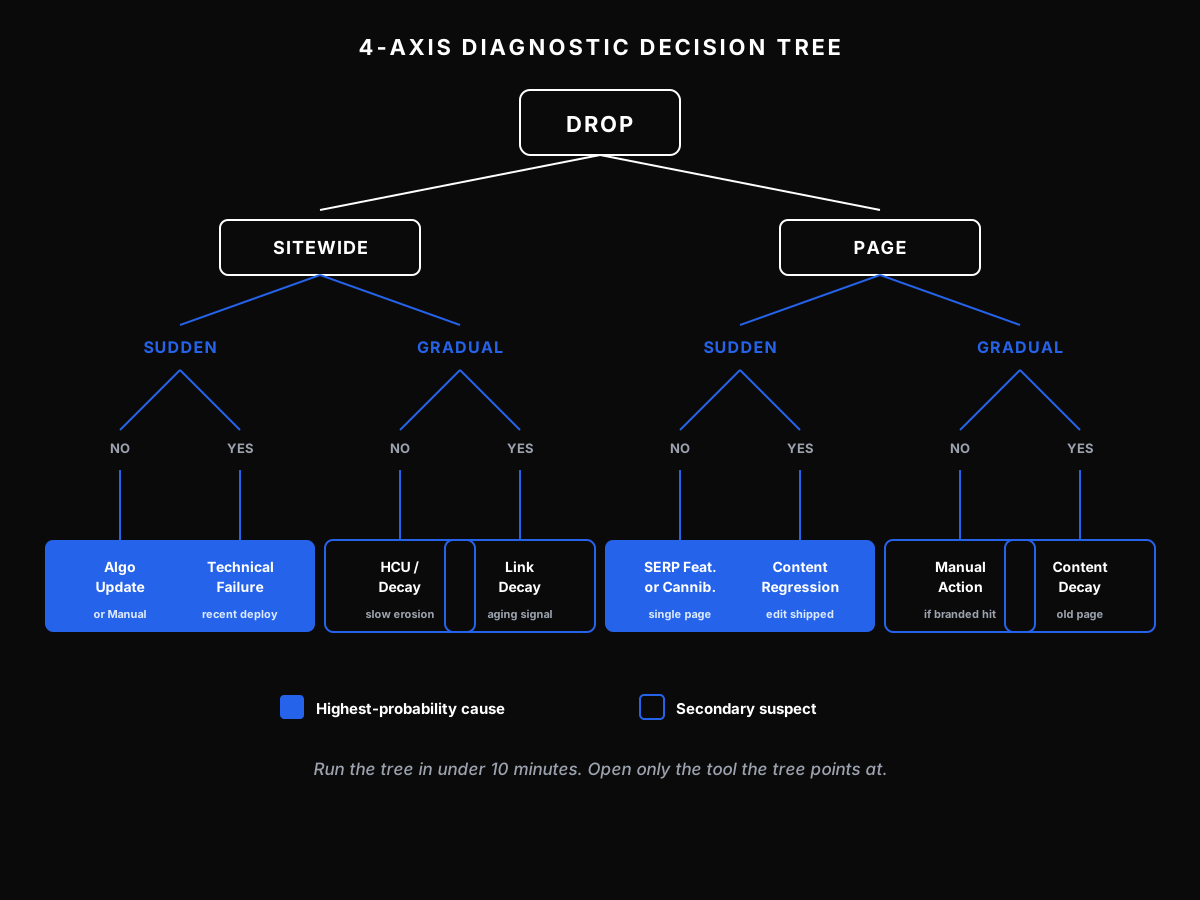
Here is the lookup table the four axes produce. Each combination points at the top 1-2 causes to investigate first:
Scope | Timing | Recent Changes | Branded | Most Likely Cause |
|---|---|---|---|---|
Sitewide | Sudden | No | Hit too | Algorithm update or manual action |
Sitewide | Sudden | Yes (deploy) | Hit too | Technical failure |
Sitewide | Gradual | No | Held | Helpful Content System or content decay |
Sitewide | Gradual | No | Hit too | Slow link decay or aging-domain signal loss |
Page | Sudden | No | Held | Cannibalization, SERP feature change, or competitor refresh |
Page | Sudden | Yes (content edit) | Held | Content quality regression on that page |
Page | Sudden | No | Hit (single page only) | Manual action targeted that URL |
Page | Gradual | No | Held | Content decay |
Sitewide | Sudden | No | Held | Link loss (high-DR sources) or SERP feature change |
Run the table. Then open only the tool that confirms the suspected cause. Skip the other 7.
Did a Google Core or Spam Update Cause Your Drop?
Confirm a Google core or spam update by cross-referencing the drop date against Google Search Central announcements and trackers like Semrush Sensor or Mozcast. Update-driven drops affect the whole site within 24-72 hours of update rollout and correlate with a confirmed announcement window.
Google publishes core and spam updates at the core updates documentation page. The page lists the start and approximate end date of each confirmed rollout. Three to four core updates ship per year; two to three spam updates ship per year. If the drop date sits inside one of those rollout windows, the update is your prior suspect.
Semrush Sensor and Mozcast publish daily SERP volatility scores. An update-driven drop on your site usually coincides with elevated industry-wide volatility on those trackers. If your drop date lines up with a 9.0+ Sensor reading and Google later confirmed a core update on that date, the cause is almost certainly the update.
Update-driven drops have a specific signature: sitewide, sudden (24-72 hours from start), and no recent changes on your end. If the drop matches that signature and the calendar matches a confirmed update, you have a high-confidence cause. Recovery requires waiting for the next update reversal or rebuilding the underlying quality signal the update demoted you on. The 90-day operator cadence for that rebuild work lives at Mojo Links algorithm update recovery; the diagnosis lives here.
Two diagnostic mistakes to avoid: blaming an update when the calendar does not match (a drop on a non-update day is not an update drop, no matter how convenient that explanation is), and dismissing an unconfirmed drop as "just an unannounced tweak" (which is sometimes true but more often hides another cause you have not investigated).
Did Google Issue a Manual Action Against Your Site?
Check the Manual Actions report in Google Search Console. Manual actions appear there immediately when issued, name the affected URLs, and list the violation category. Site-wide manual actions can drop all rankings to position 50+ overnight; partial actions target specific pages.
Manual actions are documented at the Google spam policies page. The most common categories triggering manual actions are unnatural link patterns (inbound or outbound), thin content, sneaky redirects, cloaking, and structured data abuse. Google's manual review team triggers these. They are not algorithmic.
The diagnostic shortcut is fast: open Google Search Console, go to Security and Manual Actions, then Manual Actions. If a manual action exists, it is listed there. If the page reads "No issues detected," you do not have a manual action and you can rule the category out.
Manual actions have two flavors. Site-wide actions affect the entire domain and present as a cliff-edge drop on most queries to position 50+ or worse. Partial actions target specific URLs or URL patterns (typically pages with the violation, like spammy outbound links on a section of articles) and present as a sudden page-cluster drop while the rest of the site is unaffected.
Recovery requires fixing the underlying violation across all affected URLs, filing a reconsideration request via the Manual Actions report, and waiting through the review cycle. Typical end-to-end recovery is 6-18 months. The Mojo Links Google penalty recovery service handles the fix-and-reconsider cycle end to end.
Did a Technical or Indexing Issue Trigger Your Drop?
Technical drops show as sudden de-indexation, crawl errors spiking in Google Search Console Coverage, or pages serving 5xx errors. A robots.txt block, accidental noindex tag, or canonical pointing at a 404 can wipe a page from the index within one re-crawl cycle.
The technical category is the easiest to confirm and the easiest to overlook. The confirmation path runs through 4 GSC reports: Coverage (any error spike correlated with the drop date), Page Indexing (pages flipped from Indexed to Not Indexed), Manual Actions (already ruled out in the prior step), and Crawl Stats (a sudden drop or spike in Googlebot requests).
The most common technical-cause patterns I have seen:
Accidental noindex meta tag rolled out in a template update. Affects every URL using that template. Pages stay in the index for a few weeks, then disappear in batches.
Robots.txt change blocking a directory that Google was crawling. Pages stop accruing fresh signal; ranking decays as the index entry stales.
Server returning 5xx errors during Googlebot crawl windows. Pages get de-prioritized for crawling, rankings drift down.
Canonical tag pointing at a 404 or a low-value page. Google may consolidate ranking signal onto the canonical target, which has no signal of its own, killing the source page's rank.
Site migration without redirects. Every old URL 404s; signal does not transfer.
Technical drops have a 4-12 week recovery window from the time of fix because Google's recrawl and re-rank cycle takes that long for established pages. Newer pages can recover in 2-4 weeks. The Mojo Links technical SEO audit covers the full crawl, GSC cross-reference, and Ahrefs link audit when you want the diagnosis run cold.
Did Your Content Lose Relevance Through Decay?
Content decay shows up as gradual position erosion over 6-18 months with no algorithmic event. GSC's Page Performance report reveals which queries the page used to rank for and now does not. Decay signals competitor pages have surpassed yours in freshness, depth, or entity coverage.
Decay is the slowest cause and the most often misdiagnosed. Operators see a page that ranked at position 3 two years ago now sitting at position 12 and reach for an algorithm explanation. Most of the time the algorithm did not change; the SERP did. Competitors published deeper, fresher, or more entity-rich pages. Your page got passed.
The diagnostic signature of decay is the gradual descent on the per-page GSC chart: a slow, steady drift downward over 6-18 months with no cliff edge. Pull the page's GSC Performance, switch to the position metric, view the 16-month chart. Decay looks like a downward staircase. An algorithmic drop looks like a cliff. A technical drop looks like a flat line that suddenly hits zero.
To confirm decay, pull the top 10 ranking competitors for the page's primary query. Compare publication or last-updated dates, page word counts, entity coverage, and internal linking density. If the SERP has refreshed in the last 12 months and your page has not, the cause is decay.
Recovery requires a content rewrite that re-enters the SERP at parity or above. Expect 2-4 months for the rewritten version to ranking-stabilize at its new position. The rewrite should expand entity coverage rather than just adding word count; word count alone is not the signal. Per Google's helpful content documentation, the system rewards content that demonstrably serves the user better than alternatives.
Did The Helpful Content System Downgrade Your Site?
The Helpful Content System (HCU) downgrades sites it judges to publish content primarily for search engines rather than people. Site-wide signal, not page-specific. Recovery requires 6+ months of demonstrably user-first publishing and aggressive thin-page removal.
HCU is harder to confirm than the other cause categories because Google does not flag it in GSC. The signature is sitewide, sustained, and persistent across multiple core updates with no recovery. If a site dropped during an HCU update window and has not recovered through 2-3 subsequent core updates, HCU is the working hypothesis.
Confirmed HCU update windows are listed on the Google Search Central updates page. Drops that started inside one of those windows AND that affect the entire site AND that have not reversed at any subsequent update are HCU-coded until proven otherwise.
HCU recovery is the longest of any cause category. The system evaluates sites holistically; it does not respond to single-page fixes. A site under HCU downgrade needs to remove or no-index every thin page, demonstrably rewrite content to serve user intent over search-engine intent, consolidate fragmented topics into authoritative pillar pages, and wait 6-12 months for the system to re-evaluate. Even sites doing all four well often need 12+ months to recover fully.
This is the cause where I push hardest against quick fixes. Anyone selling you a 30-day HCU recovery is selling you the wrong thing. The Mojo Links semantic SEO audit maps the topical authority gaps that an HCU recovery has to close before any timeline becomes realistic.
Did You Lose Key Backlinks or Link Velocity?
Sudden loss of high-DR referring domains creates ranking drops, especially when lost links carried branded or category anchor text. Velocity drops (new link acquisition stalling) cause slower erosion. Ahrefs Site Explorer's lost-backlinks report identifies the exact URLs to investigate or rebuild.
The link cause splits into two patterns. Sudden loss is a few high-value links dropping in a short window, often due to a referring page being removed, a referring domain expiring, or a publisher migrating CMS and losing your link in the migration. Velocity loss is your link acquisition rate dropping over months, which causes a slower, sustained ranking decline as the link graph around you continues growing and you fall behind in relative authority.
To diagnose sudden link loss, open Ahrefs Site Explorer, go to Lost Backlinks, filter to the last 30-90 days, sort by Domain Rating descending. If you see 1-5 high-DR (60+) links lost in the window that correlates with your drop, those are your suspect URLs. Investigate each: was the page removed, was the link edited out, was the entire referring domain de-indexed?
To diagnose velocity loss, pull your historical referring-domains chart for the past 24 months. A healthy velocity is consistent net new referring domains month over month. A velocity drop shows as a flat or declining curve while ranking pages drift down over the same period.
Recovery from sudden link loss is 3-6 months of targeted replacement: outreach for new links of equivalent authority, or reclamation of the lost ones where possible. Velocity loss recovery requires restarting consistent acquisition; rankings follow with a 2-4 month lag.
Are Your Own Pages Cannibalizing Each Other?
Cannibalization causes apparent ranking drops when Google switches which of your pages ranks for a query, or consolidates 2+ pages into one weaker shared position. Diagnose by comparing GSC's Pages view filtered by query against the historical SERP.
Cannibalization is the most over-diagnosed and most under-confirmed cause category. Operators reach for it the moment they see two pages that mention the same keyword. Real cannibalization requires a different pattern: two pages competing for the same SERP slot, with Google rotating between them or splitting their combined signal across both.
To confirm cannibalization, open GSC Performance, filter to the target query, switch to the Pages tab. If you see two or more URLs receiving impressions for that query AND one of them has visibly lost rank while another has visibly gained, you have cannibalization on that query. If only one URL receives meaningful impressions, you do not.
The recovery options are: consolidate the two pages into one (301 the weaker page to the stronger one), differentiate the two pages so they target distinct query intent and stop competing, or accept the cannibalization if both pages serve different user funnels and you do not need the SERP position.
I cover the per-query diagnostic in more depth in the operations spoke on Mojo Links: the keyword ranking drop diagnosis runs the GSC and Ahrefs query-level comparison; this section is the framework.
Did Your Click-Through Rate Collapse in The SERP?
CTR collapse drops rankings when Google's user-behavior signals indicate your title and snippet underperform peers. A rewritten title, missing brand, or new SERP-snippet preview can halve CTR within days, triggering position decay over the following 2-4 weeks.
CTR is a feedback signal Google uses to calibrate ranking quality. When users skip past your result and click a competitor, Google reads that as a signal your page is the wrong answer for that query and demotes you over time. The mechanism is not instant; it takes 2-4 weeks of sustained low CTR for the demotion to land in position. Which is why CTR drops show up as a delayed ranking effect rather than a same-day cliff.
To diagnose CTR collapse, open GSC Performance, filter by query, compare current CTR against the previous 90-day baseline. A drop from 8% to 4% on a query where you held position 2-3 is a CTR collapse signal. The position number may still show as 2-3 in the current window, but the next reweighting cycle will likely demote you to 4-6.
The common causes of CTR collapse are: title edits that removed brand recognition or query keywords, a SERP snippet rewrite by Google (Google sometimes replaces your meta description with a different snippet from your body text), a new SERP feature that consumed the click intent (AI Overview, knowledge panel, expanded PAA), and a competitor entering the SERP with a stronger title.
Recovery is fastest of any cause category if the cause is title-related. Edit the title back to its winning form, wait 1-2 weeks for Googlebot to re-cache and serve the new title, watch CTR recover and rankings follow 2-4 weeks later. If the cause is a SERP feature change, the recovery path is harder and routes into the next section.
Did a SERP Feature Change Push Your Clicks Elsewhere?
SERP feature changes (AI Overviews launching, knowledge panels appearing, People Also Ask blocks expanding) push your blue link below the fold. Your position number stays the same; your clicks collapse. GSC's impressions rising while clicks fall is the signal.
This is the most modern cause category and the one operators least often suspect. A SERP feature change is not a ranking drop in the classical sense (your position has not moved), but it produces the operationally identical outcome (your traffic dropped). Diagnosing it requires looking at GSC differently.
The signature is divergence between impressions and clicks. Impressions hold steady or rise (your page is still ranking and being shown). Clicks fall (users are getting their answer from the SERP feature without clicking through). CTR drops sharply on the affected queries. If you only look at the position metric, the drop is invisible.
AI Overviews are the dominant cause in 2026. When Google introduces an AI Overview for a query, the blue link below it loses 30-60% of clicks even if it retains its position. The pages most affected are informational top-of-funnel queries where the AI Overview can answer the question without a click.
The recovery options are limited because the feature change is upstream of your control. Tactics that help: rewriting content so it becomes more likely to be cited by the AI Overview itself (which preserves some traffic via the citation link), shifting query targeting toward intents that resist SERP feature consumption (commercial and how-to queries with strong action intent), and accepting that the affected page may never recover its prior click volume regardless of optimization.
This is also the cause where I argue most strongly that traffic and rankings have decoupled. A page can hold position 1 and lose 80% of its traffic. The framework matters more than the position metric.
Recovery Timelines by Cause Type
Technical fixes recover in 4-12 weeks. Link rebuilds take 3-6 months. Algorithmic update reversal takes 3-6 months. Content decay rewrite takes 2-4 months. Manual action removal takes 6-18 months. Helpful Content System recovery takes 6-12 months minimum. Timeline is a function of cause type, not effort intensity.
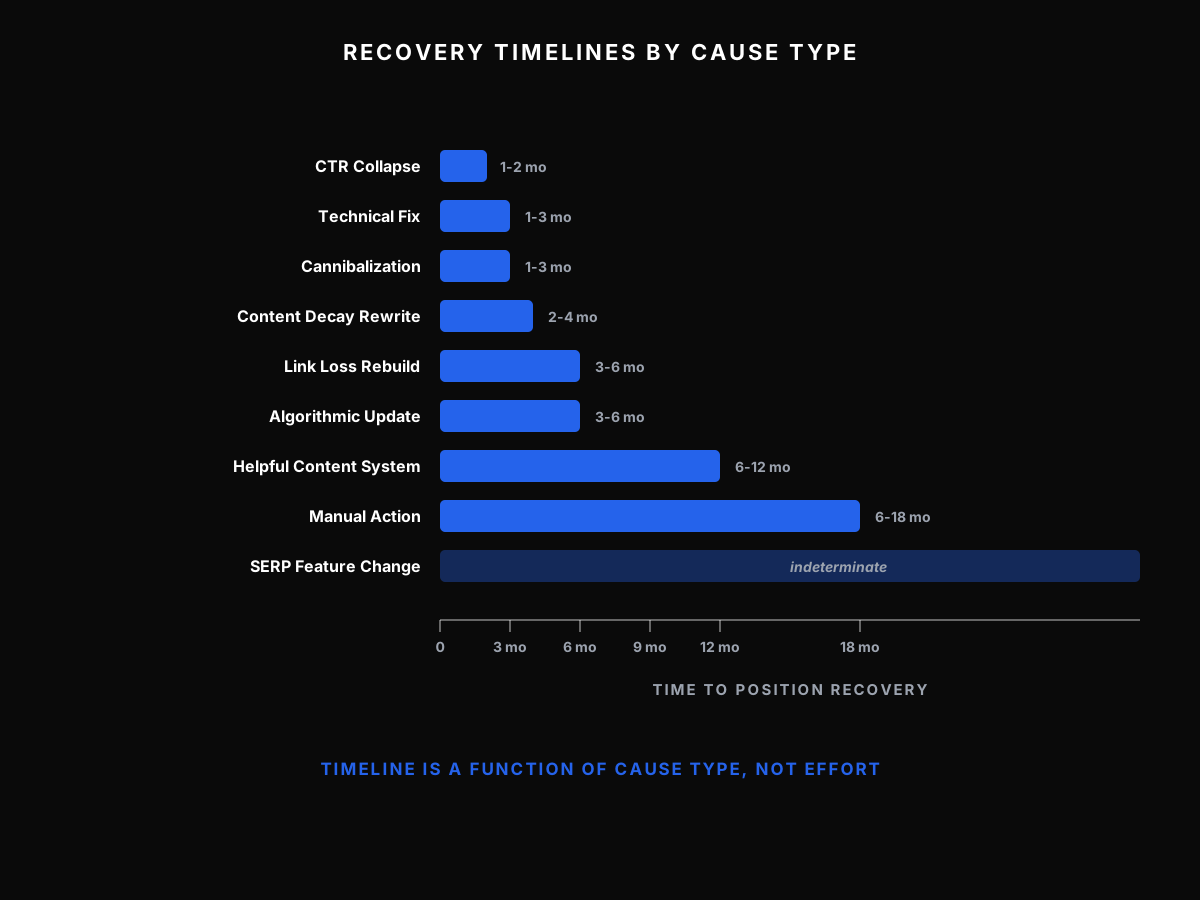
Cause | Recovery Window | What Drives the Window |
|---|---|---|
Technical or indexing failure | 4-12 weeks | Googlebot re-crawl and re-rank cycle on established pages |
CTR collapse (title-driven) | 4-8 weeks | Re-cache plus 2-4 weeks of new user signal |
Cannibalization (after consolidation) | 4-12 weeks | Re-attribution of combined signal to the canonical page |
Link loss rebuild | 3-6 months | Time to acquire equivalent-authority replacements |
Algorithmic update reversal | 3-6 months | Typically requires the next core update cycle |
Content decay rewrite | 2-4 months | New version's SERP stabilization period |
SERP feature change | Indeterminate | Often does not fully recover; tactics partial |
Manual action removal | 6-18 months | Fix, reconsider, review cycles |
Helpful Content System | 6-12 months minimum | Sitewide re-evaluation cadence |
The reason these timelines look longer than most SEO content suggests is that most SEO content sells optimism. I have seen exactly zero HCU-affected sites recover in under 6 months. I have seen many take 12-18 months. The realistic timeline is the one you can quote a stakeholder without backtracking later.
Two timeline notes worth flagging. First, timelines compound when multiple causes hit simultaneously. A site that lost rankings to both an algorithmic update AND content decay does not recover on the shorter of the two timelines; it recovers on the longer one, because both signals have to reset. Second, timelines are conditional on actually fixing the cause. The clock starts when the fix ships, not when the drop was first noticed.
Ranking Drop vs Traffic Drop: The Difference That Matters
A ranking drop changes your position in SERP for specific queries. A traffic drop changes how many visits the site receives, which can happen even when rankings stay flat (CTR collapse, AI Overviews, seasonality, or branded search decline). Diagnose them separately.
This distinction is the single most common diagnostic mistake I see. An operator opens analytics, sees a traffic drop, and immediately assumes their rankings dropped. They open GSC, see rankings holding, and conclude the data is wrong. The data is correct. They have a traffic drop without a ranking drop, which means the cause is downstream of position: CTR, SERP features, seasonality, or branded search.
The decision tree above only diagnoses ranking drops. If your ranking metric held and your traffic metric fell, the decision tree is the wrong tool. Run a traffic-shape analysis instead: which queries lost impressions, which lost clicks, did branded search decline, did a new SERP feature appear, is the date range seasonal. The operational triage for that lives at Mojo Links sudden traffic drop diagnosis with a 60-minute workflow and a 1-page deliverable.
When To Run a Professional SEO Audit vs Diagnose Yourself
Run a professional SEO audit when the drop is sitewide, sustained past 30 days, or you cannot match it to a single cause from the decision tree. DIY diagnosis works for single-page or single-cause drops with obvious recent changes (deploy, content edit, redirect).
The framework above is enough to diagnose most ranking drops if you have the tooling (GSC, Ahrefs) and 2-4 hours to run the decision tree carefully. What it does not give you is the audit infrastructure to confirm multi-cause drops, the historical data to compare your current shape against prior baselines, and the operator pattern recognition that comes from running the diagnosis across hundreds of sites.
For an operator running their own site, DIY diagnosis is the right starting point. Run the decision tree. Open the 1-2 tools the tree points at. Confirm or rule out the suspected cause within 30 minutes. If the cause is confirmed and the fix is within your skillset, ship it.
For an operator running someone else's site (in-house SEO at a company, agency owner managing client sites, marketing lead inheriting a problem), DIY diagnosis is the wrong stopping point. The drop is too high-stakes to leave at "probably an algorithm update" without a documented audit. Run the audit, document the cause, hand the stakeholder a one-page summary they can act on.
Most drops are avoidable when the work follows an SEO strategy instead of reacting after the fact.
Frequently Asked Questions About Ranking Drops
How long should I wait before investigating a ranking drop?
Wait 7 days. Most position fluctuations in the first 3-5 days resolve themselves as Google completes a partial re-rank or finishes rolling out an unannounced adjustment. Drops sustained past 7 days are real signal and worth investigation. Drops sustained past 30 days are urgent.
Can my rankings drop without me doing anything wrong?
Yes. Algorithm updates, competitor refreshes, SERP feature changes, and link decay all happen without action on your end. The drop is real; the cause is external. This is why "google ranking drop reasons without changes" is a common search query. The answer is: yes, plenty of causes are external to your site.
How do I tell if it is an algorithm update or a manual action?
Check the Manual Actions report in Google Search Console first. Manual actions are listed there explicitly. If the report says "No issues detected," it is not a manual action and you can investigate algorithmic causes next.
Should I file a reconsideration request if I lost rankings?
Only if Google Search Console shows a manual action. Reconsideration requests are not for algorithmic drops. Filing one on an algorithmic drop wastes the Google review team's time and does not affect your ranking.
How long does it take to recover from an SEO ranking drop?
Depends on cause. Technical fixes recover in 4-12 weeks. Algorithmic updates recover in 3-6 months. Manual actions take 6-18 months. Helpful Content System downgrades take 6-12 months minimum. Use the recovery timeline table above to set expectations.
Is a 5-position drop on a single query worth investigating?
On an established page (1+ year indexed), yes. On a newer page (under 90 days), no, that falls inside normal volatility. Established pages should have tight volatility bands. New pages do not yet.
What is the fastest way to diagnose a ranking drop?
Run the 4-axis decision tree above (scope, timing, recent changes, branded query performance). Each axis takes 2 minutes in Google Search Console. The 4-axis combination narrows the cause from 9 categories to 1 or 2 in under 10 minutes.