Entity salience is the SEO metric I care about most. A page with a single salient entity beats one that mentions ten concepts in passing. I trained as a linguist before SEO, and the cleanest explanation of salience I know is not a Google patent: Charles Fillmore's frame semantics. Once you see how the signals connect, you improve pages by filling frames, not counting keywords.
What Is Entity Salience?
Entity salience is how central an entity is to a piece of content, and how confidently a search engine reads that entity as the subject. A high-salience page is unmistakably about one thing. A low-salience page mentions its target entity while its structure points elsewhere, so search engines hedge on the topic.
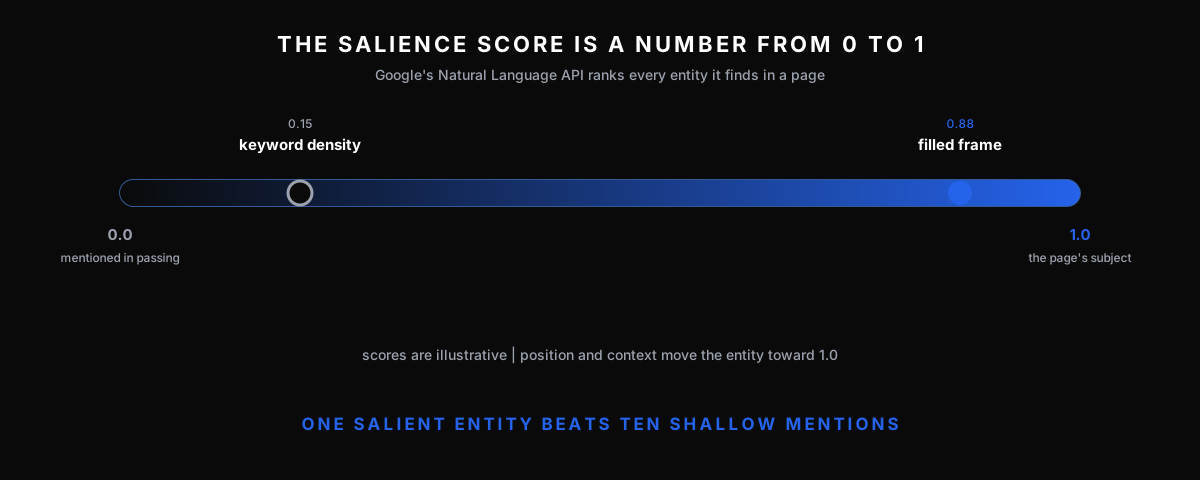
A salience score is an output of natural language processing, not a keyword count. Google's entity-salience research dates to 2014, and Google's Natural Language API returns a score for each salient entity in a text, ranking which one the content is most about. Koray Tuğberk Gübür teaches this as building entity salience within the knowledge graph, where related entities give the central entity its importance. The model underneath it predates any search engine.
What Is Frame Semantics?
Frame semantics is Charles Fillmore's theory that a word's meaning is understood only against a structured background frame of related roles. The verb "buy" evokes a commerce frame with a buyer, a seller, goods, and money. You cannot understand "buy" without the frame; the frame is the meaning.
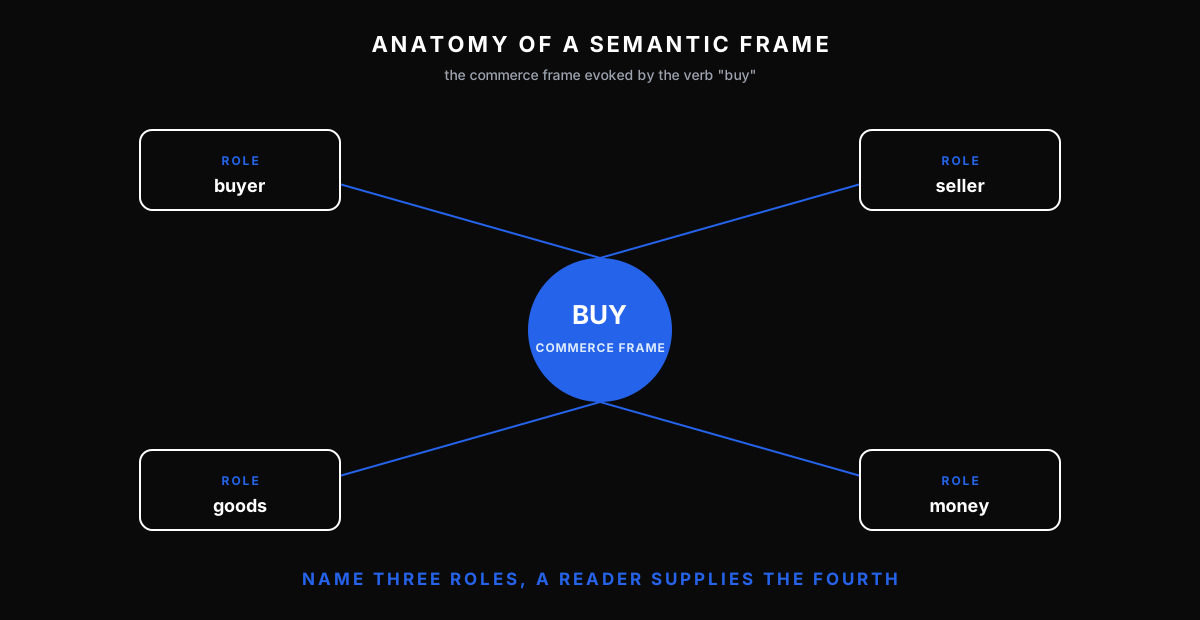
Fillmore developed frame semantics through the 1970s and 1980s, and it became FrameNet, the Berkeley project cataloguing English frames. A frame is a package of expected participants, so name three and a person supplies the fourth. This is Fillmore's frame semantics, not Erving Goffman's framing from sociology. It matters to search because a topic behaves like a word: it evokes a frame of expected content, and a reader notices when a slot is empty.
How Does Frame Semantics Explain Entity Salience?
Frame semantics explains entity salience because a topic has a frame, and a piece of content that fills the frame's slots reads as authoritative on the entity. Salience rises when the content answers the roles the frame expects. It does not rise when the page repeats the entity's name into an empty frame.
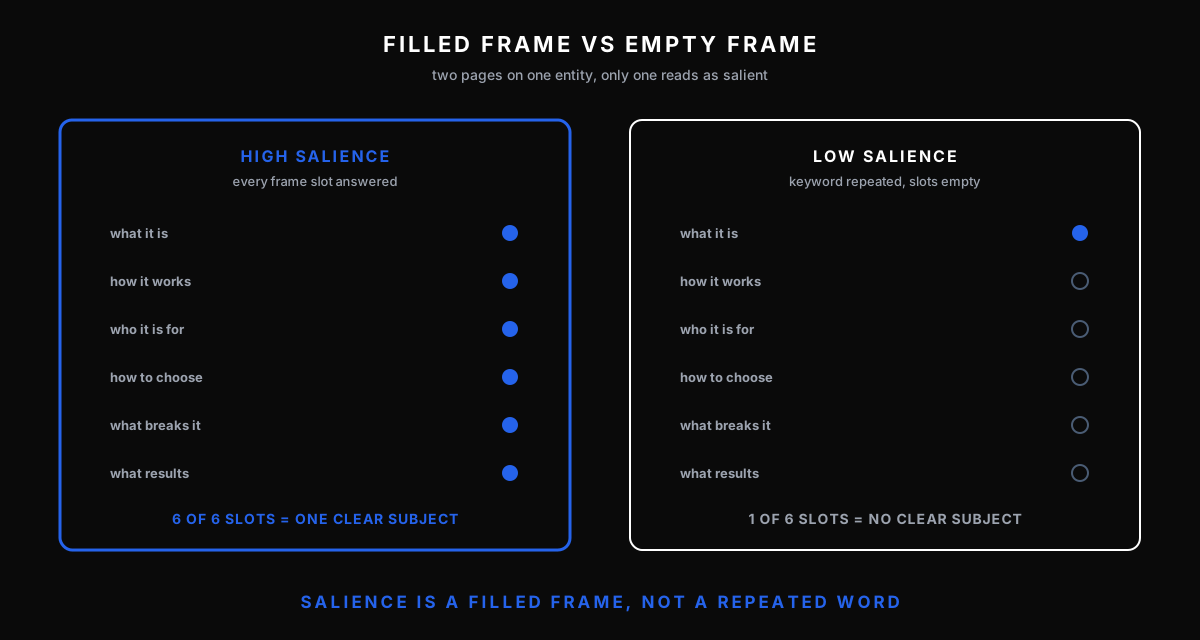
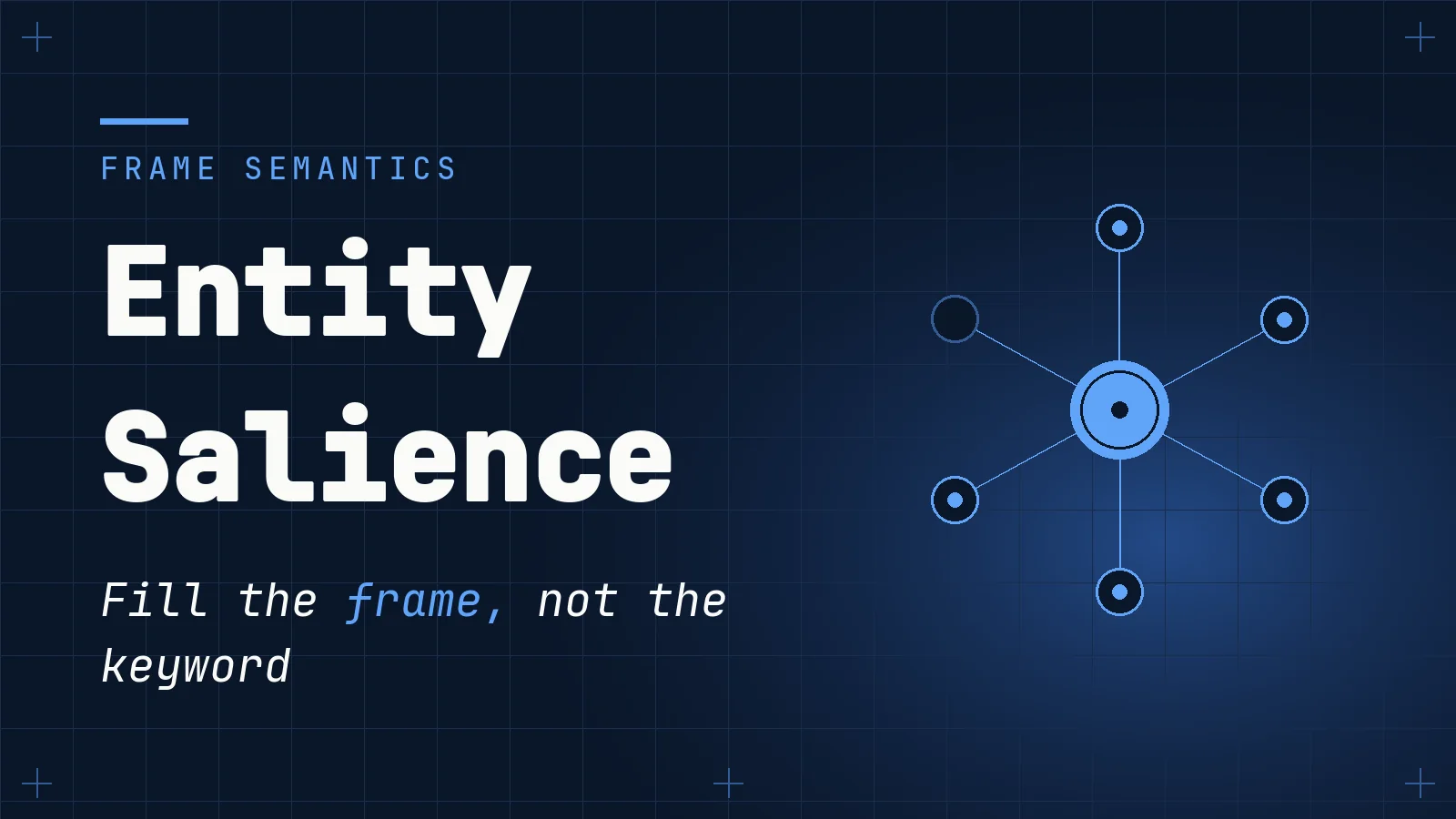
Every topic evokes a frame with six recurring slots: what it is, how it works, who it is for, how you choose it, what goes wrong, and what results it produces. Those frame elements map onto the six sections a strong page fills. A page that answers all six has filled the frame, and natural language processing reads it as a high salience score because there is nothing left to expect. This piece of content fills its own frame on purpose. Naming the frame is how the 14 lexical relations become a checklist: the frame's roles are the relations the entity participates in, the entities within its topic.
How Do Search Engines Score Entity Salience?
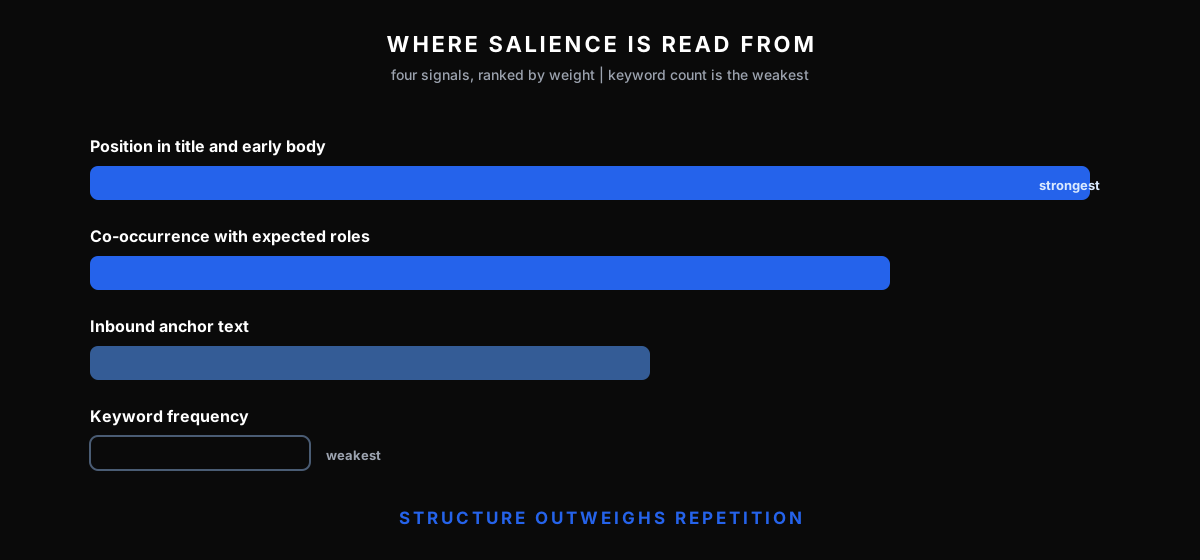
Search engines score entity salience from structural position and context: the entity in the title, early in the body, inside inbound anchors, and co-occurring with the words its frame expects. Keyword frequency is the weakest of these signals and the one operators over-index on.
Position is the first and strongest signal: an entity in the title outranks the same term in paragraph nine. Co-occurrence is next, and content that names prices, sellers, and goods proves its subject through company, not keywords. Inbound anchors carry salience from off the page, which is why the entity-attribute-value triplets you publish move it too. Relevance and importance are two different measurements, and the salience score is the second: it decides which pages reach the search results. You can measure it with the API Google uses.
How Do You Raise An Entity's Salience?
You raise an entity's salience by filling its topic frame, not by repeating its name. Put the entity in the title and opening, answer each of the frame's six roles, and earn internal links whose anchors name the entity. Fill the frame and salience follows.
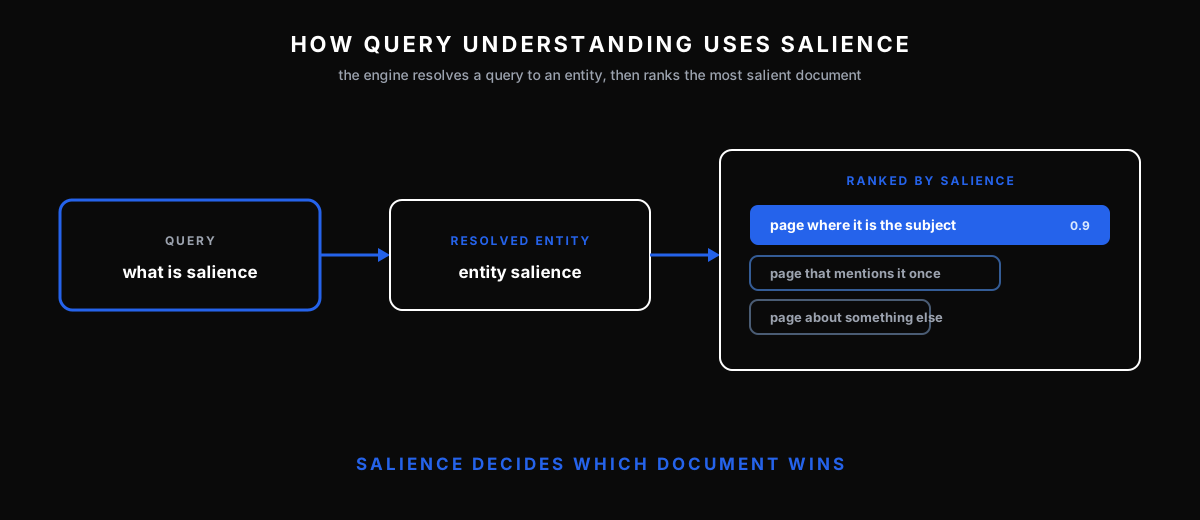
The counterintuitive part is that raising salience means writing about the entity's neighbours. A piece of content becomes more about "entity salience" when it names frame semantics, co-occurrence, and query understanding, because those related entities are the roles the frame expects. Done this way, search engine optimization improves the text for machines and readers at once, the aim of durable content marketing. To improve the salience score, name the frame's salient entities in place of the keyword, which works better than repetition and reads as genuinely expert. This is where salience compounds into topical authority: a network of pages, each salient for its own entity, is a website whose topics rank as authoritative.
What Lowers Entity Salience?
Entity salience drops when a page splits its focus across competing entities, leaves frame slots empty, or names its entity without the context its frame expects. Each failure sends the same signal: the search engine cannot identify what the page is most about, so no entity earns a high score.
Competing entities are the common case, where a page targeting two unrelated topics halves its salience for each. Empty frame slots are the quieter failure, where a page defines an entity but never mentions how it works. Thin co-occurrence is the third, where an entity named in isolation gives the parser a name and no specific concepts to confirm it. The fix is one move in reverse: one entity, a full frame, the right neighbours.
Who Needs To Think About Entity Salience?
Operators who decide what a page is about need entity salience: brief writers, content marketing leads, and anyone accountable for a page ranking. The skill is not lexicography. It is choosing one entity per page and refusing to dilute it.
I think about salience at brief level, where the damage is cheapest to prevent. A brief that names one entity and its frame roles produces salient pages by construction; a brief that lists five loose terms produces none. Frame semantics gives the brief writer a reason to refuse the sixth keyword, because it is how meaning actually works.
Is Frame Semantics The Same as Entity Salience?
No. Frame semantics is Fillmore's linguistic theory of how meaning works; entity salience is an SEO metric for how central an entity is to a page. Frame semantics is the mechanism. Entity salience is the score that mechanism produces when a search engine reads a document.
The two get confused because they describe one event from opposite ends. Frame semantics explains why a filled frame communicates a clear subject; entity salience is what the search engine records when it meets that frame. The through-line of my semantic SEO writing: meaning is structured, machines read the structure, and the operators who win build the structure the machine expects. When I want salience measured across a brand, that is what Semapoly does; when I want it executed at scale, that is what Mojo Links runs.
Frequently Asked Questions About Entity Salience
What Is An Example of Entity Salience?
A page titled "Entity Salience" that opens on the term, explains the concept, and collects internal links about it has high salience. A page that mentions it once inside an article about keyword density has low salience, despite the mention. Pages actually about the concept get mentioned as salient; a passing reference does not.
What Is a Semantic Frame?
A semantic frame is the structured background of roles a word evokes. The commerce frame, evoked by "buy" or "sell", expects a buyer, a seller, goods, and money. Understanding the word means knowing the frame, Fillmore's core claim.
How Is Entity Salience Measured?
Entity salience is measured by natural language processing tools as a score, often between 0 and 1. Google's Natural Language API returns salience scores for the salient entities it identifies, based on each entity's position, context, and co-occurrence in the text. Several third-party SEO tools use the same API.
Does Entity Salience Affect Rankings?
Yes. Entity salience decides which entity search engines read a page as being about, which sets the queries it is relevant for and its visibility. A page salient for the wrong entity competes weakly.
Who Created Frame Semantics?
Charles Fillmore created frame semantics through the 1970s and 1980s. It became FrameNet, a Berkeley project cataloguing English frames. Fillmore's frame semantics is distinct from Erving Goffman's framing in sociology.