Most operators read a backlink the way a credit score reads a number: higher is better, and the metric is the truth. I read it the opposite way. I have a background in linguistics and I have run SEO for 10 years, and the more I look at the standard authority model, the clearer its one structural limit becomes. A backlink graph can prove a link exists and is strong. It can never prove the link makes sense. That gap is not a measurement error you can tune away. It is built into what a graph is.
What Is a Backlink Graph?
A backlink graph is a data structure of nodes and edges: each page is a node, each link an edge between two nodes. It models how authority flows across the web. It is a topology, not a record of meaning.
The central entity of this post is the backlink graph, and its definition matters more than it looks. A node is a page. An edge is a link from one page to another. The graph stores which nodes exist and which edges connect them, plus a weight on each edge that stands in for strength. That is the whole object. It is the same abstraction Ahrefs, Majestic, and Google's link index are all built on, because it is the right shape for the one thing it does: tracking how authority moves.
What the structure does not contain is just as defining as what it does. The graph has no field for the topic of either page, no field for the words in the link, no field for why the link was placed. It is a map of connections with no map of meaning. Hold that distinction and most of the way the field talks about "strong" links starts to look like a category error: people read a topology and report it as a judgment about quality.
How Does a Backlink Graph Model Authority?
A backlink graph models authority with PageRank: authority flows along edges, so a node linked by many strong nodes inherits strength. The model counts and weights links. It never reads what the links say or why they were placed.
The mechanism is PageRank, the recursive algorithm Larry Page and Sergey Brin defined: a node's authority is a function of the authority of the nodes linking to it, propagated until the numbers settle. Authority flow is the verb that describes it. Strength pools at well-linked nodes and trickles outward along their edges. Google Search Central still describes links as a core signal a search engine uses for discovering and weighting pages, which is the production descendant of that original model.
Every operation in that mechanism is arithmetic over the topology. Count the edges into a node. Weight each by the source node's authority. Sum and propagate. Nowhere in that loop does the algorithm open the page, read the sentence the link sits in, or ask what the linking page is about. The mechanism is deliberately blind to language, because counting authority does not require reading meaning. That blindness is a feature for measuring flow and a defect the moment you read flow as quality.
What Can a Backlink Graph Not See?
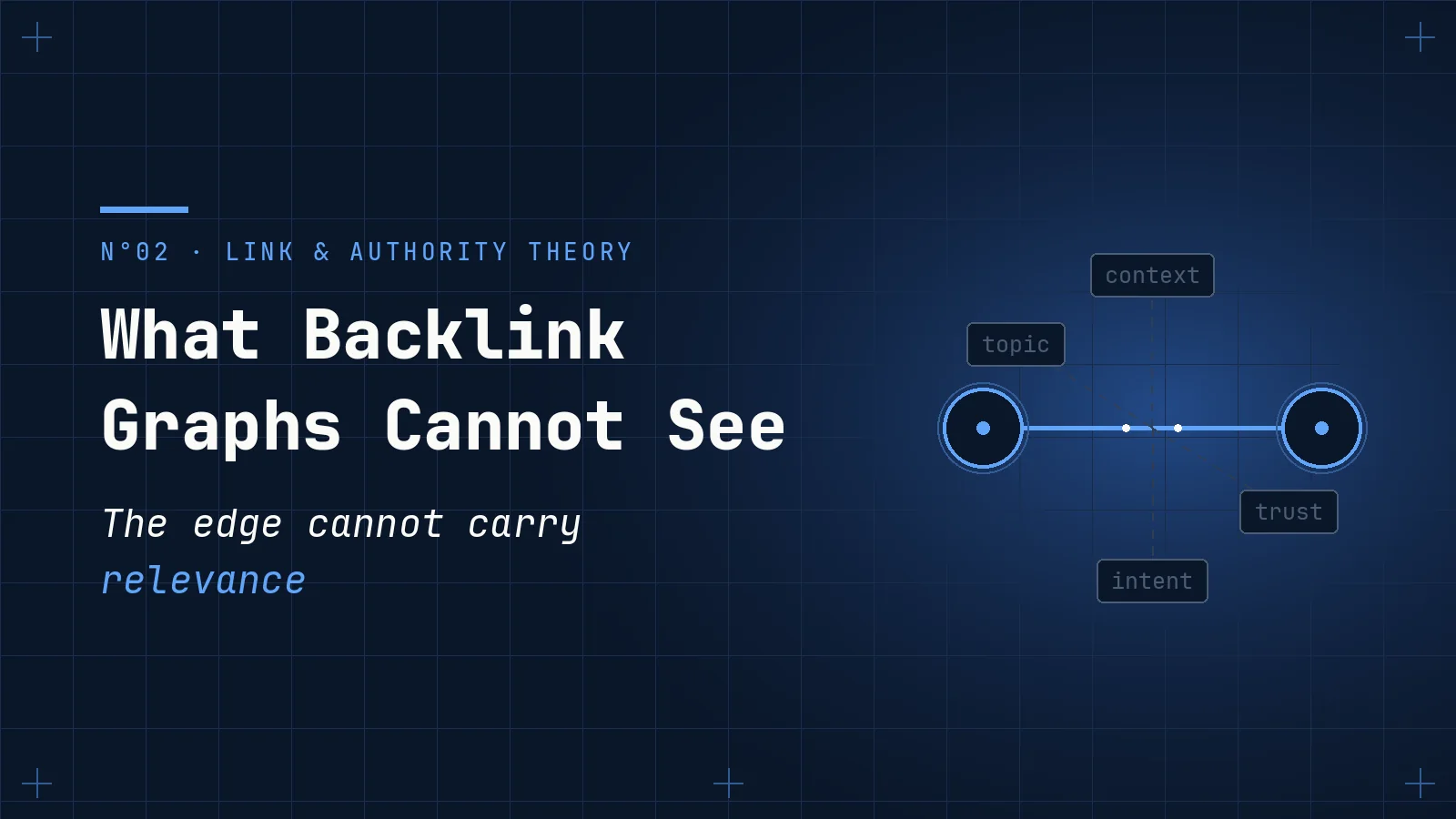
A backlink graph cannot see relevance. It records that page A links page B, but not the semantic distance between their topics, the meaning of the anchor text, the query intent the link serves, or the placement context. Relevance lives in language the graph does not store.
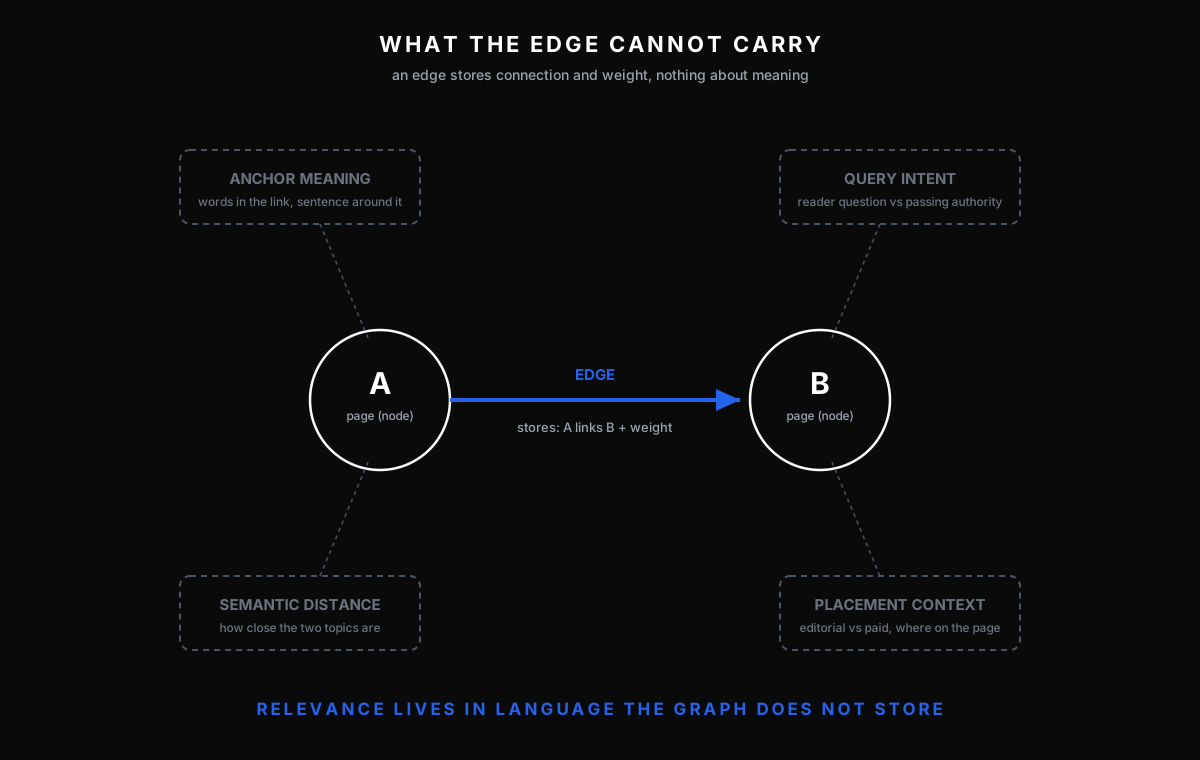
This is the information-gain core of the post, so I will name the four blind spots precisely. Each is a property of a link that decides whether the link is relevant, and each is structurally absent from the edge. The edge knows that A points to B and how strong the pointer is. It knows nothing of the four things below, because none of them is a number you can attach to a connection. They are linguistic and contextual facts, and a topology has no slot for them.
Does The Edge Carry The Anchor Text's Meaning?
The edge does not carry the anchor text's meaning. An edge stores that a link exists and its weight, not the words inside it or the sentence around it. The first blind spot is anchor and surrounding-text meaning: the edge is mute. This is exactly why I read anchor text as a topical signal rather than a string the graph counts. The anchor is the edge's missing language, the one place a link declares what it is about, and the graph throws it away the moment it reduces the link to an edge with a weight.
The second blind spot is semantic distance. A link from a page about espresso machines to a page about espresso beans is topically close; a link from a payday-loan page to the same coffee page is topically far. That distance is the whole of whether the link is on-topic, and it is a property of two bodies of text, which is to say a measure of semantic similarity between source and target. The graph stores neither text, so it cannot compute the distance. Both links are identical edges to it.
Can Topology Tell An Editorial Link from a Paid One?
Topology cannot tell an editorial link from a paid one. Both are edges of the same shape; the difference lives in placement and intent, not in the connection. The third blind spot is query intent: a link placed to answer a real reader question serves a different purpose than one placed to pass authority, and the edge encodes neither purpose. The fourth is context: an editorial link versus a paid one, the co-citation neighborhood, where on the page the link sits. All four are facts about the link's reason for existing, and a graph that stores only connection and weight has nowhere to put a reason.
Who Is Misled by Reading The Graph Alone?
Operators who read Domain Rating as a quality proxy are misled. Treating a high-DR edge as a good link assumes topology equals relevance. The graph says the link exists and is strong; it cannot say the link makes sense for the page.
The user slot here is specific: the operator who scans a link profile, sorts by Ahrefs Domain Rating, and concludes the high-DR links are the good ones. I have done this. Most people who buy or audit links do it, because the metric is right there and reading the four blind spots is slower than reading a number. The mistake is not using Domain Rating. The mistake is treating a topology score as a relevance score, when the graph it summarizes was never able to see relevance in the first place.
The split is between two questions that look like one. "Is this link strong?" is a graph question, and Domain Rating answers it honestly. "Does this link make sense for my page?" is a relevance question, and the graph has no answer, because it never stored the language that would let it judge. The operator who conflates the two reads a confident number off a structure that is silent on the thing they actually care about.
Why Do Authority Metrics Like Domain Rating Mislead?
Domain Rating misleads because it scores topology, not meaning. Two graphs with identical nodes and edges score identically, even if one link is editorially on-topic and the other irrelevant. DR counts authority flow; it cannot read whether a link belongs.
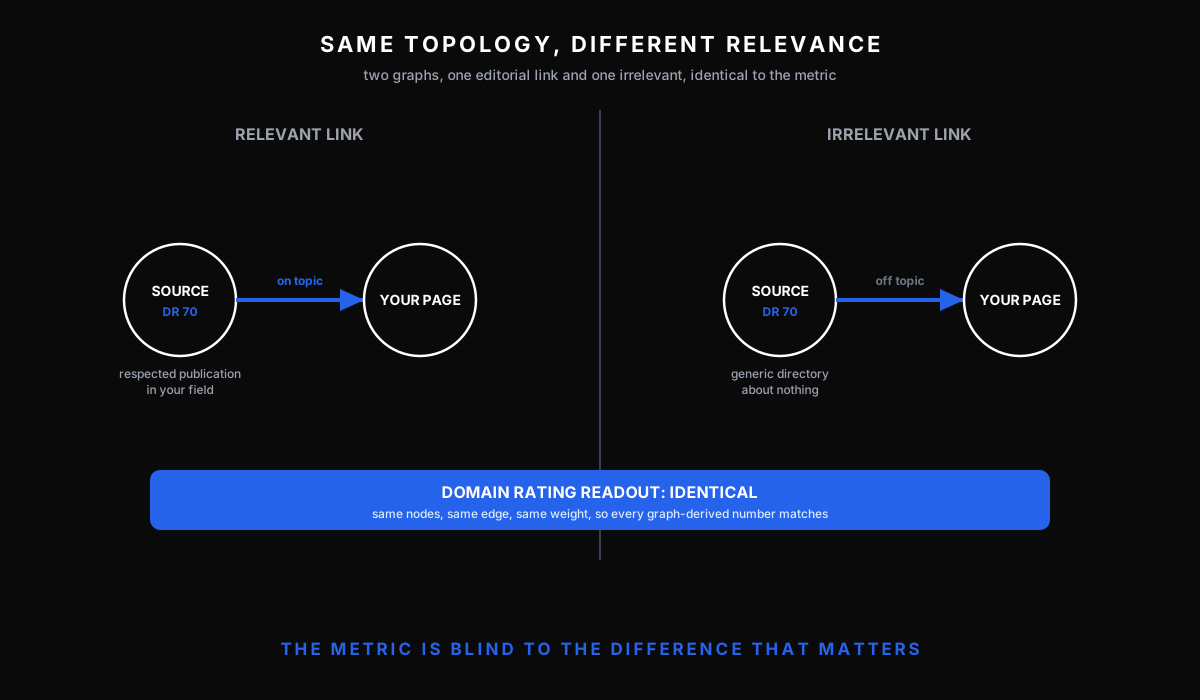
The problems slot is where this post earns its place, because the SERP is full of pages saying relevance matters and empty of pages saying why the standard metric cannot see it. Here is the mechanism of the failure, stated plainly: Domain Rating is a function of the graph, and the graph is identical for two links that differ only in relevance, so Domain Rating is identical for them too. A relevant link and an irrelevant one with the same source authority are the same edge. The metric cannot separate what the structure never distinguished.
Why Do Two Identical-Topology Graphs Score The Same on DR?
Two identical-topology graphs score the same on DR because DR reads only topology. If the nodes and edges match, every graph-derived number matches, regardless of meaning. Picture two links into my page, both from DR-70 sources, both single edges of equal weight. One source is a respected publication in my field; the other is a generic directory about nothing. To Domain Rating they are interchangeable, because the only thing that differs is the topic of the source page, and topic is precisely the field the graph does not have. The number is honest about flow and silent about fit.
What Does DR Actually Count?
Domain Rating counts the size and strength of a domain's backlink topology. It is a 0-to-100 log-scaled summary of how much link authority flows to a domain, per Ahrefs' own definition. That is a useful number and a real one. What it is not is a measure of whether any given link belongs, because it is computed entirely from the graph, and the graph holds no relevance. Reading Domain Rating as link quality is reading a flow statistic as a meaning statistic.
What Does Adding The Relevance Layer Give You?
Adding the relevance layer gives you judgment: whether a link makes sense, not just whether it exists and carries authority. You stop reading Domain Rating as quality and start reading semantic distance, anchor meaning, intent, and context, the four things the graph omits.
The outcomes slot is a capability, not a number. Once I read the four blind spots as the actual signal, I can explain why a low-DR link from a deeply relevant page moved a ranking while a high-DR link from an unrelated site did nothing. The graph could not have predicted either result, because both differences live in the layer it cannot store. The relevance layer is what I mean by link relevance: the linguistic and contextual reading of a link that the topology leaves out, sitting on top of the authority the topology measures.
I want to be exact about what this is and is not. It is not a replacement for the graph. Authority flow is real and Domain Rating measures it well. The relevance layer is the complement: the meaning reading that turns "this link is strong" into "this is a relevant backlink and it belongs." I built Mojo Links to handle the acquisition side, the work of earning links that pass both tests, but the reading rule sits upstream of any campaign. You judge a link by whether it makes sense first, and read its strength second.
Graph Topology vs The Relevance Layer: What Is The Difference?
Graph topology is the structure of connections; the relevance layer is the meaning of each connection. Topology is a property of the graph; relevance is a property of language. One is countable, the other has to be read.
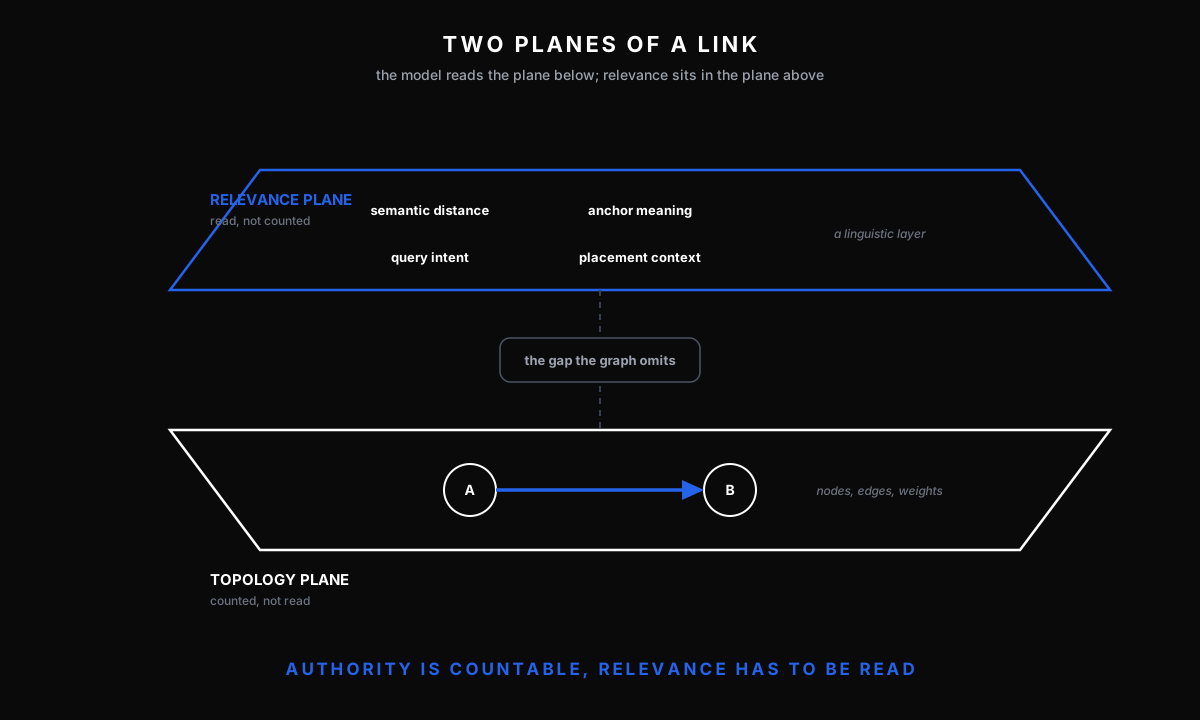
The disambiguation matters because the two are different kinds of thing, not two metrics on the same axis. Topology is combinatorial: nodes, edges, weights, paths. You can store it in a table and compute over it forever. Relevance is linguistic: it lives in the topics of two pages, the words of the anchor, the intent behind the placement, the company the link keeps. You cannot derive it from the connection alone, no matter how much compute you throw at the topology, because the inputs are not in the graph.
Why Is Relevance a Linguistic Property, Not a Graph Property?
Relevance is a linguistic property because it is defined by meaning, and meaning lives in text, not in connections. Whether a link is relevant depends on what the two pages are about, which is a fact about their language. This is the methodology I work in, the semantic SEO and topical authority framework developed by Koray Tuğberk Gübür, where a link is read as a statement about meaning. A graph property is anything you can compute from nodes and edges. A linguistic property is anything you have to read the words to know. Relevance is firmly the second kind, which is why no enrichment of the topology will ever surface it. The words have to enter the model from outside the graph.
How Should An Operator Read a Link, Then?
An operator should ask one question of a link: does this make sense? That single question forces the four blind spots into view, where Domain Rating alone hides them. It is a reading discipline, not a checklist or an audit procedure.
I am deliberately not turning this into steps, because the value is in the question, not in a workflow. When I look at a link I ask whether the source page is genuinely about my subject, whether the anchor and the sentence around it describe my page honestly, whether the link is there to help a reader or to pass authority, and whether the placement and neighborhood fit. Those are the four blind spots restated as one judgment. If the answers are yes, the link makes sense, and its Domain Rating tells me how much strength that sensible link carries. If the answers are no, a high Domain Rating is a strong pointer to nothing.
That is the whole reframe. The graph tells me a link is strong. The reading tells me whether strength is pointed at something that belongs. Reading the link as a piece of language first, and a piece of topology second, is the difference between auditing a number and exercising judgment. The execution of earning those links is its own job, and it is the operational lane; the reading rule is the thinking that has to come before it.
Frequently Asked Questions About Backlink Graphs and Relevance
What Is a Backlink Graph in One Sentence?
A backlink graph is a data structure of nodes and edges where each page is a node and each link is an edge, used to model how authority flows across the web. It is a topology of connections, not a record of what those connections mean.
Can a Backlink Graph Measure Relevance?
No. A backlink graph stores connections and weights, not language, so it cannot measure relevance. Relevance depends on the topics of two pages, the anchor's meaning, the intent behind the link, and the placement context, none of which is a property of the graph. The graph proves a link exists; it cannot prove the link makes sense.
Does Domain Rating Measure Link Relevance?
No. Domain Rating measures the size and strength of a domain's backlink topology, which is authority flow, not relevance. Two links from equally strong sources score the same on Domain Rating even if one is on-topic and the other is irrelevant, because the metric reads the graph, and the graph holds no relevance.
Is a High-DR Link Always a Good Link?
No. A high Domain Rating confirms the source has strong authority, not that the link makes sense for your page. A high-DR link from an unrelated site is a strong pointer to something irrelevant. The right question is whether the link is relevant first, and how strong it is second, never strength alone.