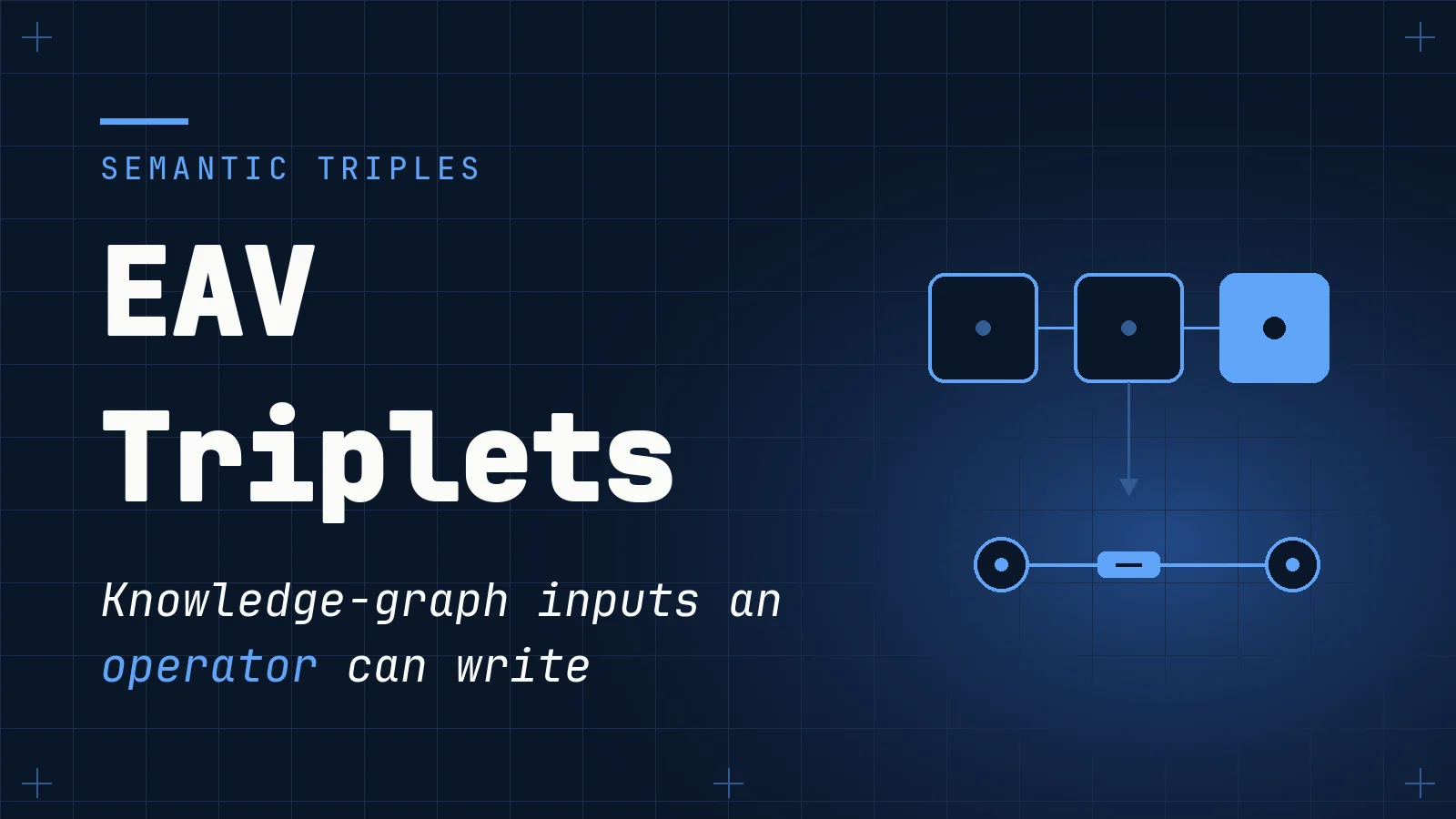
EAV triplets are the smallest unit of meaning I write for. One entity, one attribute, one specific filler: "WordNet contains 117,000 synsets" is a complete triplet, and a machine can lift it whole. I trained as a linguist, I specify triplets in every brief, and this post explains the unit itself: what it is, how knowledge graphs consume it, and why it decides which pages earn topical authority and better visibility in semantic search.
The term needs care, because the "entity attribute value" you find on the web is usually a database storage pattern with a bad reputation. That sense and mine share a name and nothing else, so the difference gets its own section near the end.
What Is An EAV Triplet?
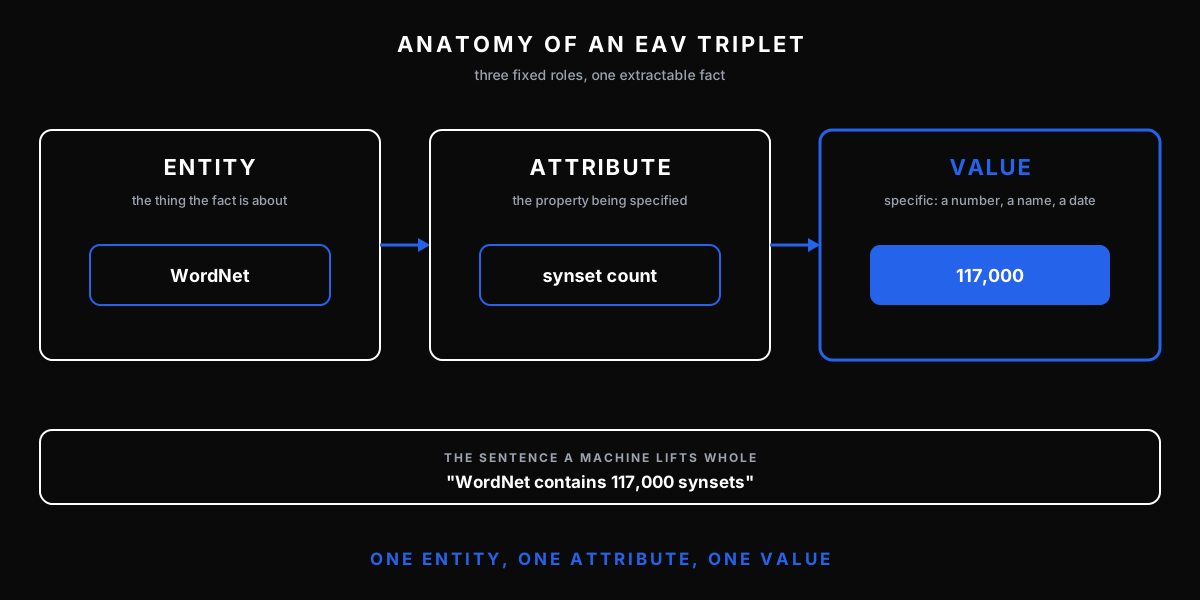
An EAV triplet is a 3-part factual statement: one entity, one attribute of that entity, and the specific filler the attribute takes. "Semapoly tracks AI citations" names an entity, an attribute (function), and a filler. A page built from explicit triplets hands search engines extractable, machine readable facts instead of prose to decode.
What Are The Three Components?
The three components carry fixed roles. The entity is the thing the fact is about, named without ambiguity. The attribute is the property being specified: a function, a count, a date, a price, a part. The third component is the specific content of that property: a number, a name, an identifier.
Specificity is the whole point. "The tool is fast" fails as a triplet because "fast" specifies nothing. "The crawler processes 200 URLs per minute" succeeds, because a machine can store 200 as the filler of a named attribute. Basic as the rule sounds, most pages on any website break it in every second paragraph.
Koray Tuğberk Gübür teaches entity-attribute-value modeling as the backbone of content configuration in semantic SEO, and my linguistics training reads the same structure as predication: natural language has always worked by attaching properties to subjects. I specify 8 to 12 explicit triplets for the central entity of every post I brief. That density is my house rule, and it exists because a machine that finds fewer treats the entity description as incomplete.
What Are Semantic Triples?
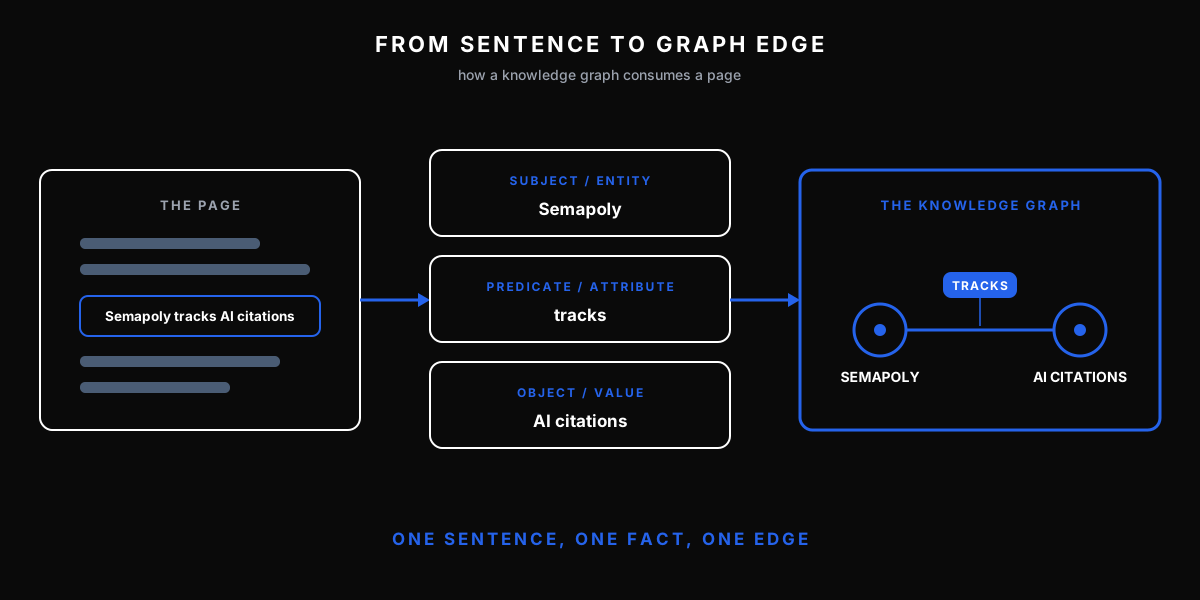
Semantic triples are the subject predicate object statements knowledge graphs are made of. Each semantic triple is one labeled edge: the two ends are nodes, and the connector between them carries the label. Together, the stored triples provide everything the retrieval systems of modern SEO know.
What Is The Subject Predicate Object Format?
The subject predicate object format is the sentence pattern of information in a graph. My "WordNet contains 117,000 synsets" reads as subject WordNet, connector contains, object 117,000 synsets. Entity maps to subject, attribute maps to the predicate and object pair's first half, filler to its second.
Wikidata stores its semantic triples as more than 100 million items in exactly this format, and Google announced its Knowledge Graph in 2012 with the phrase "things, not strings": a declaration that search engines had moved from matching text to storing structured data about entities, their relationships, and the relationship types between them.
What Is RDF?
RDF, the Resource Description Framework, is the W3C's machine readable format for triples, standardized in 1999 as a foundation of the semantic web. An RDF triple names each resource with an identifier, which is what lets structured data from different websites merge. SPARQL, the query language of the semantic web, asks questions across those merged triples, and retrieval models consume the same structured information based on the same format.
The notation matters less than the discipline. RDF is a serialization; the triplet is a way of deciding what a sentence is for. Prose that respects the triple is prose a parser can eat, and the framework is the same whether the consumer is Google, Wikidata, or the models behind AI search. For this discipline, that shared foundation is the point: one writing rule serves every consumer in the format they all parse.
How Do Knowledge Graphs Consume Triples?
Knowledge graphs consume a page by extracting its semantic triples: they resolve the entities, type the connection, and store the fact as a labeled edge. Clear declarative sentences lower the cost of that extraction. Vague sentences never become edges at all.
Entity Resolution
Entity resolution decides which node the words point at. "The framework" resolves to nothing; "RDF" resolves to one node. This is why context qualifiers and consistent naming improve extraction: search engines that cannot resolve your subject store nothing, however good the rest of the information is. Consistent naming is basic SEO hygiene restated as information architecture.
Predicate Typing
Predicate typing classifies the connection: contains, costs, launched, measures. Precise verbs help the classifier; contextless verbs like "handles" defeat it. The typed connection is the same machinery I described in the 14 lexical relations: graph edges carry names, and a triple is how a new named edge gets in.
Storage as An Edge
Storage writes the fact as an edge between two nodes, and from that moment the fact answers queries the page never saw. This is knowledge representation working in your favor: the store holds the relationship, not the string, so the fact surfaces for semantic search queries phrased in words the page never used. Better retrieval follows from better structured input; the systems reward the page that supplied the edge.
Answer engines run the same extraction with a different output. When ChatGPT or Google's AI Overview cites a source, it cites the page whose sentence carried the fact in liftable form. A triplet-dense page is a quotable page, and search engines prefer cheap extraction for the same reason: a parser that reconstructs a fact from 3 hedged sentences pays more than one that reads a single declarative sentence. The same information, structured, wins in both systems.
What Does An EAV Triplet Look Like in Prose?
An EAV triplet in prose is one declarative sentence carrying one fact, with the entity up front. The sentence "Semapoly tracks citation share across ChatGPT, Perplexity, and Google AI Overviews" is extracted in one pass. Nothing about the format is technical; it is a writing decision.
The Subject Leads
The subject leads because parsers weight early tokens. "Semapoly tracks..." beats "Citations are tracked by...". Active word order keeps a complex sentence parseable, and it serves the skimming reader for the same reason it serves the parser: the topic arrives first, the commentary after. Natural language allows a better word order than most writers pick; a triplet is choosing the better one on purpose.
The Connector Is Precise
The connector is precise: tracks, contains, costs, launched, not "handles" or "deals with". Precise verbs are context in miniature. They tell a search engine which frame the fact belongs to, which is half of understanding the fact at all, and they improve the odds that the stored edge carries the meaning you intended.
The Filler Is Specific
The filler is specific: a count, a name, a date, not "a lot" or "recently". I write the fact first and the commentary second, because a machine lifts the first sentence of a passage far more readily than the third.
The discipline pays twice. The sentence a graph extracts cleanly is the sentence a reader parses fastest, so extraction and readability improve together. The 40-word answers under every heading of this post are the rule applied to itself, and the relationship between the two audiences is not a trade-off; it is the same requirement stated twice.
Why Do Triplets Decide Topical Authority?
Triplets decide topical authority because attribute coverage is the completeness test of a page. An entity has a finite set of attributes worth specifying: parts, functions, costs, dates, contrasts. The page that fills those slots with structured facts describes the entity; the page that gestures at them does not.
The Attribute Checklist
The attribute checklist is part-whole structure, which is why I called the triplet "holonymy written as a data structure" in the lexical relations post. Walk an entity's parts and properties and you have the outline of a complete page. Leave attributes empty and the parser reading your page registers the holes, which is a completeness signal search engines read at scale across a website.
Topical authority compounds the same test across a website: coverage of a topic's entities and relationships, each entity covered through its attributes, each attribute specified. A product page states its price and unit; a methodology page states its sources and dates; the relevant test is identical.
What GSC Shows
My own Google Search Console keeps demonstrating the effect. Within 90 days of publishing, my semantic similarity post surfaced at position 6 for a query the page never used: "semantically equivalent but lexically different relations". The page earned that retrieval by covering the attribute space of its entity, not by targeting the string.
Facts stored as edges answer questions the page never anticipated. That is what a knowledge-graph input buys, and it is the most durable performance gain I know in SEO: rankings follow understanding, and understanding is built from extractable, structured facts, better ones than the competition supplies. SEO based on that foundation compounds instead of churning.
What Goes Wrong Without Explicit Triplets?
Pages without explicit triplets fail in 3 measurable ways: facts too vague to extract, entities described with holes, and zero presence where machines cite sources. Each failure traces back to sentences that carry impressions instead of specifics.

Vague Fillers
"Many synsets", "fast processing", "affordable plans": each phrase occupies the filler slot and specifies nothing, so no edge forms. The information a reader half-infers from tone, a parser does not infer at all; the language of impressions is invisible to extraction.
Attribute Holes
A page about a tool that never states its price, launch year, or measurement unit leaves attribute slots empty, and completeness scoring registers the gaps. The fix helps the reader as much as the parser: filling holes with structured data is what makes a page the last stop for its question, and a better answer than the search engine held before.
Invisibility in AI Search
An answer engine assembling a cited response quotes the page that carried the fact in extractable shape. A page of unextractable prose does not exist for that query, whatever its SEO history. The diagnosis is mechanical: take the entity, list its attributes, and check which ones your page specifies. Empty slots are the to-do list, and closing them is the fastest way to improve citation odds I have measured in any SEO engagement.
Who Needs To Model Triplets?
Operators who write or brief content need triplet modeling: brief writers, editorial leads, and anyone accountable for a page earning citations. The skill is not ontology engineering. The skill is deciding, per sentence, which fact the sentence exists to state.
I model triplets at brief level, not at draft level. A brief that lists the central entity and 8 to 12 attribute-filler pairs writes most of the page's spine before a writer types a word, and the writer's craft goes into the connective tissue where it belongs. Writers without the brief default to narrative; narrative reads well and extracts badly.
The division of labor is the fix, and understanding it changed how I run engagements: the same split serves my own posts, Mojo Links client briefs, and the audit logic I built into Semapoly. Semantic SEO gets sold as complex; modeled at the brief level, it is a checklist with a linguist's reasons, and it helps every website that adopts it, from a product catalog to a methodology blog like this one.
Is This The Same EAV as The Database Model?
No. The database EAV model is a storage pattern that keeps rows of entity-attribute-value instead of fixed columns, and database engineers widely criticize it as an anti-pattern. The content EAV triplet is a writing unit: one extractable fact per sentence. Same 3 letters, different sense.
The database sense dominates the search results for the phrase: Wikipedia's article describes the storage pattern, and the PostgreSQL threads debating it are debating schema design, not content. That criticism is real and irrelevant here. A table with generic columns trades integrity for flexibility, which is a database concern; a sentence with explicit slots trades nothing.
The collision of senses is polysemy doing what polysemy does: one label, related meanings, split search results across the web. I disambiguate by qualifying the domain every time it matters: the database EAV model for storage, the EAV triplet for content. A reader landing here from either sense knows within one paragraph which page this is, and the disambiguation itself improves how machines resolve the entity in context.
Frequently Asked Questions About EAV Triplets
What Is An Example of a Semantic Triple?
"Google announced the Knowledge Graph in 2012" is a semantic triple: subject Google, connector announced, object the Knowledge Graph, with 2012 qualifying the statement. Any complete factual sentence with a clear subject and object forms one.
Are EAV Triplets and RDF Triples The Same Thing?
They are the same structure in two notations. Entity maps to subject, attribute to the connection, filler to object. An RDF triple is the W3C serialization exchanged across the semantic web; the EAV triplet is the same fact expressed as a writing unit inside prose.
How Many Triplets Does a Page Need?
I specify 8 to 12 explicit triplets for the central entity of a post. The number is my house rule, not a standard: enough to fill the entity's core attribute slots, few enough that every one stays specific and verifiable.
Do LLMs and Answer Engines Read Triplets?
Yes. Extraction systems parse declarative sentences into stored facts, and answer engines cite the pages whose sentences carry facts in liftable shape. A triplet-dense page gives the model a clean quote; hedged prose gives it nothing.
Is EAV a Database Anti-Pattern?
The database EAV storage model attracts that criticism, and the debate belongs to schema design. The content EAV triplet shares the name only. Writing one explicit fact per sentence has no integrity cost; it is the cheapest gift a page can offer a search engine.