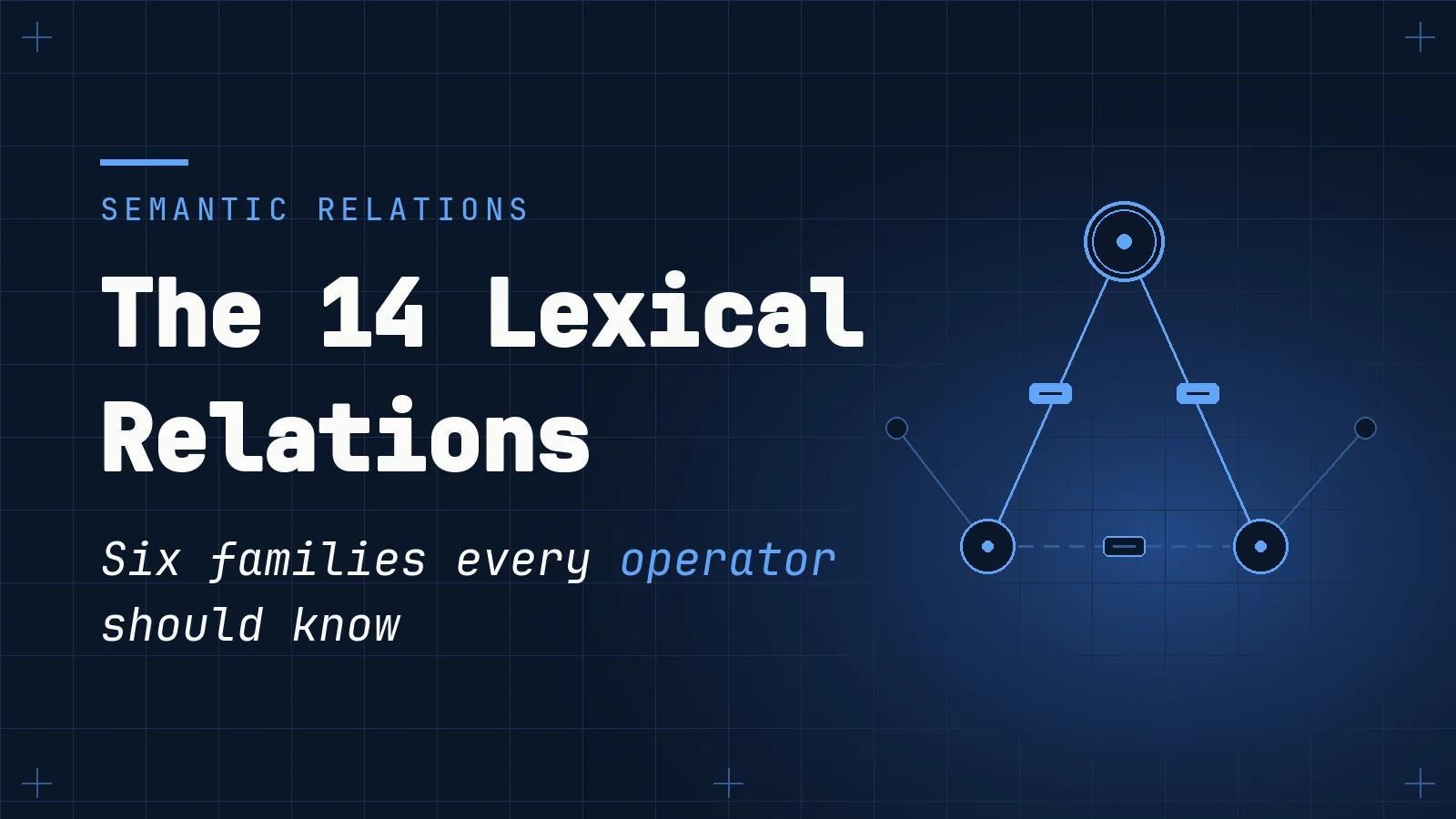
Semantic relations are typed, meaning-based connections between words or entities, and they are the level of language I trained in before I ever opened a crawler. Synonymy, antonymy, meronymy: each name refers to a distinct way two meanings connect. I count 14 lexical relations worth an operator's attention, grouped into 6 families, and every page decision I make touches at least one of them.
The industry talks about semantic SEO daily and almost never names the machinery underneath it. I studied these connections as a linguist and apply them as an operator, and the gap between the two readings is exactly where strategies fail. This post is the taxonomy: each of the 14 defined, one example each, and the search decision it drives.
What Is a Semantic Relationship?
A semantic relationship is a typed, meaning-based connection between two words or entities, such as synonymy, antonymy, or meronymy. Each connection names how two meanings relate, not how strongly. Search engines store these ties as edges in lexical databases and graphs of entities, and they lean on those edges every time they interpret a query.
Linguistics gives the connections two names. Viewed at the word level, between word forms, they are lexical: rose ties to flower. Viewed at the concept level, the tie is conceptual: ROSE connects to FLOWER as entities in a graph. The tradition goes back to the linguistic sign, a form paired with a sense, and both readings treat that sense as a bundle of features. John Lyons formalized the inventory in Semantics, his 1977 study of meaning in language, and D. A. Cruse expanded it in Lexical Semantics in 1986. I use both readings in this post because search engines operate on both levels at once: strings in queries, entities in graphs.
Semantic relationships are the working layer of meaning-driven search. EAV triplets, topical maps, anchor plans: each of those artifacts is one or more of the 14 put into practice. An operator who can name the connection can check the decision. An operator who cannot is guessing with good instincts.
What Are The 14 Lexical Relations?
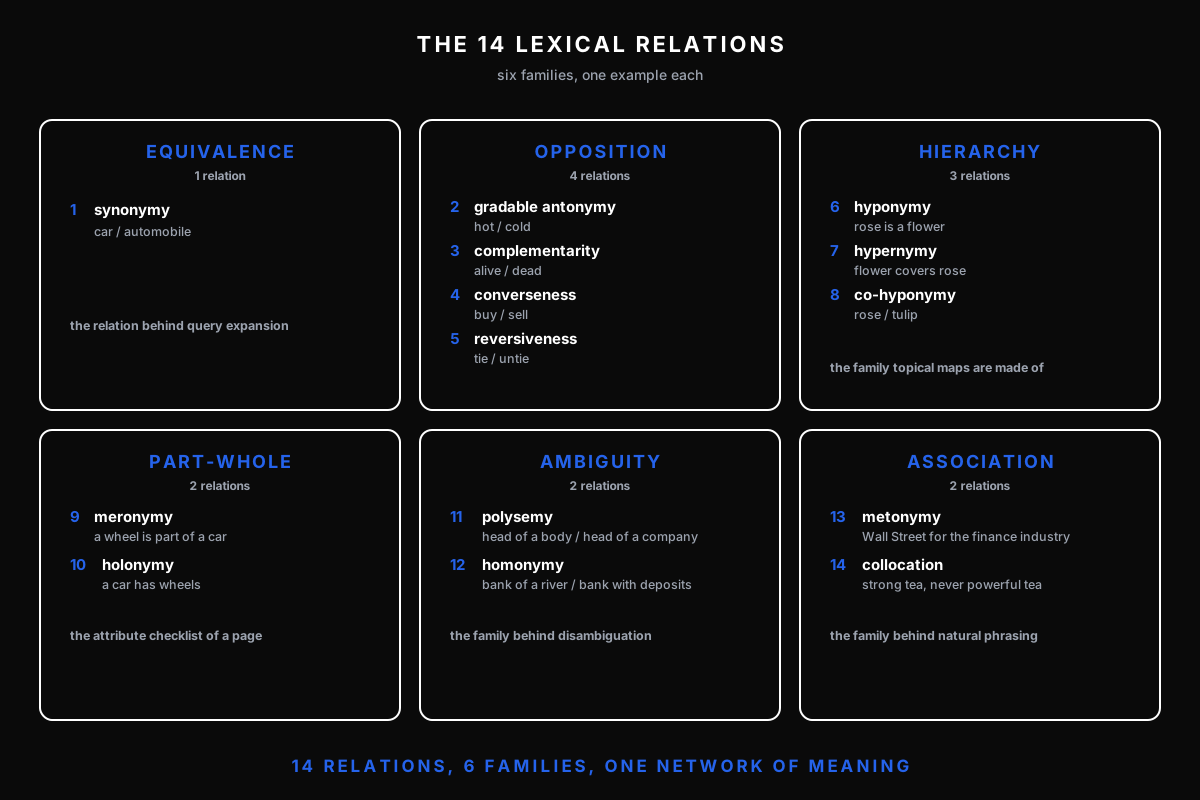
The 14 lexical relations group into six families: equivalence, opposition, hierarchy, part-whole, ambiguity, and association. The cut is mine. It condenses the inventories in D. A. Cruse's Lexical Semantics and Princeton's WordNet into the connections an SEO operator actually uses when designing pages.
Which Family Expresses Equivalence?
Equivalence holds one member: synonymy (1), where different word forms share a meaning, as in car and automobile. Absolute sameness is rare; register and speech situation almost always differ, which is why purchase appears in contracts and buy appears in queries. This family powers query expansion, and it is what an anchor plan varies on purpose. Two pages targeting semantically equivalent phrases are one page written twice.
Which Family Expresses Opposition?
Opposition holds four members. Gradable antonymy (2) opposes points on a scale: hot and cold. Complementarity (3) opposes non-gradable, binary states: alive and dead. Converseness (4) describes one event from opposite viewpoints: buy and sell, where each side is the agent of its own verb, and the agent switches when the verb does. Reversiveness (5) pairs an action with its undoing: tie and untie. Opposition drives comparison pages. Cover an attribute without its opposite and the coverage reads incomplete; take the converse pair buy and sell and you have two audiences for one transaction, each searching from its own side.
Which Family Builds Hierarchy?
Hierarchy holds three members. Hyponymy (6) points from specific to general: a dog is an animal, a rose is a flower. Hypernymy (7) is the same edge read downward: the less specific term covers the narrow one. Co-hyponymy (8) links sibling concepts under one parent: rose and tulip. Hierarchy is what a topical map is made of. The pillar is the parent, the spokes are its children, and siblings are the test for page count: co-hyponyms earn separate pages, not one blended page that serves neither.
Which Family Connects Parts and Wholes?
Part-whole holds two members. Meronymy (9) points from the part to its containing object: wheel to car. Holonymy (10) is the reverse reading: a car has wheels. This family is behind attribute coverage. An entity's meronyms and attributes are the checklist a complete page answers, which is why I specify entity-attribute-value triplets in every brief: the triplet is holonymy written as a data structure.
Which Family Creates Ambiguity?
Ambiguity holds two members. Polysemy (11) is one word form with multiple related senses: head of a body, head of a company. Homonymy (12) is one spelling with unrelated senses: bank of a river, bank holding deposits. Ambiguity is the family behind disambiguation. An ambiguous head term splits its SERP across senses, and the page that wins commits to a single sense in the title, the opening, and the anchors pointing at it.
Which Family Works by Association?
Association holds two members. Metonymy (13) substitutes something associated for the thing itself: Wall Street for the finance industry. Collocation (14) is habitual co-occurrence: strong tea, never powerful tea. Association is the family behind natural phrasing. Queries use metonymy constantly, a brand name standing for its product, and collocation is why machine-written prose reads wrong: the words are correct and the co-occurrence habits of the language are not.
How Do Search Engines Use Lexical Relations?
Search engines use lexical relations to expand queries, resolve entities, and score passages for information retrieval. Lexical databases in the WordNet tradition store the connections as typed pointers between synonym sets. Knowledge graphs store them as labeled edges: subject, predicate, and object. A query about a parent concept retrieves documents about its children because the edge between them is explicit.
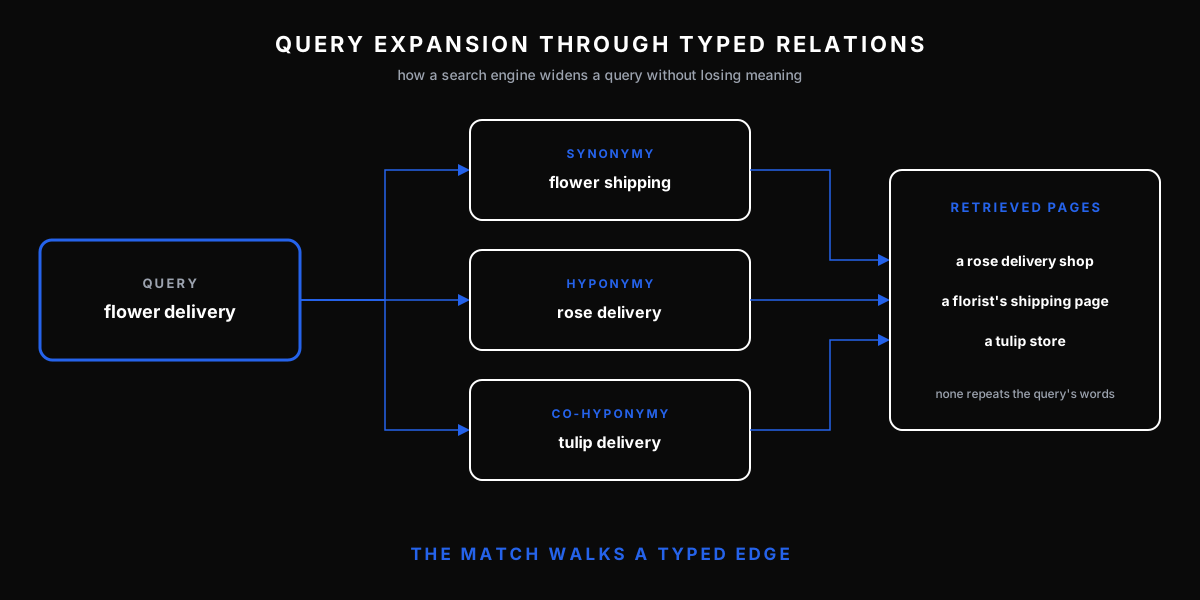
The infrastructure is documented, not speculative. Princeton's WordNet groups the English language into more than 117,000 synonym sets covering every major part of speech, linked by the same connections this taxonomy describes. Google described its synonym system publicly as early as 2010, and its knowledge graph stores how one thing refers to another as typed edges. When a search engine matches a query for flower delivery to a page about roses, that match walks a hierarchy edge. The same machinery reads phrases, not just single words: less expensive flights and cheap flights resolve to the same intent because the meanings sit close, not because the sentences repeat strings.
I watch this in my own Google Search Console. Within 90 days of publishing my previous post on graded similarity, GSC recorded it surfacing at position 6 for the query semantically equivalent but lexically different relations, a phrase I never targeted. The retrieval system mapped the page to typed-connection vocabulary because the page covers the connections themselves. Coverage of the meaning network is what gets a page retrieved for queries it never used.
Why Does The Taxonomy Matter for An SEO Operator?
The taxonomy matters because the core artifacts of this discipline are the 14 connections made operational. A topical map is applied hierarchy. An anchor plan is controlled equivalence. Attribute coverage is meronymy. Naming the connection turns each intuition into a decision another operator can check.
The practical difference shows up in briefs. When I expand a brief, I am not brainstorming subtopics; I am walking edges. Child concepts of the central entity become sections or sibling pages. Parts and attributes become the completeness checklist. Synonyms become the surface forms the main content must carry and the anchors allowed to point at it. However the writer phrases the sentences, the brief now has a completeness test instead of a vibe.
The same vocabulary explains why anchor text works as a topical signal: an anchor is a labeled edge between two documents, the same representation a graph of entities uses between two of its nodes. And it explains what topical authority measures underneath the metrics: coverage of a topic's sense network, not volume of pages near a keyword.
What Goes Wrong When Pages Ignore The Taxonomy?
Pages that ignore lexical relations fail in three predictable ways: cannibalization from unrecognized synonymy, thin coverage from missed children, and anchor monotony from unused equivalence. Each failure looks like a mystery in a rank tracker and looks obvious once the connection has a name.
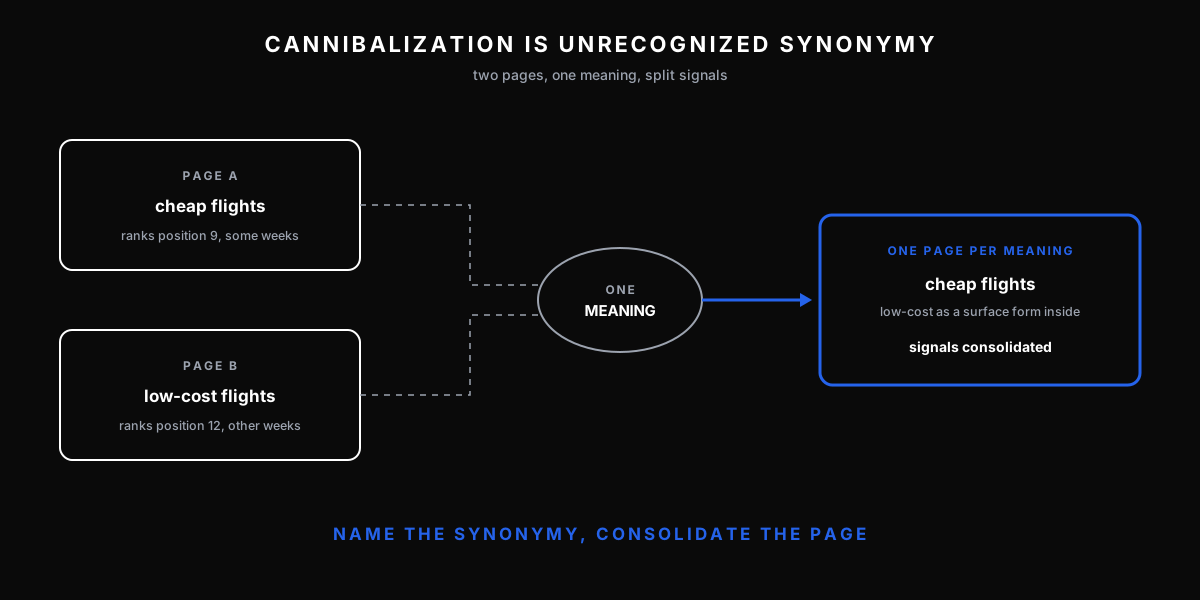
Cannibalization is the clearest case. Two pages targeting cheap flights and low-cost flights target one meaning, and the ranking system resolves the conflict by splitting signals between them; the previous section showed the same mechanism working in your favor. The fix is not a tool setting. It is recognizing the sameness and consolidating to one page per meaning. Thin coverage is the hierarchy failure: a pillar with 3 of its 12 natural children covered claims a topic it does not hold. Anchor monotony is the equivalence failure in reverse: one anchor string repeated site-wide where several semantically related phrases would carry more information. Every one of these is diagnosable the same way: name the connection between the pages, and the fix follows from its definition. That diagnostic move is the single most useful thing my linguistic training added to my SEO practice.
Who Needs To Understand Lexical Relations?
Operators who own information architecture need lexical relations: brief writers, editorial leads, and anyone who decides which pages exist. A writer can produce one good page, then another, without naming these connections. Nobody designs a coherent network of pages without using them, knowingly or not.
Koray Tuğberk Gübür teaches the study of these connections inside his Topical Authority framework, and my read after training with him directly is that the lexical level is the least understood piece of the method. Operators adopt the map-building mechanics and skip the semantics that justify them. The mechanics still work, the way a recipe works for a cook who cannot taste. The connections are the taste: they say why the map has this shape, and they say what to do when the recipe meets a case it did not anticipate.
Which Family Should An Operator Model First?
Hierarchy and equivalence come first: parent-child ties and synonymy decide which pages exist and which queries each page owns. Meronymy and holonymy come second, filling each page's attribute coverage. Association comes last; it refines sentences that structure has already placed.
The order follows dependency, not importance. Page architecture is a hierarchy decision, and a wrong hierarchy invalidates everything written inside it. Meaning ownership is an equivalence decision, and unresolved sameness produces cannibalization no amount of writing fixes. Attribute completeness is a part-whole decision made per page. Phrasing is an association decision made per paragraph and per sentence: collocation, real usage, the habits of the language. Modeling in that order gives the structure a direction: each decision constrains the next instead of contradicting it.
How Does The Taxonomy Differ from Semantic Similarity?
A semantic relationship is discrete and typed; graded similarity is continuous by design. The typed connection states that two words connect by equivalence or hierarchy and names the tie. Similarity states how close two meanings sit in vector space without naming anything.
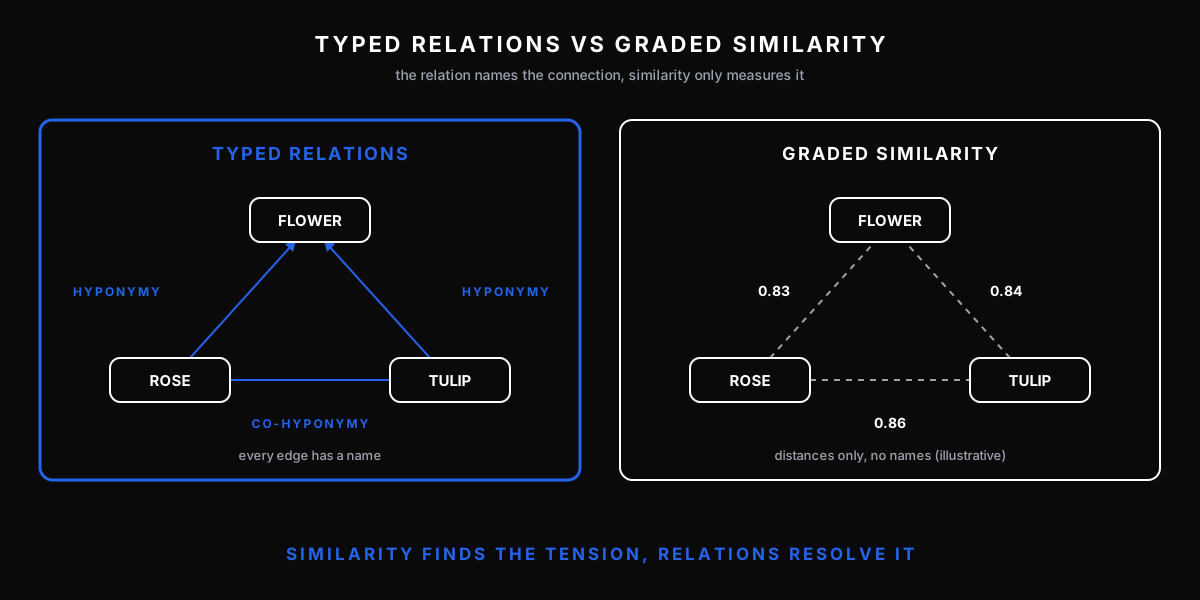
The two systems answer different questions, and I covered the graded side in my post on semantic similarity. An embedding is a vector representation of meaning: it places rose near tulip and near flower at comparable distances, and the distance alone cannot say that one neighbor is a sibling and the other is a parent. The typed edge can. This is why knowledge graphs did not disappear when embeddings arrived: retrieval systems take both signals, the graded one to find candidates and the typed one to give the reasoning something to hold.
For an operator, the division of labor is diagnostic. Similarity says two pages sit too close; the connection type says why, and the why decides the fix. Pages built on sameness get consolidated. Closely related sibling pages get differentiated. A child page gets linked up to its parent pillar. These 14 connections are the vocabulary I use when I expand a brief, whether for this site, for Mojo Links client engagements, or inside the audit logic I built into Semapoly. Similarity finds the tension; the named connection resolves it.
Frequently Asked Questions About The Taxonomy
What Is An Example of a Lexical Relation?
Synonymy is the most familiar example: car and automobile share a meaning across different forms. Hyponymy is the next most common: dog is a hyponym of animal, a specific instance under its general class.
Is Polysemy The Same as Homonymy?
No. Polysemy is one spelling with multiple related senses, like head of a body and head of a company. Homonymy is one spelling with unrelated senses, like bank of a river and bank holding deposits. However similar they look, engines treat the senses differently.
Are Lexical and Semantic Relationships The Same Thing?
They describe the same connections at two levels. Lexical ties hold between word forms; a semantic relationship holds between concepts or entities. Search engines work on both levels: strings in queries, entities in graphs, sentences in passages.
How Many of These Connections Do Linguists Count?
Inventories differ across the study of meaning; there is no single canonical count. I keep 14 connections in 6 families, a cut that condenses D. A. Cruse's Lexical Semantics and Princeton's WordNet into the terms that drive SEO decisions.
Does The Taxonomy Still Matter in The Embedding Era?
Yes. Embeddings measure how semantically close two meanings sit; they do not name the connection. Graphs of entities and lexical databases still store typed information, and retrieval uses both: similarity to find candidate sentences, typed structure to reason about concepts.