Every guide on anchor text reads it as a lever the publisher pulls: which words to use, in what mix, to look natural. I read it the opposite way. I have a background in linguistics and I have run SEO for 10 years, and the more useful question is not what string you chose, it is what that link tells Google about the page it points to. An anchor is an annotation written by someone else about your page, and relevance, not the string, is what makes that annotation mean anything.
What Is Anchor Text as a Topical Signal?
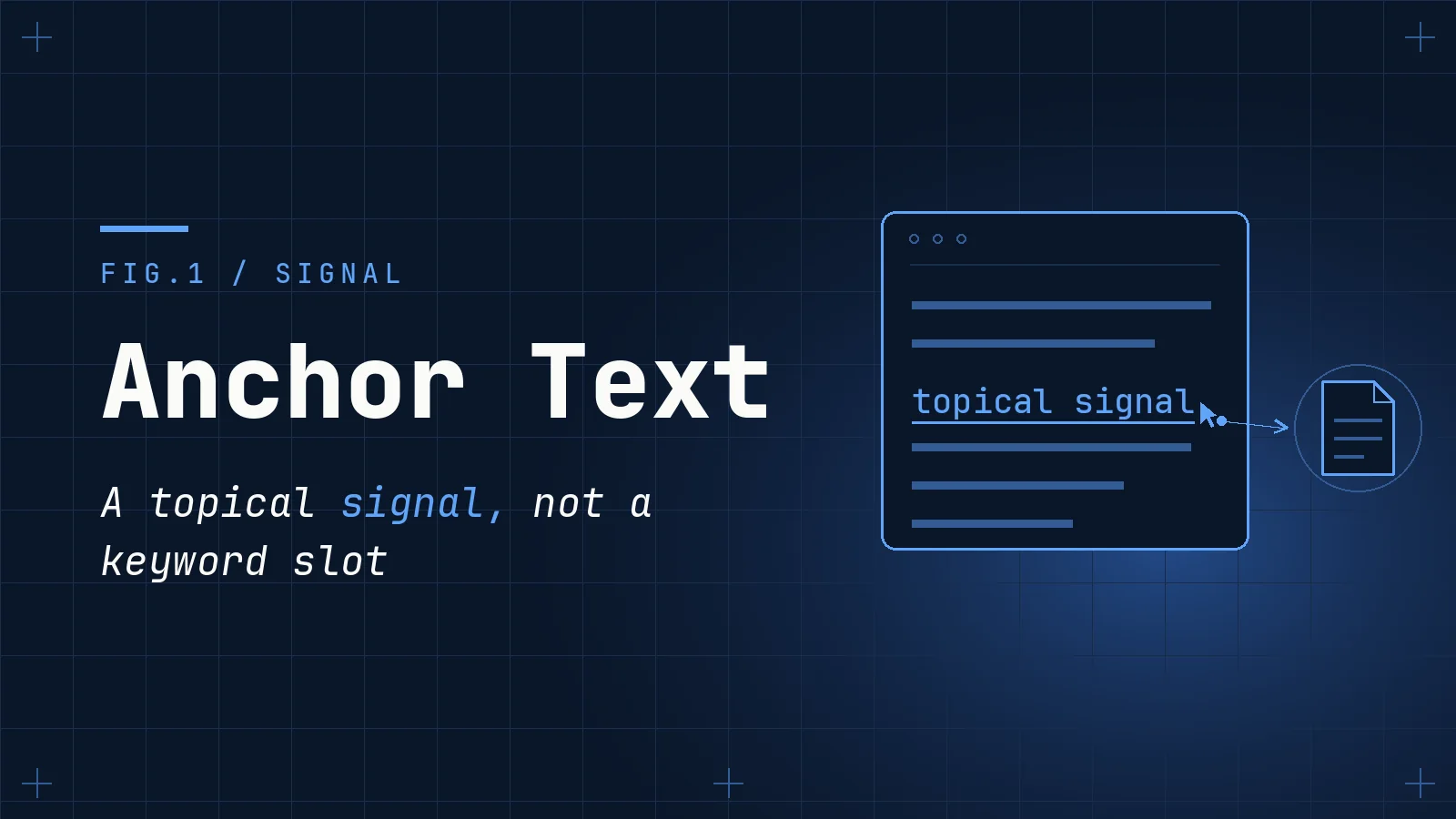
Anchor text is the clickable phrase in a link, but as a topical signal it is a third-party statement about the target page's subject. It tells Google what another site thinks this page is about, independent of the page's own words. The string is the surface; the signal is the claim underneath it.
The distinction matters because the two readings point in opposite directions. The link-placement read treats the anchor as something you author: pick the phrase, control the message. The signal read treats the anchor as something a search engine receives: an external label for the destination's topic, emitted by a page that is not yours. I work with the semantic SEO and topical authority method developed by Koray Tuğberk Gübür, and that method reads every link as a statement about meaning, not as a vote you cast for yourself.
The central entity here is anchor text understood as a signal. Its definition is a clickable link phrase read as a third-party topical annotation of the target page. What it signals is the target page's subject and entities, as judged by an external site. The direction of the signal points outward, toward the destination, not back at the source. Once you hold those three facts together, most of the standard anchor advice stops describing the thing it claims to describe.
What Does An Anchor Phrase Tell Google About The Target Page?
An anchor phrase annotates the target page from outside. Google reads it as an external label for the destination's topic and entities, weighted by how much the linking page is itself about that subject. The anchor describes the target, not the source.
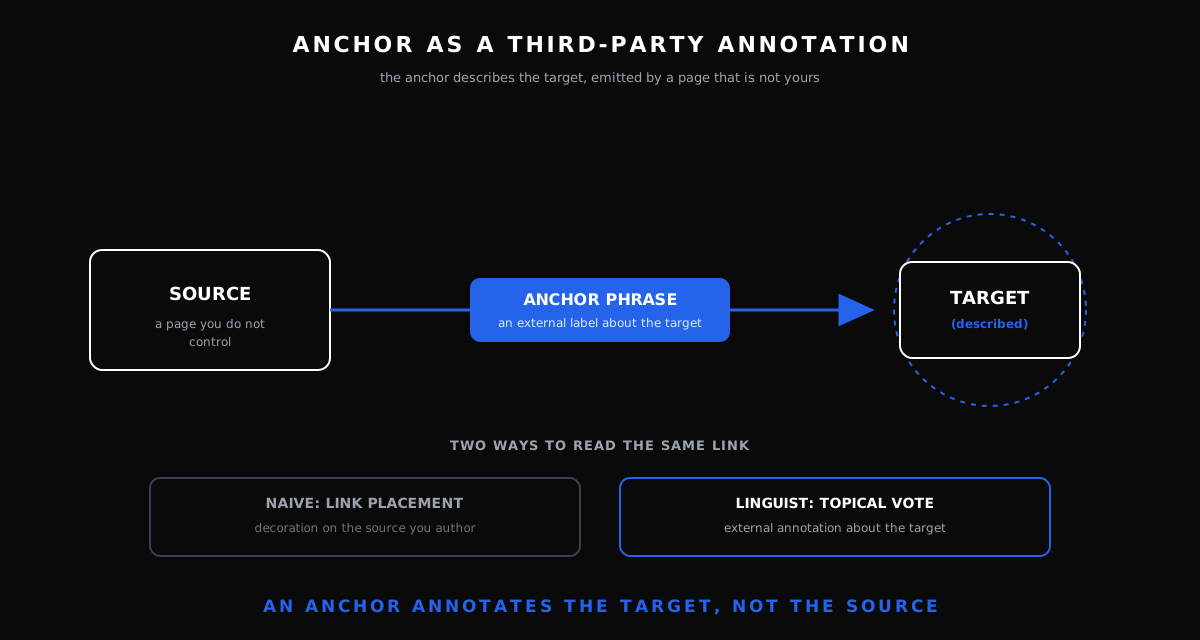
This is the part the glossary pages skip. Anchor text, on Google's side, is a statement made by one page about another. Google Search Central describes anchor text as the visible text Google uses to understand what the linked page is about. That single line reframes the whole topic: the anchor is not your description of your page, it is someone else's description of your page, and a search engine treats an independent description as evidence in a way it cannot treat your own copy.
Is Anchor Text a Vote About The Source or The Target?
The anchor is a statement about the target page. A link points outward, so the phrase that labels it labels the destination. This is the most common misread in the field: people optimize anchors as if they describe the page the link sits on, when the search engine reads them as a claim about the page the link goes to.
The original PageRank model already carried this logic. The PageRank paper by Larry Page and Sergey Brin noted that anchors often describe the target page more accurately than the target page describes itself, which is exactly why a search engine values them. A page can call itself anything. The web's collective labeling of that page is harder to fake and more informative, because it comes from outside.
What Is a Third-Party Annotation?
A third-party annotation is a label attached to your page by a source you do not control. It is the difference between a self-description and an independent one. When a topically relevant site links to my page with a phrase, that phrase is a small piece of external testimony about what my page covers, and external testimony is the kind of evidence a ranking system is built to weigh.
Why Does a Relevant Anchor Carry More Weight Than The Exact-Match String?
Relevance outweighs the string because an anchor inherits the topical authority of the page it sits on. The same exact-match phrase from a topically relevant page disambiguates the target's entity; from an unrelated page it carries little, because context, not characters, gives it meaning.
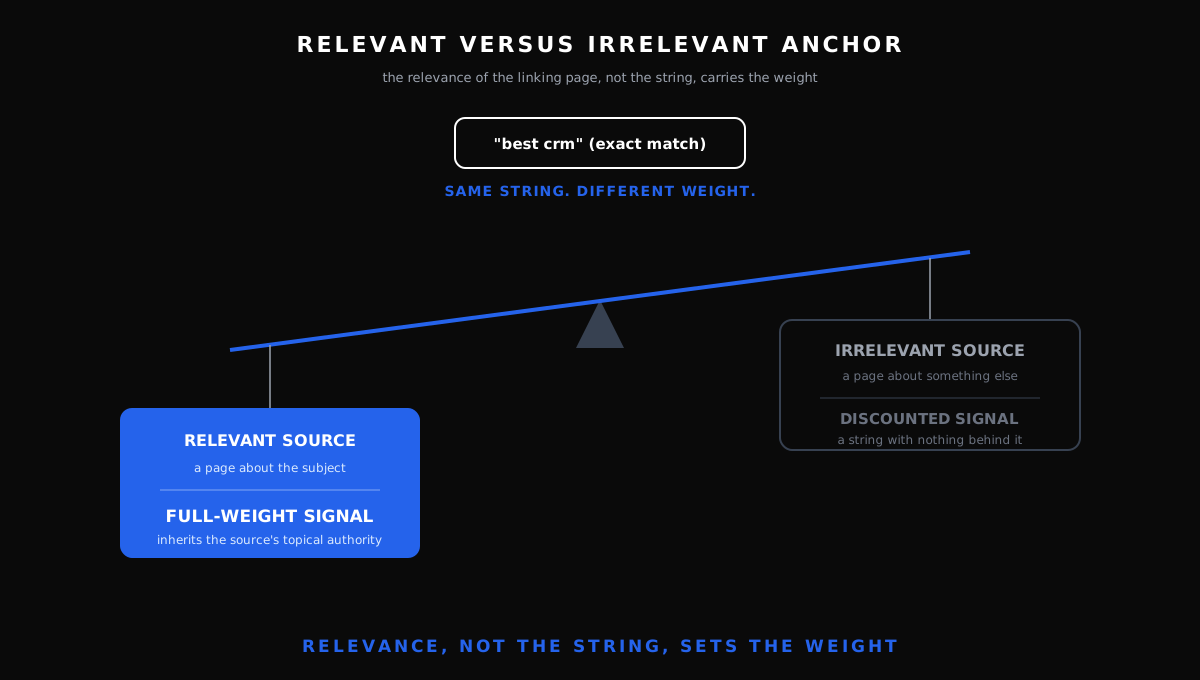
Think of two identical anchors, the same words, pointing at the same page. One sits inside an article that is itself about the topic. The other sits on a page about something unrelated. The string is byte-for-byte the same, yet the first link disambiguates my page's entity and the second barely registers, because the relevant page lends its own subject context to the link. That is what I mean by why link relevance matters: the linking page's relevance is the unit that makes the anchor mean anything at all.
A relevant anchor inherits the source's topical authority. When a page that Google already trusts on a subject links out with a phrase, the phrase arrives pre-loaded with that trust. An unrelated page has no subject authority to lend, so its anchor is a string with nothing behind it. The weight driver is the relevance of the linking page, never the characters in the box.
Can An Exact-Match Anchor on An Irrelevant Page Hurt The Signal?
An exact-match anchor on an irrelevant page is mostly a hollow signal, not a strong one. It is a string without the context that would make it mean something. This is the idea behind the anatomy of an irrelevant link: the phrase is precise, but the page it sits on contributes no topical evidence, so the search engine has a label with no supporting subject around it. The exact match looks deliberate to a human and looks empty to a parser.
What Is Entity Disambiguation in This Context?
Entity disambiguation is resolving which specific thing a page is about. A relevant anchor does this; an irrelevant one cannot. If my page is about "jaguar" the animal, a link from a wildlife site with the anchor "jaguar" confirms the entity, while the identical anchor from a car-parts site pushes the meaning the wrong way. The surrounding subject decides which entity the anchor resolves to.
Who Should Read Anchor Text This Way (and Who Is Reading It Wrong)?
Operators reasoning about why a link counted should read anchor text this way. Anyone optimizing a percentage of exact-match anchors is reading the string and ignoring the signal, measuring the label while missing what the label is attached to.
This read is for the person who looks at a backlink and asks why it moved the page, not the person who asks what percentage of their anchors are branded. Those are different jobs. The ratio question belongs to execution: how a link profile is assembled, which acquisition methods produce which anchors, how to keep a profile defensible. That work is real, and it is the operational question handled by a link-building team, not the conceptual one I am answering here.
The misread is treating the anchor as a dial. People audit their anchor mix the way you would audit a budget, counting categories of phrase, and conclude that the link did or did not work based on the string. The search engine never read the string in isolation. It read the string inside the subject of the page that emitted it, which is why two operators with identical anchor mixes get different results from links that look the same on a spreadsheet.
What Goes Wrong When You Treat Anchor Text as a Ratio?
Treating anchor text as a ratio optimizes a number instead of a meaning. The ratio mindset cannot explain why a relevant link with a generic anchor outperforms an exact-match anchor from an unrelated site, because it counts strings and never reads context.
Why Does The Ratio Mindset Miss The Signal?
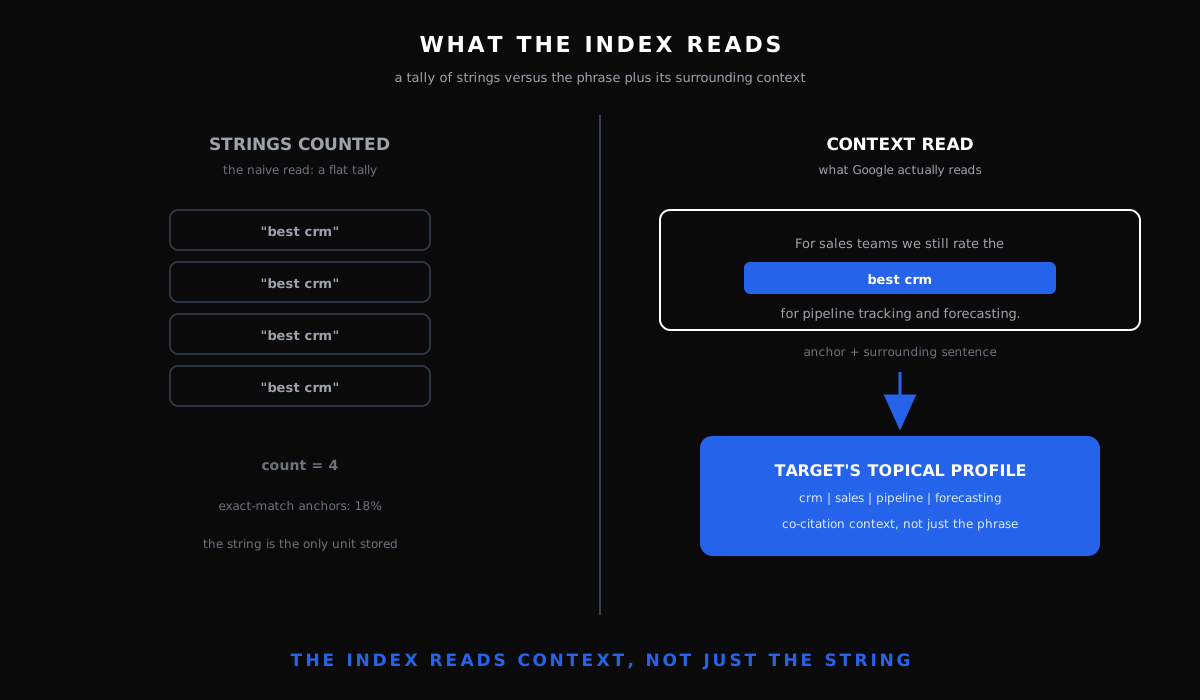
The ratio mindset misses the signal because it measures the wrong layer. It counts which strings appear and in what proportion, treating the phrase as the unit. The search engine's unit is the phrase plus its surrounding sentence plus the topic of the source page. A method that records only the first of those three will always be blind to the two that actually carry the weight.
I have watched this produce confident wrong conclusions. An operator points at a link with a perfect commercial anchor and says it should have moved the page, then points at a link with a plain branded anchor and dismisses it, when the second link came from a page deeply about the subject and the first came from a directory about nothing in particular. The spreadsheet ranked them backwards because the spreadsheet only stored the strings.
What Does An over-Optimized Profile Actually Break?
An over-optimized profile breaks the credibility of the annotation, not a quota. When a page's inbound anchors are unnaturally uniform, the collective external description stops looking like independent testimony and starts looking authored, which is the opposite of what a third-party signal is for. The failure is at the signal level: the labels no longer read as evidence from outside. How a profile gets diagnosed, cleaned, or rebuilt is the recovery question, and it sits in the execution lane, not this one.
What Does Reading Anchor Text as a Signal Give You?
Reading anchor text as a signal gives you judgment, not a quota. You can explain why a link moved a page and why another did nothing, because you are reading the topical relationship between the two pages, not auditing a distribution of phrases.
The practical payoff is diagnostic. When a link works, I can say which subject context lent it weight; when a link does nothing, I can say it sat on a page with no topical relationship to the target, regardless of how clean the anchor looked. That is a different capability from hitting a percentage. It lets me predict, before a link exists, whether it will mean anything, by asking whether the source page is genuinely about the subject.
This is also where the read connects to the rest of the methodology. An anchor plus its surrounding sentence is a small measure of semantic similarity between two pages, and the more relevant the source, the stronger that similarity. I built Mojo Links to handle the acquisition side, the work of earning those links in the first place, but the reading rule sits upstream of any campaign: relevance is what makes the annotation mean something, so relevance is what you build for.
Anchor Text vs Co-Citation vs Surrounding Text: What Is Google Actually Reading?
Google reads three linguistic units together: the anchor phrase, the surrounding sentence, and the topic of the source page. The anchor is the label, co-citation is the company it keeps, and the surrounding text is the local context that tells the search engine what the label means here.
What Is Co-Citation?
Co-citation is the set of entities named near a link that together define the target's topic. When my page is mentioned alongside known names in the same field, that proximity co-defines what my page is about, even when the anchor itself is generic. The entities sitting near the link describe the destination as much as the clickable phrase does, which is why a plain anchor inside a richly relevant passage can outperform a precise anchor inside a barren one.
Does The Surrounding Sentence Count as Anchor Context?
The surrounding sentence is part of the anchor's context. A search engine does not read the clickable phrase in isolation; it reads the sentence the link lives inside, because that sentence disambiguates the entity and supplies the topical frame. This is the same lens as semantic similarity applied to links: the anchor and its surrounding text form one passage, and the index models that passage against the target page to decide how related the two really are. The string is never alone.
Frequently Asked Questions About Anchor Text as a Signal
What Is Anchor Text in One Sentence?
It is the clickable phrase of a link, read by Google as an external signal about the target page's topic. The string is the visible part; the signal is what another site is claiming your page is about, and a search engine treats that independent claim as evidence.
Does Anchor Text Describe The Source Page or The Target Page?
The target page. An anchor is a third-party annotation of the destination, not a description of the page the link sits on. A link points outward, so the phrase labels where it goes, which is why optimizing anchors as if they describe their own page is the most common misread of the signal.
Why Does a Relevant Link with a Generic Anchor Beat An Exact-Match Anchor from An Unrelated Site?
Because relevance, not the string, gives the anchor meaning. A relevant source lends its subject context and topical authority to the link, so even a plain anchor disambiguates the target's entity. An unrelated source has no subject context to lend, so its exact-match anchor is a precise string with nothing behind it.
Is Anchor Text The Same as Co-Citation?
No. Anchor text is the clickable phrase; co-citation is the surrounding context, the entities and sentence around the link, that gives the anchor its topical meaning. The anchor is the label, co-citation is what tells a search engine what the label means here. Together they form the passage the index reads against the target page.