Most advice about semantic similarity comes from machine learning: vectors, embeddings, cosine scores. I have a background in linguistics and I have run SEO for 10 years, so I read it the other way. Semantic similarity started as a question about meaning, not math, and that is the version a writer can actually use.
What Is Semantic Similarity?
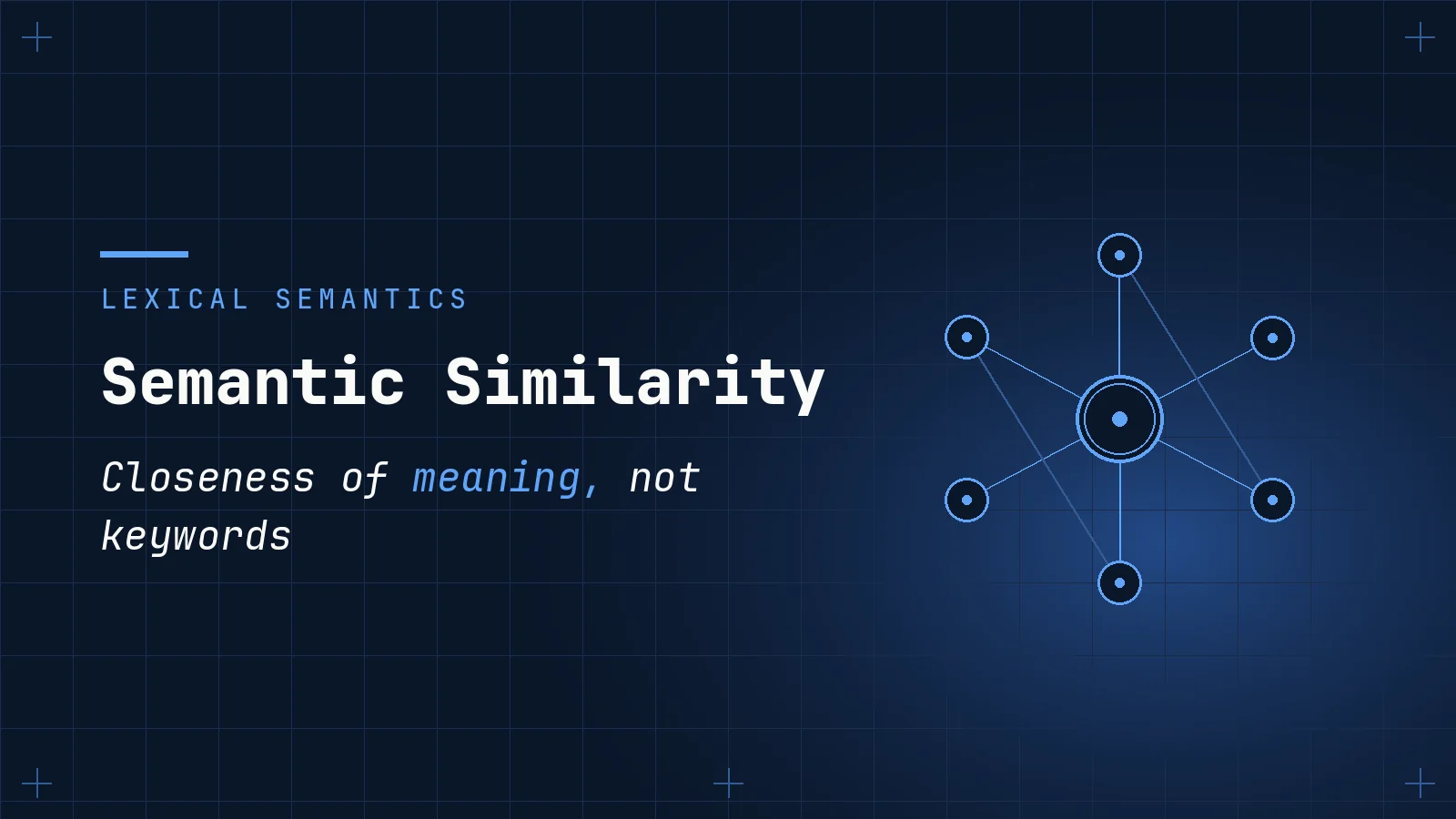
Semantic similarity is the closeness of meaning between two words or texts. A search engine uses it to judge how near your content sits to a query in meaning, not in spelling. The closer the meaning, the stronger the match, even when the exact words differ.
Closeness is the word that matters. Koray Tuğberk Gübür, whose semantic SEO methodology I work with, calls it exactly that: the closeness, or distance, between the meanings of two words. Two pages can share no keywords and still be close in meaning, or share every keyword and be far apart. The string is not the measure; the meaning is.
This reframes what a search engine is doing when it reads your page. It is not counting how many times a phrase appears. It is placing your words in a space of meaning and measuring how near they fall to the words in the query. That space is built out of relations between word meanings, which is where lexical semantics comes in.
How Does a Search Engine Measure Closeness?
It measures closeness through the relations between word meanings, read by natural language processing. Machine learning expresses that distance as numbers, but the underlying signal is linguistic: which words share meaning, which contain others, which are parts of a whole. The math is a proxy for the relations.
For a writer this is freeing, because you cannot edit a vector but you can edit relations. You decide which related concepts a page names, how it defines them, and how it connects them. That is the lever the ML framing hides. I read which queries a page is already judged close to in Google Search Console, then work on the relations, not the score.
How Do Lexical Relations Create Semantic Similarity?
Lexical relations are the structured links between word meanings, and they are what closeness is measured along. Synonymy, antonymy, hyponymy, hypernymy, meronymy and holonymy each place one word near or far from another in meaning. Semantic similarity is the distance those relations describe.
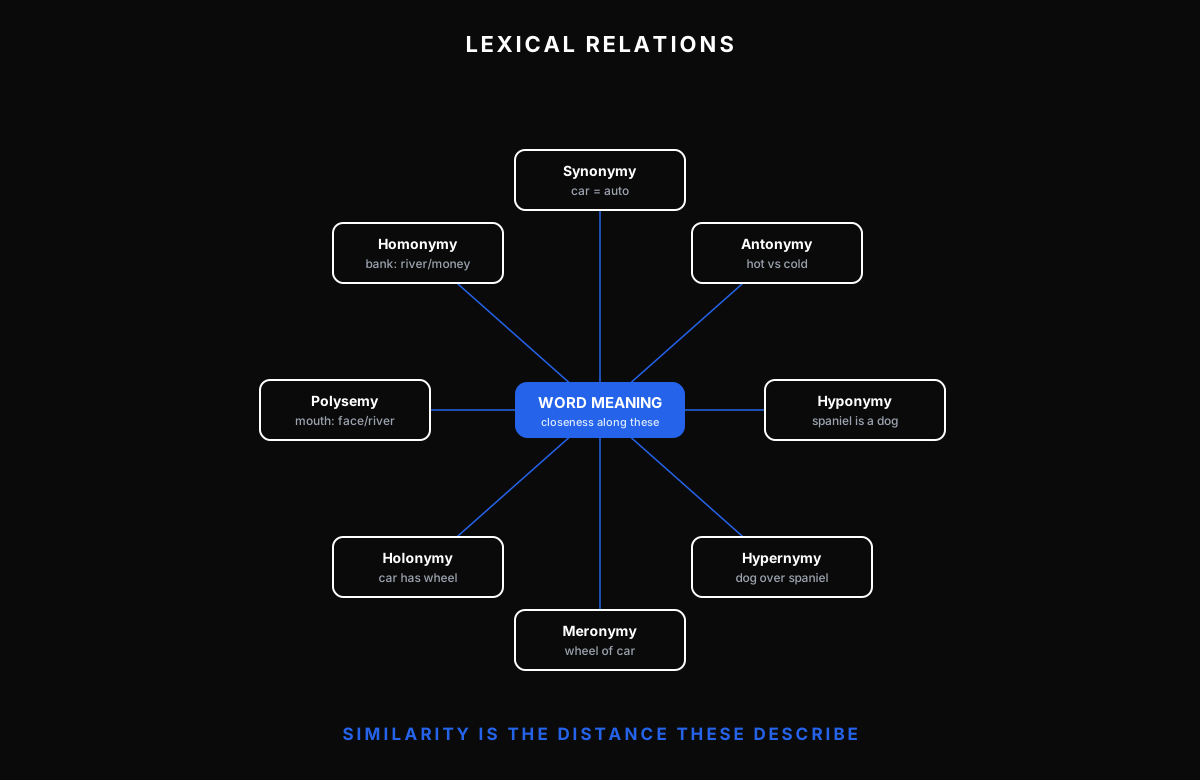
The taxonomy is older than search engines, and it is small enough to hold in your head. Synonymy is sameness of meaning (car, automobile). Antonymy is opposition (hot, cold). Hyponymy is the type-of relation, narrower (a spaniel is a kind of dog); hypernymy is its inverse, the broader category (dog over spaniel). Meronymy is the part-of relation (wheel, car); holonymy is the whole (car, wheel).
Two more matter because they cause confusion. Polysemy is one word with several related senses (the mouth of a person and the mouth of a river). Homonymy is one form with unrelated senses (a river bank and a money bank). A search engine has to resolve which sense you mean, and it does that from the relations around the word, not the word alone.
This is the linguist's read of "cover the topic". Covering a topic is not adding more words about it. It is naming the entity and walking its relations: its categories, its parts, its opposites, its kinds. That is what makes a page measurably close to the meanings a reader is searching for.
What Is The Difference Between Semantic Similarity and Semantic Relevance?
Similarity is closeness of meaning; relevance is relatedness in context. "Dog" and "cat" are similar, both pets of the same kind. "Dog" and "leash" are relevant, things used together. Content needs relevance, not just similarity, because a page of synonyms is similar to itself and useful to no one.
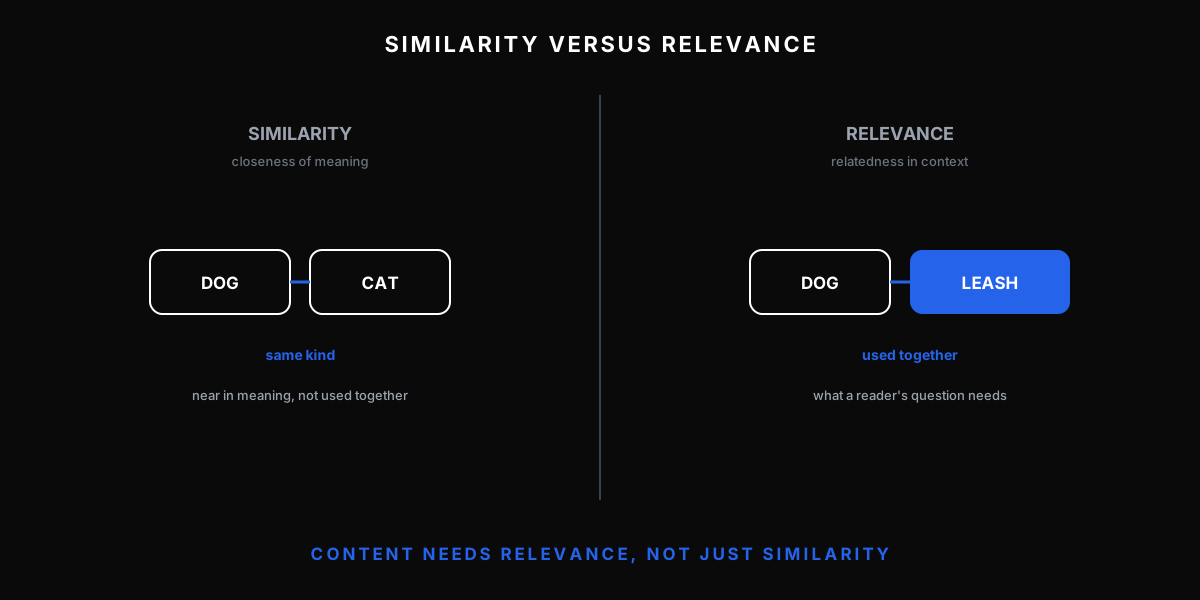
This is the distinction most writing about the topic skips, and it is the one that changes how you work. Similarity groups things of the same kind. Relevance connects things that belong together in a task or a question. A reader searching "how to walk a reactive dog" wants the leash, the training, the route, not a thesaurus of words that mean dog.
Koray draws the same line: similarity is closeness, relevance is relatedness, and search engines need both but reward relevance. Get this wrong and you produce content that scores high on similarity to your own keyword and low on usefulness. That is the trap the synonym-stuffing era ran straight into.
Are "Dog" and "Cat" Similar or Relevant?
They are similar, not especially relevant. Both are house pets, so they sit close in meaning, high similarity. They are not used together in a task, so their relevance is low. A page about cats does little for a query about dogs, even though the two words are near neighbours in meaning.
This is why similarity alone is a weak target. The words around your entity should include its relatives in meaning and its partners in context. Dog brings in cat by similarity, but it brings in leash, vet, breed and training by relevance, and those are the ones a reader's question actually needs.
Why Does The Difference Matter for Content?
Because relevance is what answers a question, and similarity is what gets mistaken for it. Writers chase similarity because it is easy to manufacture with synonyms. Relevance is harder: it requires knowing what a reader needs next, not just what means the same thing.
When I plan a piece, I map both. Similarity tells me the entity's neighbours so the page reads as on-topic. Relevance tells me the entity's partners so the page reads as useful. The second list is where the value is, and it is the one a synonym tool will never give you.
Who Needs To Think About Semantic Similarity (and Who Is Overthinking It)?
Anyone writing for complex, meaning-rich topics needs it; anyone chasing one exact phrase is overthinking it. If your topic has many related concepts, closeness of meaning decides whether search reads your page as the right answer. If it has one literal intent, a clear page is enough.
It pays off most where a topic branches: software, finance, health, law, anything with a dense web of related terms. The more relations a subject has, the more a page that walks them outranks a page that repeats a phrase. The brand that wants to be recognised as a source on a topic, not a set of keyword pages, lives or dies on this.
The overthinking looks like this: an operator computing similarity scores for individual sentences, or buying a tool that grades synonym density. That is measuring the proxy and ignoring the relations. You do not need to score similarity. You need to cover the right relations, which is a writing decision, not a calculation.
Why Do Writers Get Semantic Similarity Wrong?
Because they treat it as a synonym list. Padding a page with near-words raises its similarity to itself, not its relevance to a reader. Search rewards covering the relations around an entity, not repeating its synonyms across more sentences. The synonym pile is the classic failure mode.
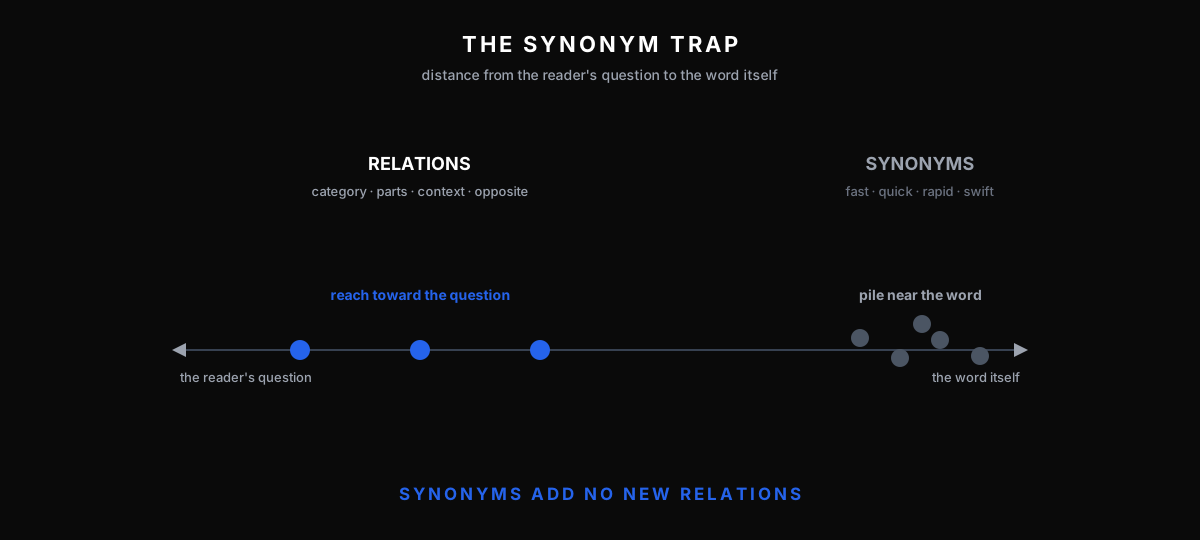
The mistake is intuitive, which is why it persists. If meaning matters, more words of similar meaning should help. They do not, because they add no new relations. Ten synonyms for "fast" tell a search engine nothing it did not already know from the first one. The page gets denser and no closer to any real question.
The fix is to add relations, not repetitions. Instead of more words for the entity, name its parts, its kinds, its context, its opposites. That is the difference between a page that is similar to itself and a page that is relevant to a reader, and it is the same discipline I apply to semantic SEO as a whole.
Is Stuffing Synonyms Semantic Similarity?
No. Stuffing synonyms is the counterfeit of semantic similarity. It raises surface variety without adding meaning. Real similarity comes from the relations a page covers, and a synonym adds none: it restates a word you already used instead of connecting a new concept.
The honest version is harder and worth more. Earn closeness by defining the entity, placing it in its category, naming its parts, and contrasting it with its opposite. Each of those is a relation a search engine can read. A synonym is just the same node, painted twice.
Can Two Pages Be Too Similar?
Yes, and that is cannibalization. When two of your own pages are too close in meaning, a search engine cannot tell which one answers the query, so it trusts neither fully. High similarity between pages is a problem, not a goal.
This is the same closeness, turned against you. The cure is relevance again: give each page a distinct job, a distinct relation to the topic, so they sit near the subject but not on top of each other. When rankings wobble for no obvious reason, overlapping pages are often why, which is one of the causes I cover in why search rankings drop.
What Does Semantic Similarity Change About How You Write?
It changes the unit of writing from the phrase to the relation. You stop hunting keywords and start mapping how concepts relate, so a search engine can measure your page as close in meaning to the questions it should answer. The keyword becomes an output, not the target.
In practice the brief changes shape. Instead of a keyword list, I write a relation list: the entity, its category, its parts, its kinds, its opposite, the things used alongside it. The draft then has to earn each relation in prose. The keywords show up on their own, because you cannot describe a relation without naming the things it connects.
The payoff is durability. A page built on relations reads as close in meaning to many questions, not one phrase, so it ranks across a topic and survives algorithm changes that punish thin keyword matching. Closeness of meaning is the direction search keeps moving, so writing for it is writing with the current.
Semantic Similarity vs Keywords vs Entities: How Do They Relate?
Keywords are strings, entities are things, and similarity is the distance between their meanings. A keyword is what a reader typed. An entity is the thing they meant. Semantic similarity is how a search engine measures the gap between the meaning of the query and the meaning of your page.
They stack rather than compete. You still read keywords from data, because they show the language people use. You resolve them to entities, because that is what a search engine indexes meaning around. Then similarity decides whether your page is close enough to be the answer. Skipping the middle step, going straight from keyword to text, is what produces pages that match words and miss meaning.
When Is a Keyword Enough, and When Do You Need Relations?
A keyword is enough when the intent is single and literal. For one narrow question with one answer, match the page to the query and stop. You need relations when the topic is broad, the intents are many, and closeness of meaning across the subject is what search is judging.
The test is practical. If a query has one obvious answer, write the answer. If a whole topic with many questions sits behind it, write the relations and let the answers fall out. Most valuable informational topics are the second kind, which is exactly where thinking in lexical relations wins.
Where Do You Start Thinking in Lexical Relations?
Start with one relation, not a checklist: name the entity, then name its category. The category, the hypernym, is the single most useful relation, because it tells a search engine what kind of thing your page is about before anything else. Everything else hangs off that placement.
This is deliberately not a step-by-step. The order of relations is a judgement, not a recipe. Once the category is set, the next questions write themselves: what are its parts, its kinds, its opposite, the things it appears alongside. Each answer is a relation, and the relations are the page.
A practical first move: write your entity, then finish six sentences, one per relation, in plain language. "A [entity] is a kind of [category]. Its parts are [meronyms]. Types include [hyponyms]. It is the opposite of [antonym]. It is used with [relevant partners]." If you cannot finish them, the topic is not yet understood, and no amount of synonyms will hide that. Filling them in is semantic similarity, done by hand. It is the same relation-mapping that, repeated across a site, builds topical authority.
Frequently Asked Questions About Semantic Similarity
What Is Semantic Similarity in One Sentence?
It is the closeness of meaning between two words or texts, the distance a search engine measures between the sense of a query and the sense of your page. It is built from lexical relations, and it is judged in meaning, not in spelling.
Is Semantic Similarity The Same as Relevance?
No. Similarity is closeness of meaning, like dog and cat; relevance is relatedness in context, like dog and leash. Content needs relevance, because a page that is only similar, a pile of synonyms, is close to itself and useless to a reader.
What Are The Lexical Relations?
The main ones are synonymy (same meaning), antonymy (opposite), hyponymy (a kind of), hypernymy (the category), meronymy (a part of), holonymy (the whole), polysemy (related senses), and homonymy (unrelated senses sharing a form). Search reads them to place words near or far in meaning.
Does Semantic Similarity Help SEO?
Yes, when you use it to cover relations rather than chase synonyms. Writing that names an entity's category, parts, kinds and context reads as close in meaning to many questions, so it ranks across a topic instead of one phrase. Synonym density does not help and can trigger cannibalization.