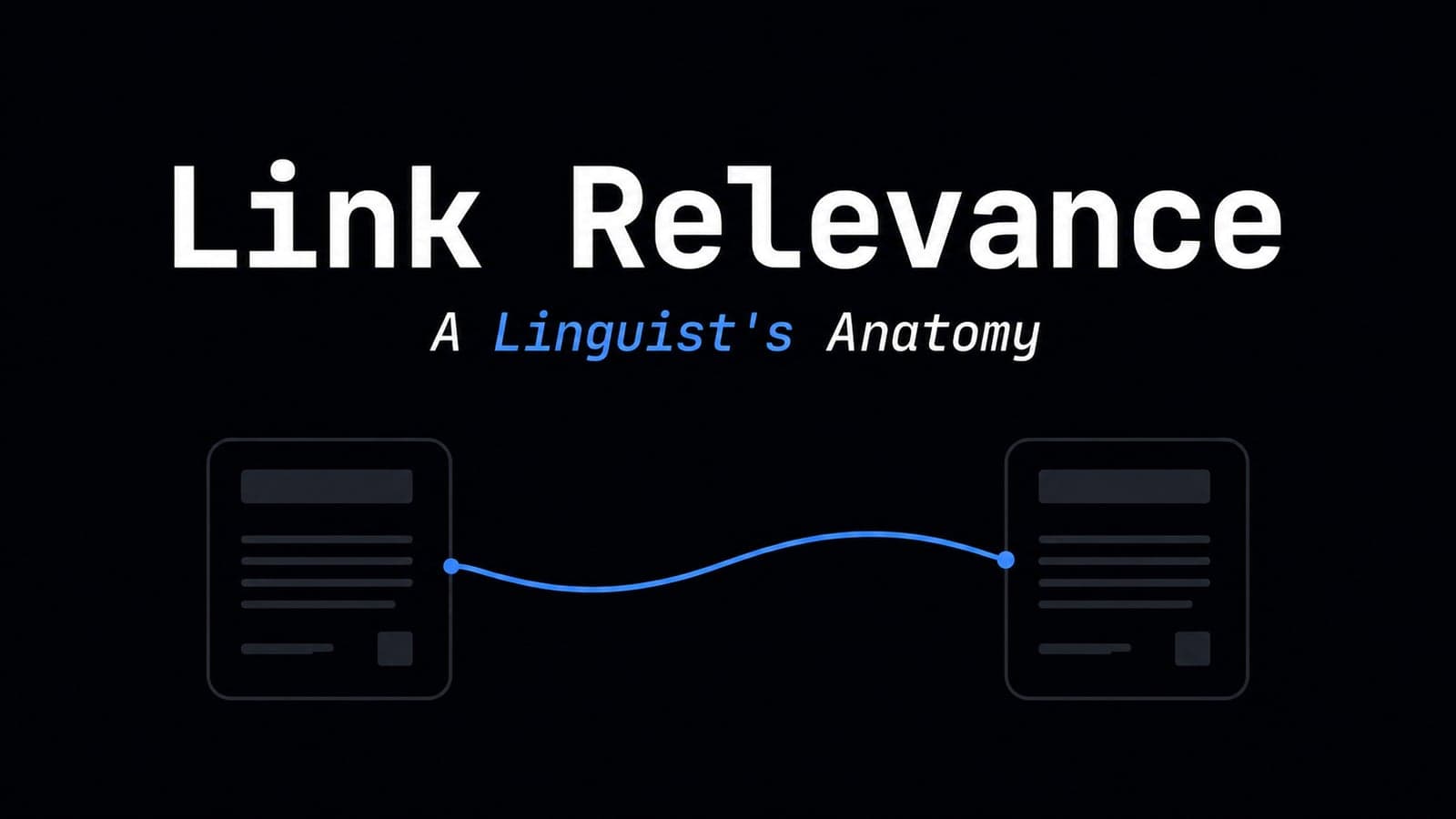
Link relevance is the degree to which a source page and a target page share semantic territory. The link itself is the signal. Relevance is what determines whether the signal carries weight. Backlink-graph metrics measure something different.
I trained in linguistics before I trained in SEO. That order matters when you read a backlink graph, because what every link actually carries is meaning, not just authority. The agency reporting structures that built the SEO industry's last decade were built around authority alone. That is the gap I want to walk through.
What Link Relevance Means, Linguistically
Link relevance, in linguistic terms, is the shared semantic space between two pages joined by a link. Linguists separate reference (what a word points at) from sense (what its surrounding context makes it mean). SEO has historically optimized for reference and ignored sense.
A link is a referential act. The hyperlink points at a target. That part is mechanical and visible to any crawler. What the link means in context is sense, and sense lives in the surrounding text, the anchor phrase, the source page's central topic, and the relationship between source and target as entities. Two links pointing at the same URL can carry completely different sense if the source contexts differ. The graph cannot tell them apart. A linguist can.
The signified and the signifier come from Ferdinand de Saussure, who I read before I read anyone in SEO. The signifier is the form: the anchor text, the link tag, the URL it points at. The signified is what that form actually means in the context where it appears. Most link-building practice in the last decade has treated the signifier as the whole link. It is not.
How a Link Transmits Meaning Between Two Pages
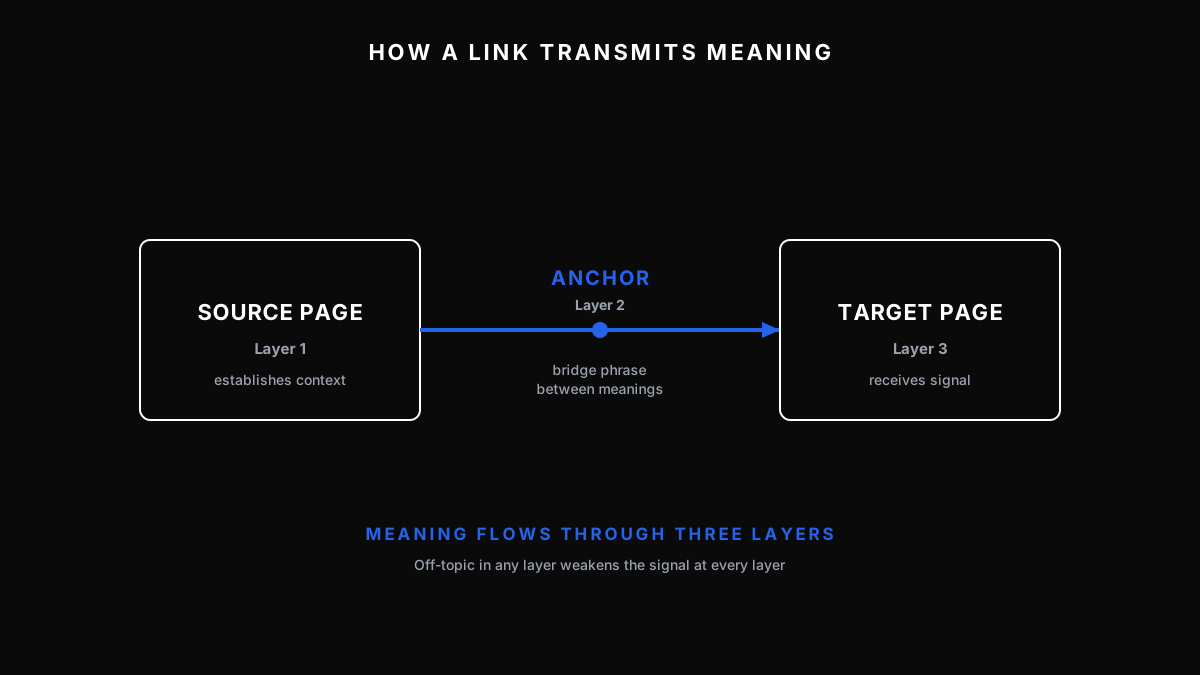
A link transmits meaning through three layers: the source page establishes context, the anchor text proposes a bridge between meanings, and the target page receives the signal. When any of the three layers is off-topic, the signal arrives weakened or near zero.
The source page is the first layer. Before a reader reaches the anchor, they have already read the surrounding paragraph, the page's heading, the title of the document. That context attaches to the link by association. If the page is about Australian commercial litigation and the link sits inside a paragraph about a specific case-management workflow, the link carries that legal context into the target. The link is no longer a pointer. It is a meaning-carrying act inside a defined topic.
The anchor is the second layer. The anchor text is the bridge phrase between two meanings. A descriptive anchor that mirrors the target page's primary entity passes the cleanest signal. An anchor that uses generic phrasing ("read more," "click here") still carries the surrounding source context but proposes no bridge of its own. The crawler has to do more inference to read the relevance.
The target page is the third layer. The link only completes its meaning when the target page actually concerns what the source context implied it would. If the source's context promises a legal compliance resource and the target page is a generic marketing page, the bridge breaks. The graph records a link. The semantic signal records a misalignment.
Why Backlink-Graph Metrics Cannot See Relevance
Backlink-graph metrics like Ahrefs Domain Rating (DR) measure structural properties of the backlink graph, not the semantic content of linked pages. Nothing inside the calculation reads what the pages are about. The metric is honest about its scope. Operators misuse it.
Ahrefs has been transparent about this. Their published definition of Ahrefs Domain Rating describes a 0-100 logarithmic score weighted by referring-domain quantity and the referring-domain quality of those referring domains. The function is recursive: a domain's score depends on the scores of the domains linking to it. That recursion captures graph strength. It does not capture topical alignment, anchor coherence, source context, or target relevance. None of those are inputs.
This is the same point I argued about server logs in the chapter on server-log discipline in the Technical SEO book. Metrics measure what they measure. Operators get into trouble when they ask a metric to answer a question it was not designed to answer. DR is a structural metric. Asking it to predict semantic-fit ranking lift is the same category of error as asking server-log status codes to tell you about user intent.
The math is unforgiving on this. Moving from DR 70 to DR 80 is dramatically harder than moving from DR 30 to DR 40 because the function is logarithmic. That is a useful property for ranking graph strength. It is a useless property for predicting whether a specific link carries semantic equity. The score and the semantic outcome are not on the same axis.
What Entity-Era Operators Are Starting To Argue
Entity-era operators argue that link value is now a function of topical alignment, not graph strength. The shift took this long because graph metrics are countable and topical alignment is not. Countability beats correctness inside agency reporting structures.
I made a version of this argument at CMSEO 2025 during the sessions on link-building mastery, and the reaction in the room was the same as it has been online: most working operators agreed the pattern matched what they were seeing in their own campaigns, but few had reset their prospecting workflows around it. I wrote that observation up after the event in my reflections from CMSEO 2025 on link-building mastery. Mojo Links has since published the qualification scorecard we use to reset that workflow, with weighted criteria and explicit kill thresholds.
The reason the shift is uneven is structural. A link-building agency that prices by Domain Rating tier (DR 50 placements cost X, DR 70 placements cost Y) has built its pricing, reporting, and account management around a graph metric. Switching to topical-alignment qualification means switching the unit of value. That is not a content tweak. It is a reorganization. Until the cost of staying with graph-strength pricing exceeds the cost of changing, the change does not happen.
The SEO industry consensus through 2023 was that graph metrics predicted link value. The pattern I see in audits since says otherwise. The countable metric is still being reported. The ranking lift that used to follow is increasingly intermittent.
The Properties of a Relevant Link
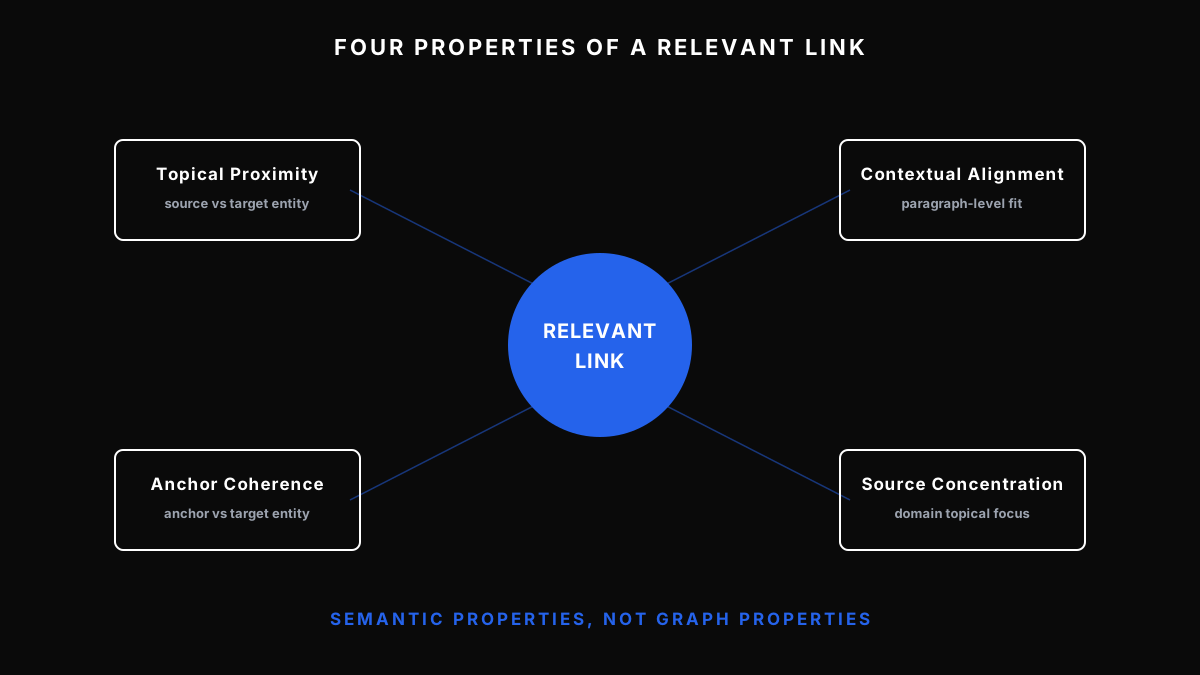
A relevant link has four properties: topical proximity between source and target entities, contextual alignment within the source page itself, anchor coherence with the target's meaning, and the source domain's topical concentration. All four are semantic properties. None are graph properties. The graph cannot see any of them.
Topical proximity is the distance between the source entity and the target entity on a knowledge graph. Two domains in the same vertical sit close. A domain in legal SaaS linking to another domain in legal SaaS sits very close. A general business publication linking to a legal SaaS sits at moderate distance. A fitness blog linking to a legal SaaS sits at maximum distance. Distance is not a binary. It is a gradient that the entity layer reads as such.
Contextual alignment is the proximity inside the source page itself. Even on a topically aligned domain, the specific paragraph that hosts the link has to belong to the same semantic neighborhood as the target. A legal industry domain publishing a productivity-themed guest post is not in legal context for the duration of that post. The link's value gets read at the paragraph level, not just the domain level.
Anchor coherence is the relationship between the anchor phrase and the target page's primary entity. The closer the anchor phrase sits to how the target page describes itself, the cleaner the bridge. This is also why over-optimized exact-match anchors carry penalty risk: they expose the manipulation. The opposite mistake is generic anchors that propose no bridge at all. Both are failures of coherence. I unpack how the bridge phrase carries meaning in anchor text as a topical signal.
Source domain's topical concentration is how tightly a source domain stays inside one topical neighborhood. A domain that publishes consistently inside one vertical signals topical authority on that vertical to the entity layer. A domain that publishes across unrelated topics signals breadth without depth. Concentrated domains pass more equity than broad domains at equivalent graph strength.
There is no productized metric in 2026 that I trust to score these four properties automatically. The operator's read is still the signal. That is a tooling gap I do not expect to last forever, but it is the state of the work today. For the agency-side operational read on this, see Mojo Links on why niche-relevant backlinks beat Domain Rating.
What Happens When Irrelevant Links Scale
When irrelevant links scale, sites accumulate backlink counts that do not move rankings. The links exist in tools. The signal Google extracts from them is near zero. No penalty notification arrives, because nothing was technically violated. The campaign simply does not work.
Across the audits I run at Mojo Links, the pattern shows up consistently. A site adds placements at the expected pace, the backlink count grows on schedule, the ranking lift never arrives. The links index. They report. They sit there. They do nothing.
I am calling this silent devaluation, because that is exactly how it presents in the data. Devaluation, not penalty: the links are not removed and there is no Search Console action. Silent, because the operator never gets a notification that the signal has been discounted. The campaign keeps running. The report keeps getting sent. The performance gap between what was promised and what is delivered widens without any visible cause.
The most preventable version of this happens when a site's reporting structure rewards backlink count. The team adds placements. The number goes up. The slide reads green. The traffic does not move. Three quarters pass before anyone audits the assumption inside the spreadsheet. By that point the budget is gone and the rankings are where they started.
The Compounding Effect of Relevance over Volume
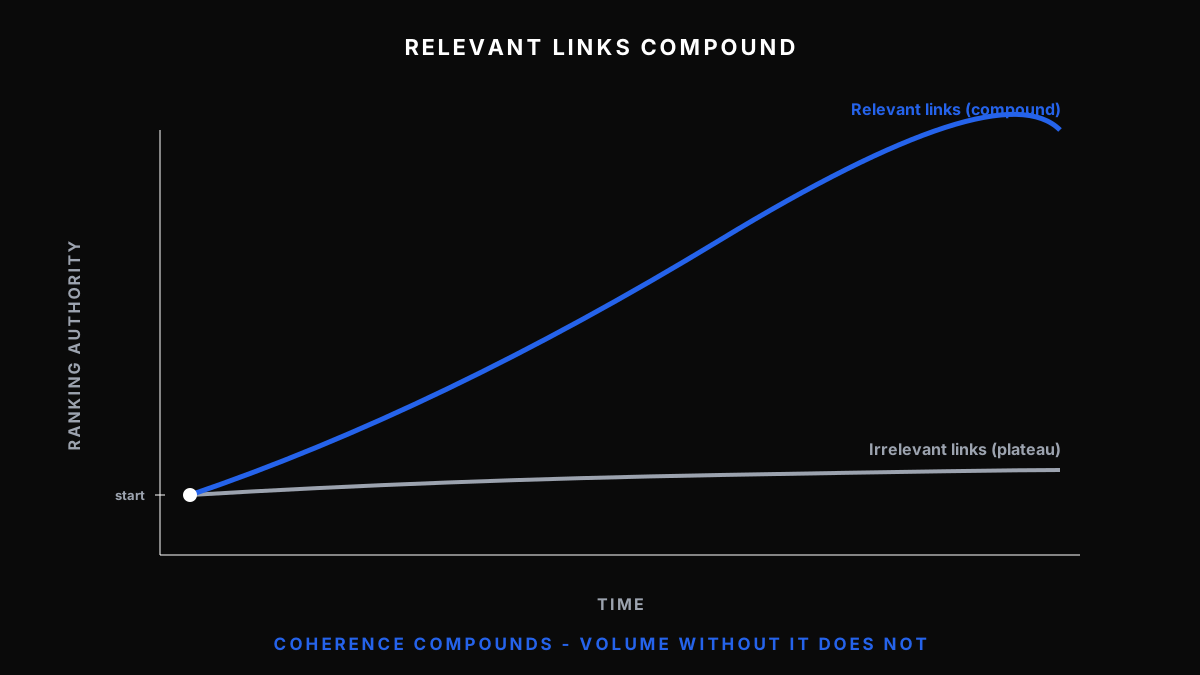
Relevant links compound. Irrelevant links plateau. A site whose backlink profile reads as topically coherent accumulates ranking momentum that survives algorithm updates. A site whose profile reads as topically noisy adds backlinks without compounding, and concedes ground during updates.
The compounding mechanism is not mysterious. Each relevant link reinforces the entity-graph classification of the target site as a member of a topical neighborhood. Classification is not a one-shot determination. It is a continually updated read, weighted by what the surrounding signal looks like. Add ten relevant links inside a neighborhood and the classification strengthens. Add a hundred irrelevant links and the classification stays flat or weakens, because the surrounding signal is now noisier, not stronger.
This is what topical authority means, mechanically. Topical Authority is Historical Data multiplied by Topical Coverage. Coverage is the breadth of the entity's content on the topic. Historical Data is the accumulated signal over time that confirms the entity belongs to that topic. Relevant links contribute to both factors. Irrelevant links contribute to neither and dilute the second.
The plateau in irrelevant-link campaigns is also not mysterious. Each new placement that does not match topically becomes another unit of noise. The graph grows. The signal stays the same. After enough placements, the noise becomes structural: the entity classification reads the domain as "publishes across many topics, owns none." Volume in the absence of coherence is not authority. It is dilution.
Ranking stability across updates follows directly from this. Sites whose backlink profile reads as coherent inside one topical neighborhood ride updates with smaller swings than sites whose profile reads as noisy. The update period does not punish coherence. It punishes the absence of it.
Where I Disagree with The Prevailing Semantic SEO Take
I disagree with the "links don't matter anymore" semantic SEO camp and the "Domain Rating is everything" link-building camp simultaneously. Links still matter mechanically. What changed is qualification. Treating link-building as obsolete and treating it as DR-chasing are two ways of being wrong about the same shift.
The "links don't matter" position has gained traction in the semantic SEO conversation over the last two years. The reasoning runs: if Google scores entity coverage and AI retrieval systems prioritize citation-worthy content, links become a legacy signal that the new ranking layer can route around. The argument is internally consistent. The data I work with does not support it. Links still contribute materially to ranking lift on commercial and YMYL queries, particularly in verticals where the entity layer is more aggressive (legal, medical, finance) but never fully absent.
The opposite position lives in the operator class that learned link-building in the 2018-2022 era. The unit of value was Domain Rating then because that is what worked. The reporting structure still rewards DR-tier placements. The campaigns still get budgeted on DR-tier pricing. The change happens inside Google's evaluation layer. The agency reporting layer has not caught up. Both camps share the same root failure. They treat their preferred metric as the goal. The goal is the entity overlap. The metric is downstream of the goal.
The framework I learned directly from Koray Tuğberk Gübür reconciles both positions. Topical Authority is the goal state. Links are one of several signals that build it, alongside content coverage and historical data. Qualification rules for those links have hardened. Operators who internalize this stop arguing about whether links matter and start arguing about which links matter, which is the conversation that actually moves rankings.
Frequently Asked Questions
Is link building obsolete now?
No. Link building is structurally necessary for commercial-query rankings in competitive verticals. What is obsolete is the prospecting workflow that filters by graph metric alone. The work has not disappeared. It has moved upstream, into qualification.
Does this apply to small sites or only established ones?
Both, but small sites feel the consequences faster. A large established domain has historical entity associations that buffer against marginal devaluation. A small site has fewer associations, so each new link either reinforces the entity claim or wastes the placement. Topical-fit discipline matters more on smaller domains, not less.
How long until topical authority compounds?
Sixty to ninety days is the window where ranking lift starts to become visible after a relevance reset. The first thirty days are indexing and re-evaluation. The compounding effect on entity classification accumulates after that and continues strengthening over the following six to twelve months. Operators who measure at thirty days never see the curve.
What about Moz Domain Authority and Majestic Trust Flow?
Same diagnosis as Ahrefs Domain Rating. Both measure graph properties of the backlink profile. Neither measures entity coherence between source and target. The tool name does not change the mechanic. They are useful as floor filters against obvious spam. They are not useful as qualifiers of semantic fit.
What This Means for Your Site
If you are running a campaign right now where backlink counts grow and rankings do not, the diagnosis is almost certainly the pattern I described above. The fix is not more links. The fix is the qualification layer that sits in front of the campaign.
The graph still matters. Relevance decides what the graph means. Operators who read both signals together are the operators whose campaigns still produce ranking lift in 2026.