Most semantic SEO guides say the same thing: add synonyms, cover the topic more broadly, use related phrases. I have a background in linguistics and I have run SEO for 10 years, remotely from Thailand. That is not semantics. Semantics is the study of meaning, and meaning does not live in keywords, it lives in the relations between concepts.
What Is Semantic SEO?
Semantic SEO is optimizing for meaning, not strings of words. You describe entities, their attributes, and their relations so a search engine understands what a page is about, instead of just matching a phrase. The goal is for a machine to read and trust your meaning.
An entity is a thing with its own identity: a person, a company, a product, a concept. An attribute is one of its properties, and a value is the specific content of that property. Semantic SEO makes those three elements unambiguous in your content, because that is what a search engine reconstructs meaning from. A keyword is only a label you sometimes stick on an entity.
Old SEO treated a page as a bag of words: repeat the phrase more often, rank higher. Semantic SEO treats a page as a set of statements about entities. I work with the semantic SEO and topical authority method developed by Koray Tuğberk Gübür, and underneath it sits one shift in perspective: you are not optimizing text, you are organizing the knowledge that text carries.
How Is Semantic SEO Different from Keywords?
A keyword is a string of characters; an entity is a meaning. Search engines stopped matching identical phrases to each other long ago. They now match the sense of a query to the sense of a page, so what matters is which concepts you describe and how you connect them, not how often the exact phrase appears.
The simplest test: a page can use your main phrase zero times and still be the best answer, if it describes the right entity with the right attributes. The reverse is also true, a page stuffed with the phrase can be useless because it says nothing specific. Meaning beats repetition, because the search engine reads sense, not the count of occurrences.
How Does Google Read Meaning Instead of Keywords?
Google turns words into entities and connects them in a knowledge graph. Language models recognize meaning, intent, and the relations between concepts. The search engine matches the meaning of a query to the meaning of a page, not identical keywords to each other. That is the essence of semantic search.
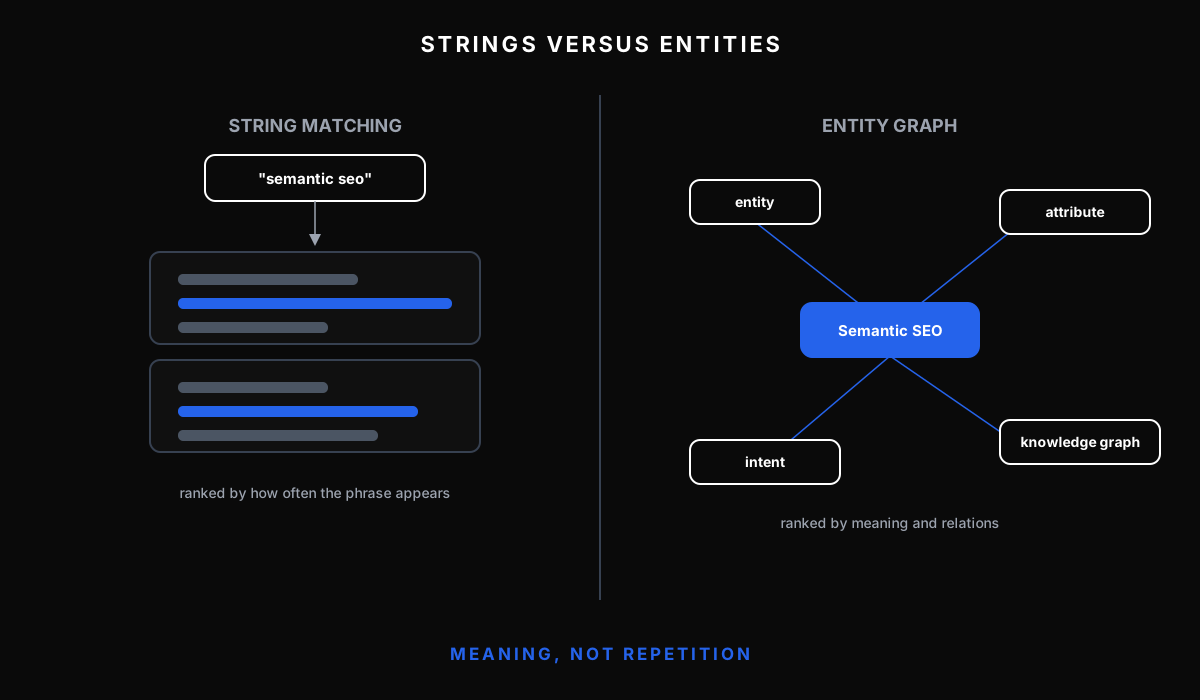
The turning point was 2012 and the Knowledge Graph. Google announced its famous "things, not strings" that year. From that point the search engine no longer looks for pages where a phrase repeats, but for pages that describe the right entity. The knowledge graph is a vast store of entities and the relations between them, and your content either fits it or it does not.
Then came natural language processing models, NLP for short. RankBrain has interpreted never-before-seen queries since 2015. BERT has understood context and word order since 2019, so "to" and "from" change the meaning. MUM has connected information across languages and formats since 2021, and today's large language models extend the same idea to generated answers. They all do the same thing: they read meaning, not the string. What they share is a focus on search intent, the meaning behind a query, and on relevance judged by sense rather than string overlap.
For an operator the conclusion is single. If the search engine reads meaning, your job is not to repeat the phrase but to describe the entity so fully that the machine has no doubt what the page is about. I read which queries you actually appear for from Google Search Console, because that data shows the meaning Google has already assigned to you.
Why Is Semantic SEO Lexical Semantics, Not Keywords?
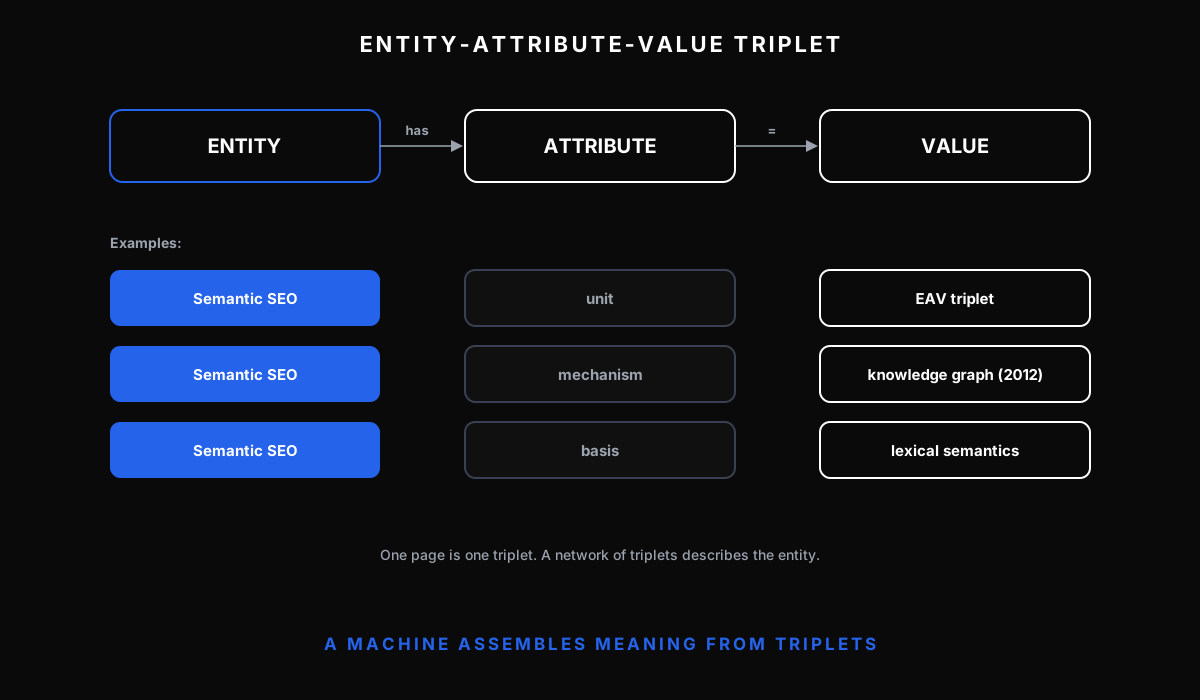
Semantic SEO works on relations between concepts, and that is the subject of lexical semantics. Synonymy, hyponymy, meronymy are not decoration, they are how you describe an entity. The unit is not a keyword but an entity-attribute-value triplet. You write for a parser building a graph, not for a reader skimming phrases.
This is where a linguistics background stops being trivia and becomes an advantage. Lexical semantics has described for decades how words connect through meaning. A search engine now does exactly the same thing, only by machine. So when I write content, I do not think "how many times to use the phrase", I think "which attributes of this entity must I cover for the description to be complete".
The single most important sentence in this piece: semantic SEO is not writing for a reader who skims, it is writing for a parser that builds a graph. What matters is whether the relations between entities are machine-legible, not how many words you have about the topic. The reader gets a better text as a side effect, but you design it for the machine that reconstructs meaning.
What Is An Entity-Attribute-Value (EAV) Triplet?
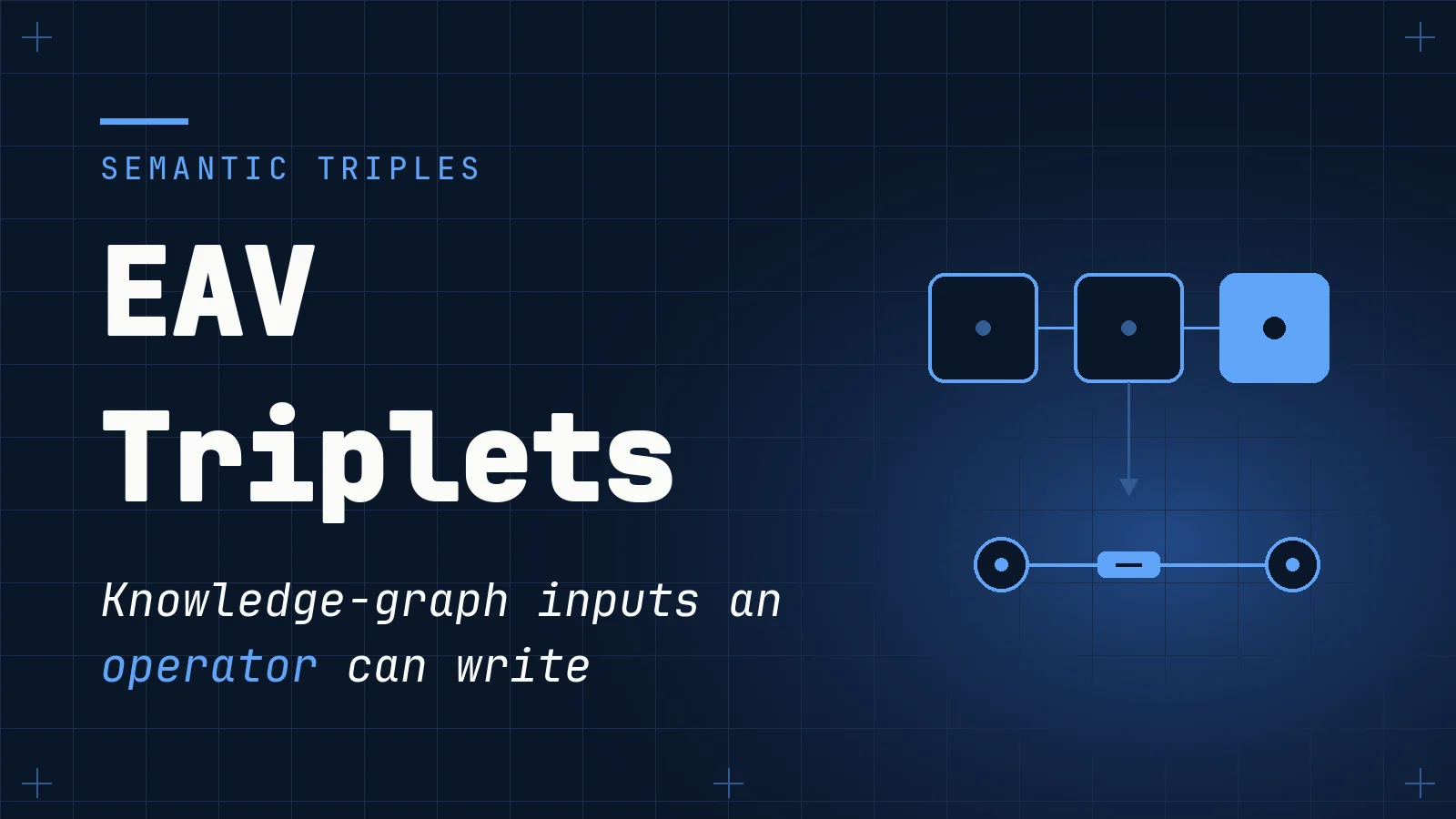
An EAV triplet is the smallest unit of meaning: an entity, one of its attributes, and the value of that attribute. "Semantic SEO (entity) has a unit (attribute) that is the triplet (value)" is one such triplet. From thousands of these statements a search engine assembles a picture of what a page is about.
When I plan content, I break an entity into attributes and assign each a value, ideally a concrete one: a number, a name, a date. "The Knowledge Graph launched in 2012" is a stronger triplet than "the knowledge graph has existed for a while", because it carries a checkable value. The more unambiguous triplets, the easier it is for a machine to trust your page as a source about that entity.
What Are Lexical Relations in Content?
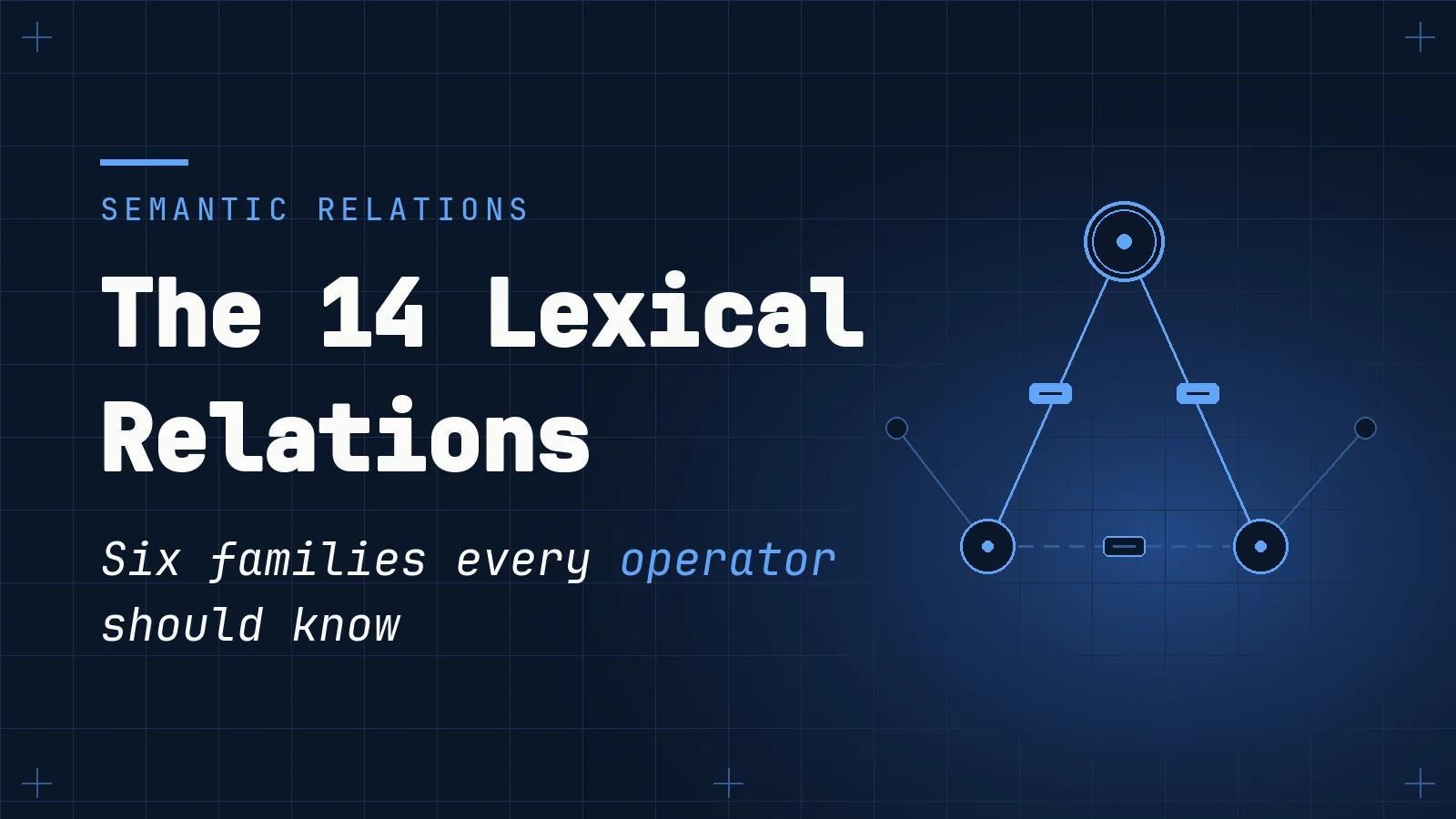
Lexical relations are meaning links between words: synonymy, hyponymy, meronymy, and a dozen more. They tell a search engine that "link", "hyperlink", and "anchor" can be the same entity, and that "dog" is a kind of "animal". Without them, the description of an entity has holes.
Hyponymy is the type-of relation (semantic SEO is a type of SEO). Meronymy is the part-of relation (an entity is part of the knowledge graph). When those relations are present in the content, a search engine recognizes where your entity sits inside the larger structure of concepts. That is what "topic coverage" actually is, described precisely, rather than as "add related words".
Who Actually Needs Semantic SEO?
Semantic SEO matters most to anyone competing for informational questions and for AI citation. If you fight for one transactional phrase in a small market, traditional tactics suffice. When a topic is complex, meaning decides visibility, not phrase repetition.
It works hardest where the subject is broad and full of concepts: technology, finance, health, law, software. The more entities and relations in a topic, the bigger the edge of a page that describes them properly over a page that just repeats phrases. The same applies to brands that want to be recognized as an entity, not as a pile of landing pages.
The second signal that you need a semantic approach is the ambition to be cited by AI models. Answers in AI Overviews and in chat assistants are built from entities and relations, not from keyword density. Whoever wants to be there needs content a machine can decompose into statements. That is usually work for someone who thinks in meaning, an independent SEO consultant or a team that understands this layer.
Who Can Skip Semantic SEO?
Not every page needs it. If you run one local service and compete for a handful of city-name phrases, the semantic apparatus is overkill. A correct page and a few clear entities are enough, because the topic is narrow and barely branched.
I say this plainly, because semantic SEO gets sold as a magic word for everything. It is not. It is a tool for complex topics and for building authority around an entity. With simple, local demand the return on this work is simply smaller than from a well-set listing and a few pages.
Why Do Most Semantic SEO Guides Get It Wrong?
Because most still equate semantic SEO with adding related keywords, the LSI myth, or schema markup alone. That is a category error. Semantic SEO is not more words about a topic, it is describing the relations between entities that a machine can extract.
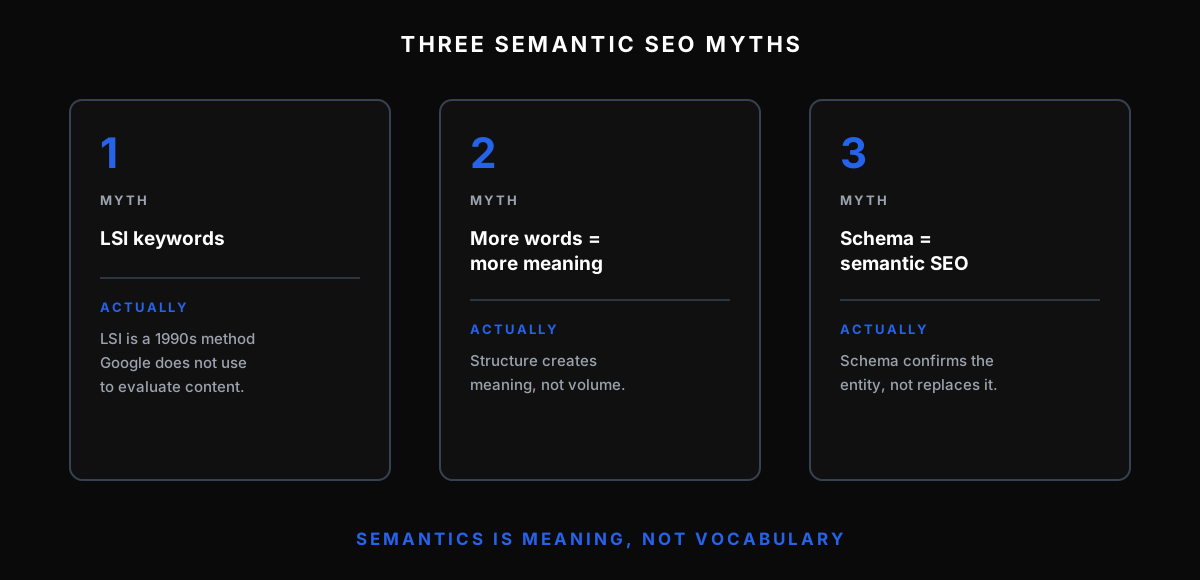
The first myth is LSI keywords. The second is "more words about a topic means more meaning". The third is "schema handles semantic SEO". All three confuse a tool with the goal. The goal is legible meaning, and the things listed are at best a substitute for it, at worst a distraction that eats budget.
One mistake unites them: they treat semantics as a layer of vocabulary, not as a layer of meaning. Pouring in synonyms does not create meaning. Structure creates meaning: which entities you describe, what attributes you assign them, and how you bind them together. I apply the same thinking to SEO strategy: what to do is decided by the goal, not by the length of the task list.
Do LSI Keywords Exist?
LSI keywords do not exist as an SEO technique. LSI, latent semantic indexing, is an old mathematical method from the 1990s that Google does not use to evaluate content. "LSI keywords" is a marketing label for ordinary synonyms and related phrases.
This does not mean related concepts are worthless. They matter a great deal, but as part of describing an entity, not as a list of magic words to paste in. The difference is fundamental: you add concepts because they belong to the topic, not because a tool told you to use them a set number of times.
Is Schema The Same as Semantic SEO?
Schema helps, but it is not semantic SEO. Structured data from schema.org is a way to tell a search engine directly which entity is on a page. That speeds up understanding, but it does not replace the content, where meaning has to be present.
You can have perfect schema on a semantically empty page and still not rank, because a declaration in the code does not replace describing the entity in the text. Schema is like a label on a box: it helps if there is something in the box. Meaning in the content first, then schema that confirms it, never the other way around.
What Does Semantic SEO Actually Deliver?
Good semantic SEO delivers citability: a page that search engines and AI models recognize as a source about an entity. The result is presence in AI Overviews and answer snippets, and ranking for a whole topic rather than a single phrase.
The most tangible effect is breadth. A page described well semantically ranks for dozens of queries you never deliberately targeted and earns featured snippets, because it covers the entity, not a single phrase. That is the difference between "I rank for one keyword" and "I am recognized as a source about this concept".
The second effect is resilience. Content built around meaning suffers less from algorithm changes, because the algorithm moves toward ever better understanding of sense, not away from it. You work in the direction the search engine is heading, so time works for you, not against you.
How Does Semantic SEO Connect To Topical Authority?
Topical authority is the result of consistent semantic SEO. When you systematically cover the attributes of one entity and its neighbors, a search engine starts treating you as a source on that topic. A single page is a triplet, a network of pages is authority.
This is where semantics meets the concept of topical authority. Semantic SEO describes a single entity properly, and topical authority arranges those descriptions into topic clusters joined by internal linking, so each page strengthens the others. One without the other works worse: a good single page without a map gets lost, and a map without proper descriptions is empty.
Semantic SEO vs Traditional (Keyword) SEO: What Changed?
The unit of work changed: from the phrase to the entity. Traditional SEO optimized a page for a specific keyword. Semantic SEO optimizes it for meaning, that is, for an entity and its attributes. Phrases are still a map, but the goal is description, not frequency.
This does not mean keywords are dead. I still read them from the data, because they show the language people ask in. Their status changed: they are an input to understanding intent, not a list that has to fit inside the text. Semantic search rewards the page that answers the meaning behind those words, not the one that repeats them most, so I ask which entity the searcher has in mind, not which phrase they typed.
When Is a Keyword Enough, and When Do You Need An Entity?
A keyword is enough when the intent is single and narrow. For a simple transactional phrase, matching the page to the query settles it. You need an entity when the topic is complex, the intents are many, and visibility is decided by completeness of description, not by hitting the phrase.
The line is practical. If one query has one obvious answer, think in phrases. If a whole topic with many questions sits behind the query, think in entities and their attributes. Most valuable informational queries belong to that second group, which is exactly why the semantic approach wins there.
Where Do You Start Thinking Semantically?
Start with one decision, not a task list: which single entity is this page about. That is a question, not an action, and it sets everything else. Only once you know the entity does it make sense to ask about its attributes, relations, and the phrases people use to ask about it.
This is deliberately not a step-by-step guide. Step-by-step belongs to execution, and semantic thinking begins with the frame in which those steps make sense. First the question "what exactly is this page about, as a thing, not as a phrase", then the attributes and the content. The reverse order produces pages that are about everything and nothing.
A practical first move: name the entity with one noun and write down ten of its attributes that a reader would want to know. If you cannot list ten, the topic is still unrecognized, and no amount of keywords will fix that. Filling those attributes with concrete detail is semantic SEO in action.
Frequently Asked Questions About Semantic SEO
What Is Semantic SEO in One Sentence?
It is optimizing for meaning rather than strings of words: you describe entities, their attributes, and the relations between them so search engines and AI models understand what a page is really about. The unit is an entity-attribute-value triplet, not a keyword.
Is Semantic SEO The Same as LSI Keywords?
No. LSI keywords are a marketing label for synonyms, based on an old method Google does not use to evaluate content. Semantic SEO is the description of entities and relations, not pasting a list of related phrases in some set number.
Do I Need Schema Markup To Do Semantic SEO?
Schema helps, but it is not a requirement. Structured data from schema.org confirms to a search engine which entity is on the page, but it does not replace meaning in the content itself. Describe the entity in the text first, then add schema that supports it, never the other way around.
How Is Semantic SEO Different from Traditional SEO?
Traditional SEO optimizes a page for a specific keyword. Semantic SEO is a way of thinking about content: building it around entities and relations rather than around phrase frequency. The keyword is an input to understanding intent, not the target you repeat.
Who Creates a Semantic SEO Strategy?
It is created by someone who thinks in meaning, usually an independent SEO consultant or strategist who reads the data. The execution, content, optimization, and links, is done by a team. The best setup is one strategist setting the entity map and a coordinated team building it.